


 Castlegar, BC. Serving the Kootenays and beyond.
The site that makes a nervous first visit feel safe to book.
Wellness and clinic website design that fills the unfilled schedule.
People find a clinic in pain or in doubt, then judge whether you feel safe before they ever open the calendar. I build clinic and studio websites from Castlegar, BC that turn that nervous search into a booked intake, so the unfilled schedule and the quiet no-shows stop deciding your month.

What a nervous patient is really weighing
I treat a clinic or studio site as the front half of the care experience. Every page answers the quiet questions a nervous visitor is really asking: is this safe, is this for me, will I be in good hands, and do you bill direct. Clear scope of practice, credible practitioner bios, honest expectations, college-aware language, and privacy you can feel all work together so the booking handoff to Jane or Cliniko happens when the person is ready, not pushed.
- 01
They are deciding whether to be vulnerable
Booking means letting someone treat, touch, counsel, or assess them. Before price or availability, the visitor is judging whether the clinic feels competent, calm, and safe. Tone and clarity carry more weight than any feature.
- 02
Direct billing decides more bookings than your bio
Before a patient reads a word about your approach, many are scanning for one thing: do you bill Pacific Blue Cross, Telus eClaims, ICBC, or WorkSafeBC direct. If the answer is missing, they assume it is no and book the clinic that says so on the page. It is the cheapest conversion win in this vertical.
- 03
Uncertainty postpones the booking
If a visitor cannot tell who a service is for, what happens in the first session, what it costs, or how to prepare, they close the tab and tell themselves they will book later. Most never come back, and the unfilled schedule quietly absorbs the loss.
- 04
They are choosing a person, not a logo
In care, fit is everything. A real bio, credentials, registration, approach, and a human photo let someone picture the appointment and pre-trust the practitioner. The right fit shown early reduces no-shows and mismatched bookings.
- 05
Privacy fear is doing quiet work
Health intent is sensitive. People notice when a site asks for too much, looks insecure, or hides who is behind it. Visible privacy respect and a secure path for intake forms lower the silent resistance that kills a booking.
See the Morrow Clinic concept in the wild.
Concept build from my portfolio, no real affiliation
The Morrow Clinic is the fictional integrated wellness practice that proves the system end to end: a 39-URL build in a calm morning register, direct billing and no-referral-needed answered on the first screen, eight care pages organized by what the visitor feels instead of clinical taxonomy, a two-minute booking flow that keeps its promise, and zero outcome claims anywhere, so the pattern transfers to regulated practitioners without a compliance rewrite.
- Calm-first morning register
- Direct billing up front
- Two-minute booking flow
- 39 sitemap URLs
The Morrow Clinic is a fictional concept build created to demonstrate the category. No real clinic affiliation, patient outcomes, booking results, or practice performance should be implied.
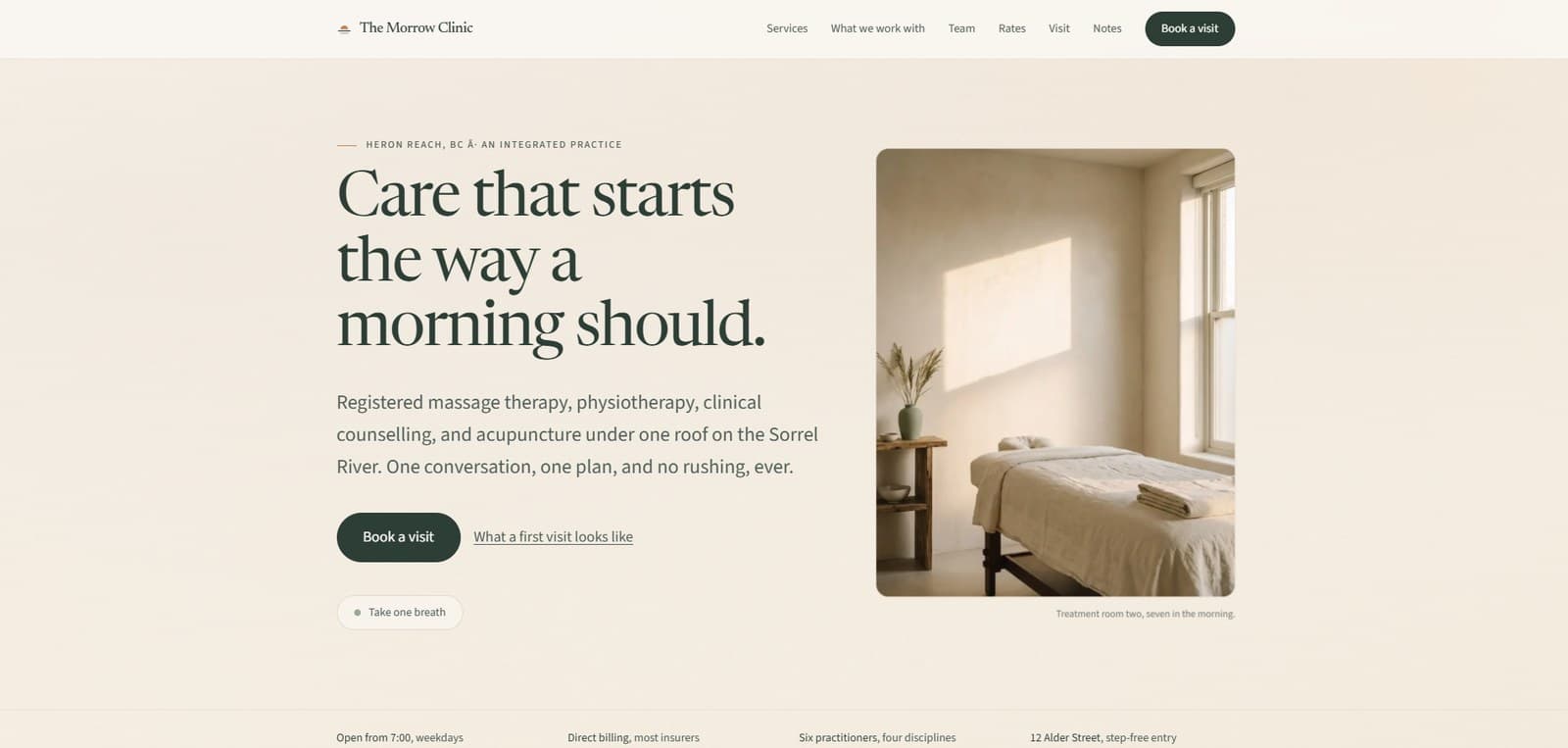
What a clinic site needs to fill the schedule
- 01
Service and scope clarity
Each service page explains who it helps, what the first visit looks like, session length, honest pricing, what to bring, and any contraindications. I keep scope of practice clear so the page builds confidence without straying into claims a college would flag.
- 02
Practitioner credibility pages
Real bios with credentials, college registration, specialties, philosophy, and a warm photo. This is the strongest trust asset in wellness: it lets a visitor choose the right fit, supports name and provider searches, and cuts no-shows and mismatched bookings before they ever reach the intake forms.
- 03
A calm path into Jane or Cliniko
I hand off cleanly into Jane App, Cliniko, Juvonno, or your EMR, with new-patient paths, consult requests, class and membership sign-up, waitlists, and recalls that bring lapsed patients back. The public experience stays warm and on-brand while the secure software does what it is built for.
- 04
Education that earns local search
Condition, treatment, and goal pages answer what people actually type: physiotherapy after a Kootenay ski injury, massage therapy in Nelson, counselling in Castlegar, a chiropractor with online booking. Helpful and honest, never overpromising outcomes, so the clinic ranks for real local intent without inviting a regulatory complaint.
- 05
Accessible, fast, and mobile-first
Most wellness searches happen on a phone, often by someone unwell or in pain. I build to WCAG 2.2 AA with strong contrast, keyboard support, and fast loads, so the site works for every body and reads as the professional standard of care it represents.
The standard that comes with every build I ship.
- Care-first homepage and clear service architecture
- Practitioner bios with credentials and college registration
- Direct billing answers for Pacific Blue Cross, Telus eClaims, ICBC, and WorkSafeBC
- Booking handoff to Jane, Cliniko, Juvonno, or your EMR
- Service, treatment, condition, and FAQ pages
- PIPA-aware privacy notes with a named privacy contact
- WCAG 2.2 AA accessible, mobile-first, fast build
- Local SEO for town, service, and provider searches
- CASL-aware newsletter, recall, and reminder setup

The questions your page leaves open, and what the front desk pays for them
Somebody in pain will not phone to find out. Every open question below is paid in hesitation by the patient and in interruptions by your front desk, and each one has a build decision that settles it.
Direct billing is not answered on the page
Costs them
Someone weighing a Pacific Blue Cross claim or an ICBC claim after a Highway 3 winter assumes the answer is no, and books the clinic that said so on its site.
Costs you
The front desk answering the same insurance question between patients all day, and an unfilled schedule with no obvious reason behind it.
FixDirect billing for Pacific Blue Cross, Telus eClaims, ICBC, and WorkSafeBC shown where the booking decision happens, worded inside your college advertising rules.
Nothing describes what the first appointment involves
Costs them
They cannot picture the room, the hour, what to wear, or how much of them gets touched, so they postpone and tell themselves they will book later.
Costs you
No-shows and late cancels from people who were never quite ready, arriving too close to the hour to fill the slot with anyone else.
FixEvery service page written to the real first visit: session length, what to bring, what happens in the room, honest pricing, and any contraindications.
All the practitioners share one team page
Costs them
They cannot tell who they would actually see, so choosing the person who will treat them comes down to a coin toss.
Costs you
Mismatched bookings landing on the wrong practitioner and the awkward reshuffle at reception when the fit is obviously wrong.
FixA page for each practitioner with credentials, college registration, approach, specialties, and a warm photo, so the right patient books the right person.
Booking means phoning during clinic hours
Costs them
The back seizes on a Sunday, and by Tuesday phoning a stranger about it feels like more effort than living with it for another week.
Costs you
Voicemail returned between patients, and the evening demand handed to whichever clinic had an open calendar on the page.
FixA calm handoff into Jane, Cliniko, Juvonno, or your EMR from every service page, so the booking happens the moment the decision is made.
Intake forms sit on the marketing site
Costs them
They are asked for health history in something that looks like a newsletter signup, and a private person stops right there.
Costs you
Sensitive detail landing in an inbox you now have to defend under PIPA, plus clipboards handed out at the door because the online path was never trusted.
FixIntake handed off to your secure platform, a plain-language PIPA privacy note with a named contact, and nothing sensitive stored on the marketing site.
Direct billing up front, private intake behind it
The single most-asked question a BC patient has before booking is whether you bill direct. Pacific Blue Cross, Telus eClaims, an ICBC claim after a Highway 3 winter, a WorkSafeBC referral: if the answer lives three clicks deep, the patient assumes it is no and books the clinic that says it on the homepage. I put direct billing where the decision happens and keep the wording inside your college advertising rules.
Behind that promise sits the intake. Intake forms carry health history, so they never live on the marketing site. I hand them off to your secure platform, publish a plain-language PIPA privacy note with a named contact, and keep recalls and reminders on the right side of consent.
- Direct billing shown for Pacific Blue Cross, Telus eClaims, ICBC, and WorkSafeBC, worded college-safe
- Intake forms handed off to your secure platform, never stored on the marketing site
- A plain-language PIPA privacy note with a named contact for personal information
- Recall and reminder flows that respect consent instead of testing it
PIPA, college advertising rules, and the lines I never cross
A site in this category is judged on more than looks. These are the obligations and reassurances I build in by default, so the business stays credible and protected.

Health privacy under PIPA and PIPEDA
BC private clinics fall under PIPA, and PIPEDA can apply for out-of-province patients or federally regulated work. I keep sensitive intake off the marketing site, link into your secure platform, publish a clear privacy policy, and name the person responsible for personal information, as the law expects.
College advertising rules
Regulated professions under BC health legislation face real limits on marketing. I write language that avoids guaranteed outcomes, cure claims, comparative or superlative boasts, and fear-based messaging, and I handle patient testimonials carefully since several colleges restrict or prohibit them.
Clear scope of practice and disclaimers
Content stays inside what each practitioner is registered to do. I use honest, educational framing with appropriate disclaimers so visitors are informed, the clinic is protected, and nothing on the page reads as diagnosis or a promise of results.
Secure booking and payment
Booking and payment run through your compliant, PCI DSS aligned platform over encrypted connections. The site never stores card or health data itself, so the sensitive layer lives where it is properly secured rather than on a marketing page.
Accessibility as standard
I build to WCAG 2.2 AA, the benchmark Canadian accessibility law keeps pointing at and where BC regulation is heading. Accessible care information is an ethical baseline for a clinic and a practical way to serve patients with disabilities, injuries, and hard days.
CASL for email, recalls, and reminders
Newsletters and promotional messages need proper consent, sender identification, and a working unsubscribe under CASL. Appointment reminders and recalls that stay transactional are generally exempt. I set up forms and flows so the clinic stays onside and out of penalty range.
Want this standard on your site?
One conversation, no pitch deck. Tell me where the business is stuck and I will tell you what I would build.
26 of the 70 Massage therapy on The Kootenay List have no website, as of September 3, 2026. The ones that do are the ones a customer can find.
What a build like this costs.
A focused presence site starts with the Trailhead: $2,000, or $500 today and $142 a month on Own It Monthly ($2,204 total). Plenty of businesses in this industry need exactly that and nothing more.
Bigger jobs usually land at $6,500, or $1,625 today and $457 a month on Own It Monthly ($7,109 total)
The Engine · typical timeline 4 to 5 weeks
A clinic sells trust and bookings at the same time: service pages, practitioner bios, direct billing answers, and a clean handoff into Jane or Cliniko is exactly the weight Engine is built to carry.
The honest answer depends on what you actually need, not on a package name. Start with the free check-up or the contact form, and I will book a proper 45-minute consultation with you, no pressure either way.
Comparing options right now? What a website should cost breaks down how to read any quote, and who actually owns your website covers what you keep if you ever leave, on any platform, including mine.
Jane, Cliniko, and practice software does the plumbing. KMD wins the decision.
Your booking software runs the practice once someone commits. It does almost nothing to win the commitment in the first place.
Practice platforms like Jane App, Cliniko, Juvonno, and clinic EMRs are excellent at the operational layer: schedules, charting, intake forms, reminders, and PIPA-aware record keeping. They are not a public website. Their booking widget assumes the person has already decided to trust you. The decision happens earlier, on the page, before anyone opens the calendar.
What the category tool covers
- Online booking, scheduling, reminders, and waitlists
- Secure intake forms, charting, and patient records in Canada
- Payments, invoicing, and insurance receipts
- Telehealth, packages, memberships, and class registration
- Reporting on no-shows, retention, and practitioner load
Where the upgrade actually pays off.
- 01
Lead with what the first visit feels like, so a nervous person can picture it and book with less fear.
- 02
Answer direct billing on the homepage instead of making patients phone the front desk to ask.
- 03
Build helpful condition and FAQ content that earns local search without risking a college complaint.
Related guides.
- Jane App Is Great for Booking. Your Clinic Website Is a Different Job.
- What a Great Website for a Kootenay Clinic or Wellness Business Needs
- Should Your Small Business Website Have an AI Assistant?
- Why Some Local Businesses Feel Trustworthy Online in 10 Seconds and Others Don’t
- A Salon or Barber Website That Books While You Cut
- Google Business Profile Suspended or Not Verified
- What Service Pages Need to Say if You Want More Calls and Better Leads
- How to Show Up in ChatGPT and AI Search as a Small Business
- What Should SEO Cost a Small Business in Canada?
- Squarespace Alternative for Small Businesses: When a Custom Site Wins
What practitioners ask before they book a call
Do you have an example of a clinic website?+
Yes. The Morrow Clinic is my full working wellness concept, clearly labelled as fictional: direct billing answered on the first screen, care pages organized by what the patient feels, a two-minute booking flow, and zero outcome claims so the pattern fits college advertising rules. The case study and live site are in my portfolio.
Do you build sites that show direct billing options?+
Yes. If your clinic bills Pacific Blue Cross, Telus eClaims, ICBC, or WorkSafeBC direct, I put that where the booking decision happens, worded inside your college advertising rules. It is the most-asked question BC patients bring to a clinic site, and most sites make them phone to ask.
How much does a physiotherapy or clinic website cost in BC?+
Most Kootenay clinics land in my Engine build at $6,500, live in four to five weeks, or $1,625 today and $457 a month on Own It Monthly ($7,109 total), the 12-payment plan where you own the site outright at the end. A solo practice with simpler needs can start smaller; I scope before I quote.
Can you connect to Jane, Cliniko, or our EMR booking?+
I hand off into Jane App, Cliniko, Juvonno, or your clinic EMR for booking and intake forms. The website stays warm and on-brand while secure scheduling and records live inside your compliant platform, which is where patients and colleges expect them to be.
Will the copy follow our college advertising rules?+
That is the default, not an add-on. I avoid guaranteed outcomes, cure or comparative claims, and fear-based language, and I handle testimonials carefully because several BC colleges restrict them. You stay the clinical authority, your college bylaws govern, and the language stays defensible.
How do you handle patient privacy?+
Sensitive intake never sits on the marketing site. I link into your secure platform, publish a clear PIPA-aware privacy policy, and name the person responsible for personal information. Visitors can feel the care taken with their information, which makes them more willing to book.
Should every practitioner get their own page?+
Usually, yes. Practitioner pages are the strongest trust asset in wellness. They show credentials and college registration, help people choose the right fit, support provider name searches, and cut the mismatched bookings and no-shows that quietly hollow out a schedule.
We are a small or solo practice. Is this overkill?+
Not at all. A solo practitioner lives or dies on trust and a full schedule, and that is exactly what this build protects. I scope it to your services and budget, and Own It Monthly exists so the unfilled schedule gets fixed now rather than next fiscal year.

Who builds this
I am Brett, the person behind Kootenay Made Digital. I plan, design, and build every site myself from Castlegar, BC, so the person you email is the person doing the work.
Founder, Kootenay Made Digital · Castlegar, BC
Ready to stop staring at the unfilled schedule?
Most clinics and studios land in my Engine build: live in four to five weeks, college-safe from day one, and built to turn the next nervous search into a booked intake.
No website yet?
Start My First WebsiteAlready have one?
Get a Free Check-Up