


 hello@kootenaymade.ca
 Castlegar, BC. Serving the Kootenays and beyond.
Nobody wants to phone a shop to find out what it costs.
Auto repair website design that answers the price question before the phone rings.
A driver with a noise and a bad feeling checks three shops on their phone before they call one. I design auto repair and tire shop websites from Castlegar, BC that answer the questions they are actually asking, what it costs, when you can take it, and whether the bill will match the estimate, so the call you get is a booking rather than a price hunt.

What a driver decides before they dial your shop
I treat a shop website as the front counter for everyone who has not walked in yet. That means it does the same things a good service advisor does: it answers the price question straight, it explains what happens before anything gets touched, it shows the work rather than claiming it, and it makes booking a bay simple enough to do from a parking lot. A shop that publishes how a bill gets built is doing something the chains cannot copy without giving up their margin, and that is the whole advantage. The full list is in my guide on what an auto repair website should include.
- 01
They arrive braced for a surprise
The driver is not price shopping for fun. They are protecting themselves against a bill that lands bigger than the conversation, because that has happened to them or to someone they know. Every number you publish takes a brick out of that wall.
- 02
The noise has already scared them
People rarely book a shop while calm. There is a sound, a light, a wobble, or a deadline. A website that names the symptom in plain language and says what it usually means turns anxiety into an appointment instead of a week of avoidance.
- 03
Trust in this trade is proved, never stated
Honest and reliable appear on every shop page in the country and mean nothing now. Photos of the actual bay, the actual crew, and an actual invoice do the work those adjectives stopped doing years ago.
- 04
Convenience decides the tie
Two shops look equally decent and one lets them request a time from a phone at nine at night. That is the whole decision. After hours is exactly when people deal with car problems, because that is when the car is finally parked.
- 05
The season sets the urgency
In this region the calendar drives the phone: winter tire changeover, pass conditions, road salt, minus twenty mornings, and road trip season. A website that speaks to the month it actually is feels like a local shop rather than a template.
See the Harkness Auto & Tire concept in the wild.
Concept build from my portfolio, no real affiliation
Harkness Auto & Tire is the fictional independent shop I built to prove the model end to end, as the Trailhead, Full Coverage version: ten jobs priced openly on the page, a published shop rate, parts at cost plus twenty percent, an inspection report a driver approves line by line, a page for each community the shop serves, 20 guides answering what drivers search, and a homepage hero that moves the building through an entire year on one locked camera as you scroll.
- Ten jobs priced on the page
- Published shop rate and parts policy
- An inspection report you approve line by line
- A page for each community, 20 guides
- Scroll-scrubbed year on one camera
- Winter changeover week picker
- WCAG 2.2 AA throughout
Harkness Auto & Tire is a fictional concept build created to demonstrate the category. Coppervale BC, the family, the reviews, and the phone number are invented. No real garage, customer, or outcome should be implied.
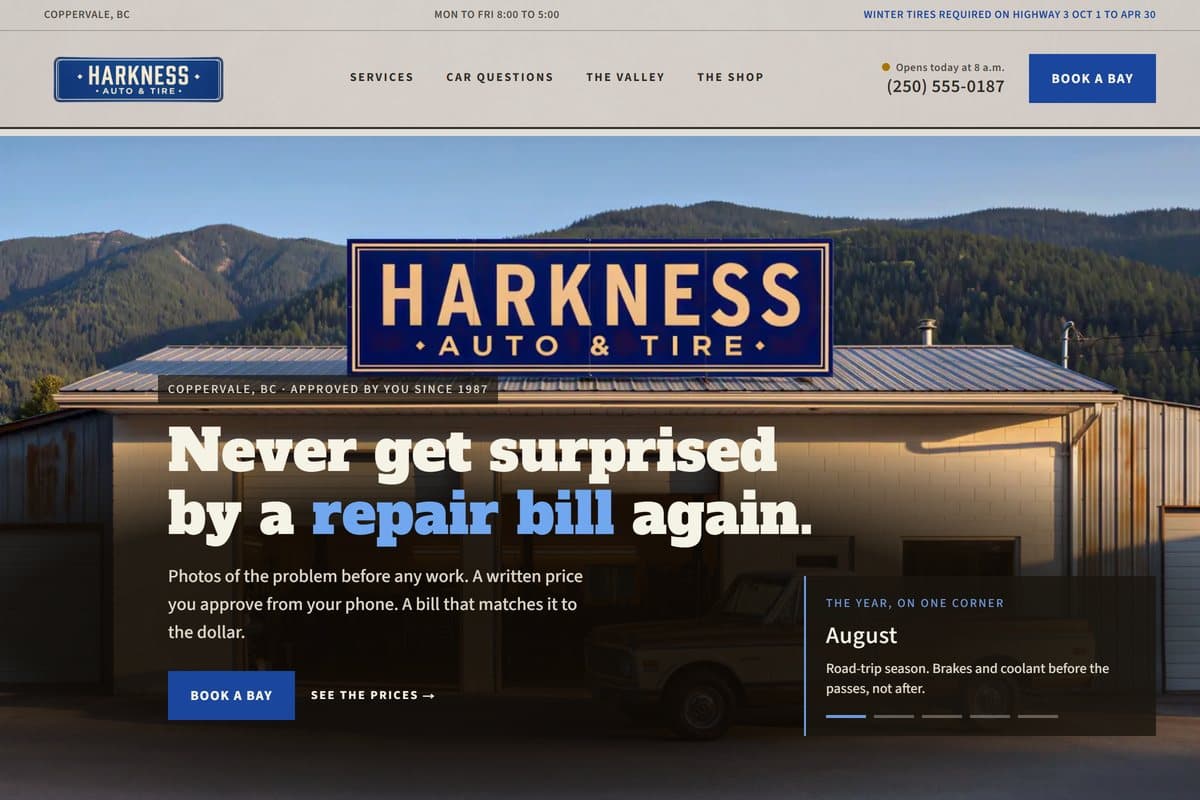
What a shop build covers, front counter to final invoice
- 01
Services with real numbers beside them
The core jobs listed the way a driver thinks about them, oil and filter, brakes per axle, tire changeover, diagnostic hour, alignment, battery, cooling system, exhaust, and a pre-purchase inspection, each with a price or an honest range and a plain sentence about what is included. This is the page that ends the phone tag.
- 02
The changeover season path
Winter tire deadlines create the busiest weeks of your year and the most frustrating ones for customers. A dedicated path that states the date, explains tire storage if you offer it, and takes bookings early spreads that rush across September instead of cramming it into one panicked week.
- 03
Booking that fits how people actually contact a shop
A request form that asks for the vehicle, the symptom, and two times that work, with the phone number kept beside it for the person who would rather talk. It works without an account or a calendar integration, so a simple ask stays simple.
- 04
The shop, in real photographs
Real photographs of the bays, the tools, the crew, and the building from the road, so a first-time customer recognizes the place when they pull in. Stock photos of a gleaming showroom nobody in your town has ever seen do the opposite of what they are meant to.
- 05
Reviews placed where the doubt lives
Testimonials sitting next to the services they are about, rather than a carousel at the bottom that everyone scrolls past. A review about a fair diagnosis belongs beside the diagnostic hour, where it answers the exact question being asked.
- 06
Found in the moment of need
Local search structure so the shop turns up for the searches that matter in your towns, the trade plus the place, the symptom plus the place, and the seasonal ones that spike every autumn. Google Business Profile aligned with the site so the map listing and the website tell the same story.
The standard that comes with every build I ship.
- A services and prices page that answers the cost question without a phone call
- Published shop rate, parts policy, and diagnostic terms in plain language
- A booking request path built for phones, with the number always in reach
- Seasonal content for changeover, pass conditions, and cold-start season
- Real shop photography direction, or generated imagery only where honest and labelled
- Local search foundations, schema, and Google Business Profile alignment
- Reviews positioned beside the services they answer
- Fleet and account enquiry paths where the shop serves business customers
- WCAG 2.2 AA accessibility and a site that stays fast on a phone in a parking lot
- A written handover: you own the code, the domain, and every account

What the guessing costs, on both sides of the counter
Every friction below is charged twice: once to the driver in worry, once to you in hours you never billed. The build decision on the right ends both at the same time.
No prices anywhere on the site
Costs them
They cannot compare you to anyone without picking up the phone, so they call three shops and treat every answer as an opening offer.
Costs you
Quote calls that were never going to book, taken mid-job with your hands full, and the customer who quietly went to the chain that publishes numbers.
FixPublish the flat jobs, the shop rate, and what a diagnostic costs, so the phone rings to book instead of to ask.
The estimate and the final bill are two different conversations
Costs them
They brace for the invoice, and one bad surprise turns a regular into somebody else's regular.
Costs you
The awkward call at pickup, discounts given to keep the peace, and a reputation you have to rebuild one customer at a time.
FixState the estimate and approval process on the page, photograph the problem before the work, and show a sample invoice in full.
Booking only happens by phone, during shop hours
Costs them
They remember the noise at nine at night, when you are closed, and by morning the urgency has faded.
Costs you
Voicemail tag, a front counter interrupted every few minutes, and the after-hours work that goes to whoever takes a form.
FixA request path that takes vehicle, symptom, and two workable times in about thirty seconds, with the number still beside it.
Changeover season arrives all at once
Costs them
They call the week the deadline hits and hear that you are booked solid, which feels like being turned away.
Costs you
Two frantic weeks, overtime, and turned-down work in October against quiet bays in September.
FixA seasonal path that opens bookings early, states the deadline, and explains tire storage if you offer it.
The shop looks like every other shop online
Costs them
Nothing tells them whether you are the careful operation or the one that guesses, so they default to the biggest sign.
Costs you
Competing on price against franchises whose whole model is volume, in a trade where your actual advantage is judgment.
FixReal photographs of your bays, your crew, and your work, with reviews placed beside the services they are about.
The estimate problem, and how a website solves it
Every survey of what people dislike about auto repair lands in the same place, and it is not the price. It is not knowing the price. The driver has been burned once by a bill that arrived bigger than the conversation, so now they brace, they call three shops, and they treat every honest quote as an opening offer.
That suspicion is expensive for a good shop. It costs you the phone time that gets spent quoting instead of booking, and it costs you the customer who never called because your website gave them nothing to compare and they went with the chain that publishes numbers.
The fix is not a price list that ties your hands. It is showing the mechanics of how a bill gets built here, which is a fundamentally different promise and one no franchise can copy.
- Publish the shop rate and what a diagnostic hour costs, then say whether the diagnostic fee comes off the repair bill
- Show a real, itemized sample invoice so a stranger can read a whole bill before they ever receive one
- State the parts policy in a sentence, at cost plus a named percentage beats the word fair every time
- Photograph the problem before the work starts, and say on the website that you do, because that single habit ends most billing arguments
- Name the jobs you price flat, and be honest about the ones that need to be looked at first
Payments, privacy, and the promises you put in writing
A site in this category is judged on more than looks. These are the obligations and reassurances I build in by default, so the business stays credible and protected.

Estimates and authorization, in writing
BC consumer protection expectations around vehicle repair centre on the same idea your best customers already want: an estimate before the work, and authorization before anything beyond it. A website that states your estimate and approval process is both a trust builder and a record of the promise you keep.
Card payments handled by a processor, not your server
If the shop takes deposits or payments online, those go through a processor like Stripe or Square using hosted checkout. Card numbers never touch the website, which keeps your liability small and your obligations simple.
Customer information, collected lightly
Under PIPEDA and BC PIPA the safest posture is to collect only what a booking actually needs, say what it is used for at the point of capture, and never buy or sell customer lists. Vehicle history belongs in your shop system, not scattered through form inboxes.
Want this standard on your site?
One conversation, no pitch deck. Tell me where the business is stuck and I will tell you what I would build.
57 of the 104 Mechanics & auto repair on The Kootenay List have no website, as of September 3, 2026. The ones that do are the ones a customer can find.
What a build like this costs.
Most builds here start at $2,000, or $500 today and $142 a month on Own It Monthly ($2,204 total)
The Trailhead · typical timeline 2 to 3 weeks
Most independent shops need three pages that do their job hard: what you fix and what it costs, who you are, and how to book. Shops running fleet accounts, multiple locations, or a tire storage program usually grow into the Engine.
The honest answer depends on what you actually need, not on a package name. Start with the free check-up or the contact form, and I will book a proper 45-minute consultation with you, no pressure either way.
Comparing options right now? What a website should cost breaks down how to read any quote, and who actually owns your website covers what you keep if you ever leave, on any platform, including mine.
The shop management software you already run does the plumbing. KMD wins the decision.
The shop system runs the work. It does not win the customer. Most of them ship a bolt-on website template that makes every independent shop in the province look like the same page with a different phone number, which is exactly the impression an independent shop cannot afford.
Systems like Mitchell 1, Shop-Ware, Tekmetric, Protractor, and RO Writer own the operation: work orders, digital vehicle inspections, parts ordering, labour guides, invoicing, and customer history. They are built for the bay and the back office, and they are good at it.
What the shop system already handles
- Work orders, digital inspections, and photo documentation
- Labour guides, parts ordering, and vendor catalogues
- Invoicing, payments, and customer vehicle history
- Appointment calendars and technician scheduling
- Reminder texts and emails for service intervals
Where the upgrade actually pays off.
- 01
Publish the shop rate. The shops that do it get fewer price calls and better ones.
- 02
Photograph every job before you touch it, and say on the website that you do. It ends billing arguments before they start.
- 03
Put the winter changeover date on the homepage in September, not October. The early bookings are the calm ones.
- 04
Answer your Google reviews, especially the rough ones, in the voice you would use across the counter.
- 05
Name the jobs you do not do. Sending someone to the right specialist buys more loyalty than taking work you would rather not have.
- 06
Keep the phone number tappable in the header on every page. Half your visitors are standing beside the problem.
Related guides.
- What Should an Auto Repair Shop Website Include?
- What a Small Local Business Actually Needs Online First
- Why Most Small Businesses Lose Customers After the First Website Visit
- What Should a 15-Second Video Ad Say?
- Why Your Business Is Not Showing Up on Google Maps
- How Reviews Affect Local Search, Trust, and Phone Calls
- Google Business Profile Guide for Kootenay Businesses (2026)
- GoDaddy Website Builder Alternative for Small Business
- Do You Actually Need a Website in 2026?
- SEO vs Google Ads for a Small Local Business: Which Should You Start With?
Questions I hear across the counter
Should I really put prices on my website?+
For the jobs you can price, yes, and it is the single biggest advantage an independent shop has over a chain right now. Nobody wants to phone a shop to learn what an oil change costs. You do not have to price everything: publish the flat jobs, publish the shop rate and diagnostic hour, and be straight that some work needs eyes on it first. The result is fewer price-shopping calls and more booking calls.
Will publishing my rate mean I get undercut?+
The customers who choose purely on the lowest number were never going to be good customers, and the chains already publish. What publishing does is win the much larger group who are afraid of being taken advantage of, and who pick the shop that behaved transparently before they even called.
How much does an auto repair website cost?+
Most independent shops fit the Trailhead at $2,000, or $500 today and $142 a month for 12 months on Own It Monthly, which is $2,204 all in and yours outright at the final payment, no credit checks, with the domain in your name from day one. Shops running fleet accounts, tire storage programs, or multiple locations usually land on the Engine at $6,500. Kootenay businesses get the 10% neighbours discount off any build.
Can customers book a bay online?+
Yes, and I keep it deliberately simple: vehicle, symptom, and a couple of times that work, sent straight to you. Full calendar integration is possible where your shop system supports it, but most independent shops find a clean request form converts better than a rigid live calendar, because the advisor still gets to sequence the day properly.
Does it work with Mitchell 1, Tekmetric, or Shop-Ware?+
The website sits in front of whatever you run and hands work to it, rather than trying to replace it. Booking requests can route into your existing intake, and where a system offers a real integration path I will use it. What I will not do is force you off software your team already knows for the sake of the website.
What about winter tire changeover season?+
That is exactly where a shop website earns its cost. BC mountain routes require winter tires from October 1 to April 30, so the demand spike is on a calendar you can plan for. I build a changeover path that opens bookings in September, explains storage if you offer it, and takes pressure off the two weeks when everyone remembers at once.
I have run on word of mouth for twenty years. Do I need this?+
Word of mouth still works, and a website makes it work harder. When someone recommends you at a barbecue, the next thing that happens is a phone search, and what they find decides whether the recommendation converts. The site is not replacing your reputation, it is making sure a stranger can verify it in ten seconds.
Do you build for mobile mechanics and fleet shops too?+
Yes. A mobile operation needs the service area, the call-out policy, and what can and cannot be done in a driveway made obvious. A fleet-focused shop needs an account enquiry path and downtime language rather than consumer pricing. Same craft, different front door.
Who owns the website when it is finished?+
You do, completely. The code, the domain, the content, and every account are yours, documented at handover. I do not hold a site hostage to a monthly fee, and if you ever want someone else to work on it, everything they need is already in your hands.

Who builds this
I am Brett, the person behind Kootenay Made Digital. I plan, design, and build every site myself from Castlegar, BC, so the person you email is the person doing the work.
Founder, Kootenay Made Digital · Castlegar, BC
Get the bays booked before changeover hits
Somebody in your town is looking at three shops right now with winter coming and a noise they do not like. The shop whose website answers the price question, shows the work, and makes booking a bay take ten seconds is the one that gets the call.
No website yet?
Start My First WebsiteAlready have one?
Get a Free Check-Up