

 hello@kootenaymade.ca
 Castlegar, BC. Serving the Kootenays and beyond.
 9 min read
Key takeaways
- Quote every service to a ceiling and name what moves the number. A starting-at price reads as a warning.
- A first-timer arrives with a photo and no vocabulary. Name the service for them before the calendar opens.
- Give every chair its own page, including the work that stylist does not take.
- Keep the look book on your own domain, where search can read it and no algorithm can bury it.
- The site decides. Your booking app still books. Nothing gets replaced.

On this page
What does a salon or barber website actually do?
It answers the question a client is embarrassed to ask. What is this called, what will it cost me, and can my hair even get there. A salon site earns its cost by naming the service, quoting it to a ceiling, showing the person who will do it, and then handing the booking straight to the app you already run.
Square Appointments, Fresha, Booksy, Vagaro, and GlossGenius all run the calendar well, and my guide has online booking systems compared on price in Canada. Deposits, reminders, rebooking prompts, gift cards, and the retail till are handled. Instagram carries the look book. All of it is useful, and none of it is yours.
The deciding happens somewhere else, usually at night, usually by somebody holding a photograph and hoping. That is the hour your website is for.
They arrive with a photo and no vocabulary
The reference picture is long hair, styled, shot under perfect light. The client does not know whether it is balayage, a full head of foils, or three visits away from where they are now. So the appointment sits unbooked for a month.
A menu written in the trade's language makes that worse. A first-timer guesses, books the wrong service, and the wrong block of time comes with it. Four hours of work gets rushed into two, or a chair sits open for nothing.
The repair is a short intake that asks about their hair in ordinary words. How long is it now. Has it been coloured. How light do you want to go. Then the page names the service, quotes the ceiling, and says how many visits it takes.
A client who cannot name the service will not book it. Name it for them and the appointment happens tonight.
Publish a price with a ceiling on it
A number that only goes up tells a careful person to wait. A ceiling does the opposite. Publish what a service can cost at the top, name what moves it, and the visitor stops calculating risk and starts picking a day.
| What is being compared | What most salon sites do | What a site that books does |
|---|---|---|
| The number | Colour from $95, and nothing after the from. | Colour $95 to $260, with what moves it named. |
| The menu | Balayage, root retouch, gloss, toner. Guess. | Describe your hair in ordinary words and the page names the service. |
| The stylists | One team photo and five first names. | A page per chair: the work, the specialities, who is taking new clients. |
| The look book | A grid on a platform that decides who sees it. | Your best work on your own domain, sorted by service and hair type. |
| Walk-ins | Silence, so people drive over and guess. | Real walk-in hours, plus the booking link on every page. |
| The visit | An address and nothing else. | Parking, the step at the door, the noise, whether kids are fine. |
A starting-at number nobody ever pays produces the awkward conversation at the till that costs you the rebooking. Quoting to a ceiling with the variables named keeps the page honest and takes the argument out of the checkout.
The booking handoff, drawn
Nothing about this replaces your calendar. The website does the deciding and hands off a client who arrives booked for the correct block of time, aware of the price, and no longer surprised three hours in.
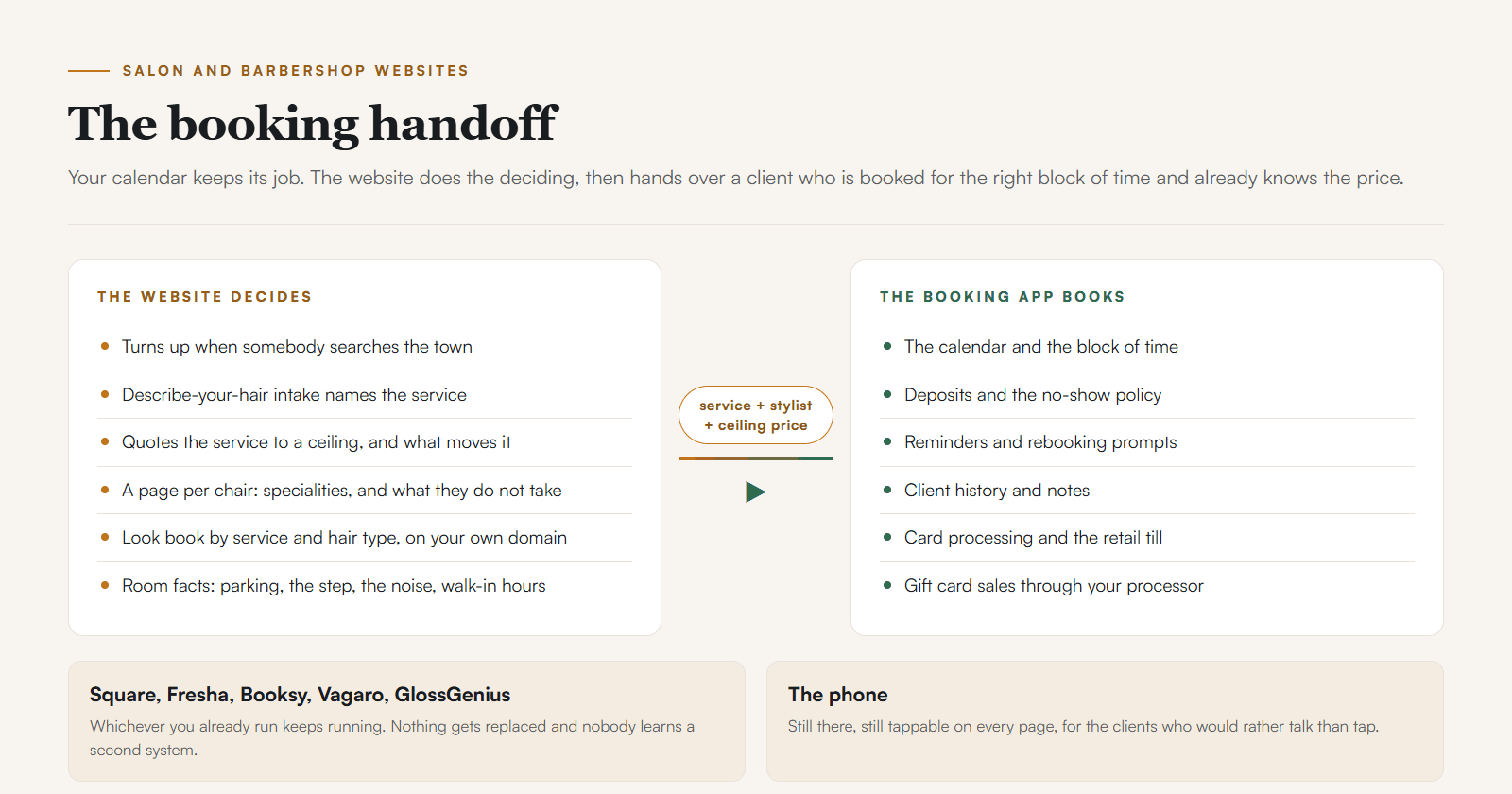
The phone goes back to being for the clients who prefer it. Everybody else books at ten at night from the couch, which is when this decision actually gets made.
A page for every chair
Clients follow the person who cuts their hair, whatever the sign over the door says. A stylist page converts better than any amount of copy about the salon, and it makes rebooking feel like a standing appointment.
- The work that stylist actually does, shown rather than listed.
- What they specialise in, named the way a client would say it. Curls, a proper fade, colour correction, blonde.
- What they do not take, stated in public. It is the fastest trust move a specialist can make.
- Whether they are accepting new clients this month, and how far out they book.
- A booking link that lands on that person with the right service already chosen.

The third line is the one nobody does. Saying in public what you do not take is the fastest trust move a specialist can make, and it stops requests landing on whoever happens to be free. A colourist booked for a fade is a bad afternoon for everyone.
The look book belongs on your own domain
Your best work is currently rented to an app that decides who sees it, and none of it turns up when somebody searches your town. Move the originals somewhere a search engine can read them.
Sort it by service and by hair type, because that is how a client looks for proof that their hair can get there. Caption each one with what it took and how it grows out, which answers the second question before it gets asked. Compress everything so the page opens in a blink on a phone at the bus stop.
Keep posting to the grid. Let it point at the look book instead of holding it. My guide on a Facebook page versus a website covers the same trade in more detail, and the salon and barbershop website design page shows how the look book gets built.
The room facts almost nobody publishes
How loud it is, whether there is a step at the door, where to park, which days smell like colour, and whether anybody has to make conversation. Nobody publishes it, and plenty of people decide on it.
- Getting in
- Where to park, whether there is a step at the door, and how wide the doorway is if somebody needs to know.
- The sound of it
- Busy and social, or quiet. Music loud or low. Whether anybody has to make conversation. Plenty of people decide on this alone.
- Who is welcome
- Kids, strollers, a support person waiting, a service dog. Say it rather than making somebody phone to ask.
- Colour days
- If certain days smell like colour, say which. Someone sensitive to it will book a Tuesday morning and thank you.
- Walk-in reality
- The real walk-in hours, and an honest note about the Saturday wait. Someone who drives in and waits an hour does not come back.
These cost nothing to write and they are the difference between a nervous person booking and a nervous person closing the tab. They also happen to be accessibility facts, which is the standard I build to anyway. The accessibility guide for Canadian websites covers the rest.
Gift cards, retail, and the quiet months
January and November are decided in advance. A site that can carry a promotion earns its cost in a single season, and gift cards are the easiest thing on it to sell badly.
Consumer Protection BC says most gift cards for a monetary value cannot carry an expiry date in this province, with exceptions for cards good for a specific service, such as a haircut voucher. So put the terms beside the buy button in plain language. A card bought in December should still work in July, and nobody should arrive holding a dead one.
The December email that sells them has its own rules. Canada's Anti-Spam Legislation wants real consent, your salon named as the sender, and a working unsubscribe. Capture the list properly through the year and the promotion lands safely when you need it.
Where salons and barbers stand in the Kootenays
This is a busy category with a lot of quiet operators. Being the shop that answers first is still a real advantage in Nelson, Castlegar, Cranbrook, and Kimberley.
On The Kootenay List, the register of Kootenay businesses I built and maintain, 35 of the 86 spas & esthetics listed have no website at all, as of September 3, 2026. The full picture by town and category is in the Kootenay business web census.
Kimberley is the sharpest example. Roughly a third of its listed businesses have a website of any kind, which is among the lowest rates in the region, and a chair there competes mostly against silence. Nelson runs the other way, closer to three quarters online, so a Baker Street shop is competing on what the page actually says. The web design in Nelson and web design in Kimberley pages carry each town's numbers.
What it costs, and the order to fix it in
A salon needs three things live and correct: what you charge, who does it, and how to book. That is a Trailhead build at $2,000, typically delivered in 2 to 3 weeks.
Studios adding retail, memberships, or a page for each of several locations scope higher, usually toward the Engine at $6,500. The Own It Monthly plan spreads the Trailhead: $2,000 once, or $500 today and 12 monthly payments of $142, which is $2,204 all in and yours outright at payment 12. Kootenay businesses get the 10% neighbours discount off any build. What you pay depends on what the shop actually needs, not on a package name.
- 01Rewrite the price list so every line has a ceiling, and name what moves the number.
- 02Replace the jargon menu with a short intake that asks about their hair in ordinary words.
- 03Give every chair its own page, including the work that stylist does not take.
- 04Move the look book onto your own domain, sorted by service and hair type, compressed to load fast.
- 05Publish the room facts: parking, the step, the noise, kids, and the real walk-in hours.
- 06Point the booking button at the app you already run, with the right service preselected.
- 07Make your hours match your Google Business Profile exactly, then check them every season.
Every week somebody in your town searches for a colourist, a fade, or a fill, and books whoever answered the question first. If a site already exists, the free website check-up will show you which of those seven steps is missing. If there is no site yet, start with a salon website that takes the booking and bring your price list.
Sources and further reading
- Consumer Protection BC: gift cards
Most gift cards for a monetary value cannot carry an expiry date in BC, with exceptions for cards good for a specific service, such as a haircut voucher. Read September 2026.
- Google Business Profile help: edit your business hours
How to keep regular and special hours current on the profile, so a walk-in searching two blocks away sees the same hours the door shows.
- Government of Canada: Canada’s Anti-Spam Legislation
The federal rules that govern the December gift-card email and any promotion you send. Consent, sender identification, and a working unsubscribe.
- WCAG 2.2 quick reference
The accessibility criteria I build to. Contrast, keyboard access, labelled booking forms, and alt text on every look-book image.
Frequently asked questions
I already use a booking app. Why pay for a website?
The app takes a booking that was decided somewhere else. A booking link cannot show a price ceiling, introduce the stylist, or turn up when somebody searches your town. The site does the deciding, then hands the client into the app you already run.
Do I really have to publish prices?
You have to publish a range with a ceiling, and it is the highest-return decision in this category. A number that stops somewhere lets a careful person book. Hiding it filters your clientele down to whoever worries least about money, which is a smaller room than it sounds.
My salon is on Instagram and it works. Is that enough?
It works until it does not. Instagram owns the audience and decides who sees a post, and it disappears the moment somebody searches instead of scrolls. Keep posting. Keep the look book, the prices, and the booking path on something you own.
What happens when a stylist leaves?
Stylists live as data on my builds, so a chair changing hands is one edit rather than a redesign. You update the page yourself from a phone: new name, new specialities, new availability. Nobody has to email a designer because somebody moved shops in March.
Can the site take deposits so people stop no-showing?
Your booking app almost certainly handles deposits and reminders already, and that is the right place for them. The site links into it and states the policy in plain words on the page, which is usually where the no-show problem actually starts.
Do barbershops need this, or is it a salon thing?
Barbershops often need it more. A barbershop lives on people two blocks away asking their phone who is open, so accurate hours, an obvious address, and a booking link that works with a thumb is most of the battle. The rest is a page per chair.
How much does a salon or barbershop website cost?
Most salons land on the Trailhead at $2,000, typically delivered in 2 to 3 weeks, with a 12-month payment plan available. Studios adding retail, memberships, or a page for each of several locations scope higher. Kootenay businesses get the 10% neighbours discount off any build.
Related pages
- Salon and barbershop websites
- Wellness and clinic websites
- Web design in Nelson
- Web design in Castlegar
Kootenay Made Digital
I build websites, local presence, and calm AI setups for Kootenay small businesses. Plain language, published prices, and clear work that makes you easier to find and easier to choose.