


 Castlegar, BC. Serving the Kootenays and beyond.
The booking happens the moment a traveller believes the photos.
Hotel and lodge website design that turns OTA browsers into direct bookings.
Every stay booked through an OTA hands the platform a commission and the guest's email. I build hotel and lodge websites from Castlegar, BC that win the direct booking instead: honest all-in rates, rooms a guest can tell apart, and a booking path that feels as safe as the app.

How a traveller chooses between your lodge and the OTA grid
I position a lodging site as the property's case for booking direct. Honest photography and copy set the right expectation, all-in pricing and visible policies remove the friction that sends travellers back to an OTA, and a clean handoff to your booking engine keeps the transaction safe, with accessibility, privacy, and payment standards built in so the property stays credible and protected.
- 01
They book the stay they can picture
A traveller is imagining the morning light, the bed, the drive in, the parking, the dog policy, and what is walkable nearby. The site has to answer the feeling and the logistics in the same breath, or the doubt sends them elsewhere.
- 02
Surprise fees break trust instantly
When a rate balloons at checkout with cleaning charges, resort fees, or taxes that were hidden until the last step, the guest feels misled and bounces. Honest all-in pricing is now both the law and the conversion advantage.
- 03
Direct has to feel as safe as the app
Travellers trust OTAs because the checkout is smooth and the cancellation terms are visible. To win direct bookings you have to match that confidence: clear policies, a secure payment page, and an instant, professional confirmation.
- 04
Every OTA booking rents back your own guest
The commission is not the only cost. The platform keeps the email, owns the review, and remarkets the guest to your competitors. A direct booking is the only one where the relationship is actually yours to keep.
- 05
Walk-ins moved onto the phone
The highway walk-in who saw your sign and pulled in still exists, but now the pull-in happens on a phone in a Nelson coffee shop two hours before check-in. If the mobile site loads slowly or hides the rate, that last-minute stay goes to whichever property the app surfaces first.
See the Cedar & Stone Lodge concept in the wild.
Concept build from my portfolio, no real affiliation
Cedar & Stone Lodge is the fictional five-room bed and breakfast near Radium Hot Springs that proves the lodging system end to end: five individually sold rooms with honest rates, a direct-booking path with a date picker, breakfast and dining content that sells the stay, and fifteen journal guides aimed at the searches travellers actually make.
- 29 sitemap URLs
- Direct-booking engine
- 5 rooms sold individually
- 15 traveller guides
Cedar & Stone Lodge is a fictional concept build created to demonstrate the category. No real lodge affiliation, booking results, guest outcomes, or operating performance should be implied.
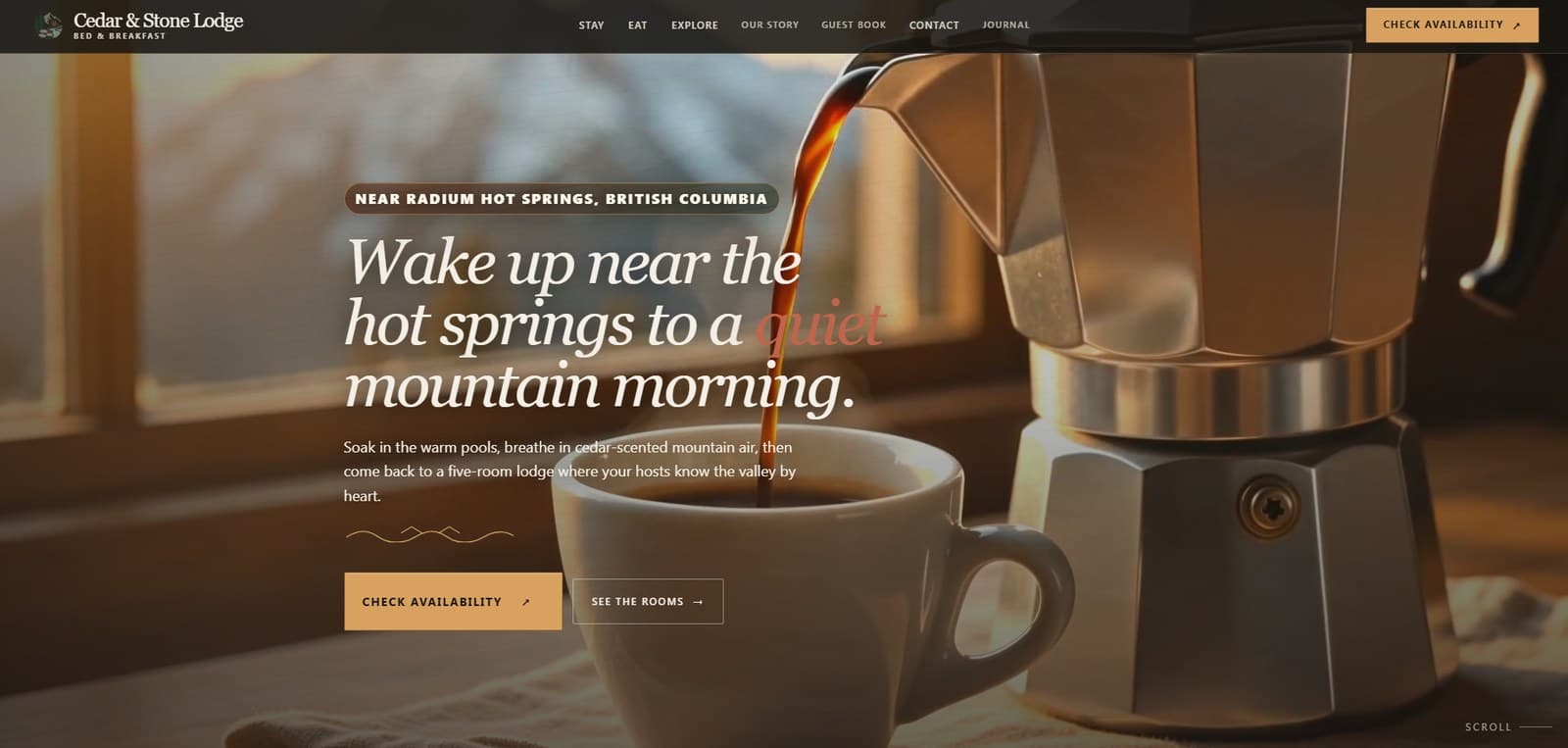
What goes into a direct-booking lodging website
- 01
Photography-led room and rate clarity
Give every room type, cabin, suite, and package its own honest page: real photos, what is included, who it fits, bed configuration, view, and the true nightly rate. When the guest can tell the rooms apart and trust the images, the comparison stops being about price alone.
- 02
A direct-booking path that feels safe
I hand off to your booking engine or embed it where it belongs, with deposits, cancellation terms, and check-in details visible before the guest commits. Your channel manager keeps availability synced; the site's job is making the direct path the smooth one, so there is no reason to leave for the app.
- 03
Honest all-in pricing and policy clarity
Show the real price a guest will pay, with PST, MRDT, and any mandatory fees disclosed up front rather than sprung at checkout. Cancellation, deposit, pet, parking, and accessibility policies live where guests look for them, which builds trust and meets Canada's drip-pricing rules.
- 04
Local planning that makes the stay feel easy
Seasonal guides, powder-day notes for Whitewater and Red, Kootenay Lake ferry timing, dining picks, and drive times position the property as the local expert and the easy choice. This is the content an OTA tile can never carry, and it is what turns a browser into a booking.
- 05
Repeat guests and the last-minute phone booking
Most stays get researched and booked on a phone, often in low signal between the lake and the hill. I build light, fast pages with tap-friendly booking and clear arrival details, then capture consent-based email so seasonal offers, opening dates, and gift cards lift shoulder-season occupancy without paying commission twice.
The standard that comes with every build I ship.
- Premium, photography-led lodging homepage
- Room, cabin, suite, amenity, and package pages with honest rates
- Booking engine handoff or embed with clear policies
- All-in pricing presentation with taxes and fees disclosed
- Local guide, itinerary, and seasonal planning structure
- Consent-based email capture and seasonal campaign foundation
- Wedding, retreat, and group inquiry paths with their own routes
- Accessibility, arrival, parking, and pet guidance pages
- Fast mobile-first build with secure forms and confirmations

The cost of every stay that books somewhere else
Each friction below gets paid twice: the guest pays in doubt, you pay in commission or an empty room. The build decision on the right settles both at once.
Your own site shows less than your OTA listing
Costs them
They cannot check the room, the terms, or the real rate without going back to the platform, where all three sit on one screen.
Costs you
Commission on a guest who already knew your name, and a platform that keeps the email and markets them the property down the highway.
FixRoom-by-room pages on your own domain with real photos, bed configuration, view, what is included, and the all-in nightly rate.
A stranger cannot tell your rooms apart
Costs them
Nothing says whether the higher rate buys the lake view or a bigger television, so they take the cheapest and arrive slightly disappointed.
Costs you
Your best rooms sit unsold while the entry room fills, and the mismatch comes back later as a review about value.
FixEvery room type gets its own page, named and sold on who it fits and what the morning looks like from it, not on the rate alone.
The rate moves between the page and the checkout
Costs them
They feel handled, reopen the app, and pay a similar total to a company that showed the whole number first.
Costs you
Abandoned direct bookings, then commission on the same guest arriving through the platform an hour later.
FixAll-in rate display with PST and MRDT stated up front, and deposit, cancellation, pet, and parking terms visible before the date picker.
Nothing on the site explains arrival
Costs them
They pull in after dark unsure where to park, whether anyone is still at the desk, and how long the last gravel stretch runs.
Costs you
Calls to your cell at ten at night, late arrivals you wait up for, and front-desk time that never lands on an invoice.
FixAn arrival page covering directions, late check-in, parking, the key handoff, pets, and accessible access, linked from every confirmation.
No way to reach the guests who already stayed
Costs them
They liked the place, forgot the name by spring, and rebook through whichever platform emailed them first.
Costs you
Shoulder-season nights discounted to strangers while your returning guests pay commission a second time.
FixConsent-based email capture at booking and after checkout, so opening dates and quiet-week offers reach people who already like the property.
The direct-booking math on a 20-room Kootenay lodge
Run the numbers once and OTA commission stops feeling like a cost of doing business. A 20-room lodge near Kootenay Lake at 60 percent occupancy across a 120-night season sells roughly 1,440 room-nights. At a $200 average rate that is about $288,000 in stays. If two thirds of it arrives through the platforms at 15 to 25 percent commission, somewhere between $28,000 and $48,000 leaves the valley every season.
The goal is not zero OTA; the platforms are how strangers find you, and that reach is worth paying for. The goal is shifting the guests who already know your name, the repeat visits, the referrals, the direct searches, onto the commission-free path. Even moving a modest share of OTA volume to direct covers the website inside its first season, and the recovered margin repeats every year after.
- All-in rates on your site that match or beat the OTA price for the same room
- A booking handoff smooth enough that direct never feels like a gamble
- Consent-based email so the second stay books direct by default
Selling stays online has rules. I build to them.
A site in this category is judged on more than looks. These are the obligations and reassurances I build in by default, so the business stays credible and protected.

All-in pricing under the Competition Act
Canada's amended Competition Act treats drip pricing as deceptive: mandatory, fixed fees must be in the advertised price, not added at checkout. I present honest all-in rates and disclose government taxes such as PST and the up-to-three-percent MRDT clearly, so guests are never surprised and the property stays onside.
Secure payments and PCI DSS
Direct booking means handling card data responsibly. I route payment through your booking engine or a hosted, tokenized payment page so card numbers never touch your site, which keeps you in the simplest PCI DSS scope and protects guest data the way PIPEDA expects.
Guest privacy under PIPEDA
Booking, inquiry, and newsletter forms collect personal information, so I build them with a plain-language privacy statement, purpose-limited data collection, and secure transmission. Guests know what you collect and why, and the property meets its federal privacy obligations.
Email consent under CASL
Canada's anti-spam law requires real opt-in consent before marketing emails. I set up signup with express consent, clear sender identification, and a working unsubscribe in every message, and I keep the consent record clean, so seasonal campaigns grow the list without legal exposure.
Accessibility to WCAG 2.2 AA
I build to WCAG 2.2 AA, the level BC's and Canada's accessibility legislation both point toward, with keyboard navigation, colour contrast, and screen-reader structure. Accessible-room details, including step-free access and bathroom features, get spelled out so guests with disabilities can book with confidence.
Honest amenity and accessible-room representation
What you show is what you owe. I help present amenities, room features, accessibility, pet rules, and policies accurately, so the stay matches the listing. Honest representation prevents disputes and chargebacks and is the foundation of the reviews that drive future direct bookings.
Short-term rental registration display
If you operate short-stay rentals in BC, the provincial registry requires a valid registration number, and a business licence number where the local government mandates one, on your listings as of May 1, 2025. I build clean places to display these so cabins and suites stay compliant and bookable.
Want this standard on your site?
One conversation, no pitch deck. Tell me where the business is stuck and I will tell you what I would build.
40 of the 131 Hotels & lodges on The Kootenay List have no website, as of September 3, 2026. The ones that do are the ones a customer can find.
What a build like this costs.
A focused presence site starts with the Trailhead: $2,000, or $500 today and $142 a month on Own It Monthly ($2,204 total). Plenty of businesses in this industry need exactly that and nothing more.
Bigger jobs usually land at $6,500, or $1,625 today and $457 a month on Own It Monthly ($7,109 total)
The Engine · typical timeline 4 to 5 weeks
A lodge sells atmosphere, and atmosphere needs the photography-led custom design plus the room, package, and local-guide depth that keeps recovering OTA commission season after season. The Engine gives all of it the room it needs.
The honest answer depends on what you actually need, not on a package name. Start with the free check-up or the contact form, and I will book a proper 45-minute consultation with you, no pressure either way.
Comparing options right now? What a website should cost breaks down how to read any quote, and who actually owns your website covers what you keep if you ever leave, on any platform, including mine.
OTAs and your booking engine does the plumbing. KMD wins the decision.
The platforms and the booking engine handle distribution and the transaction. The website has to handle everything that happens before it: belief in the photos, clarity on the room and the real price, confidence that arrival will be easy, and the feeling that booking direct is the smarter choice.
Online travel agencies like Booking.com, Expedia, and Airbnb buy the top of Google, carry real demand, and feel safe to travellers, but they frame your property next to every competitor on price, take a commission on each reservation, and keep the guest relationship after checkout. Your property management system, channel manager, and booking engine keep availability, rates, and payment synced across every channel, yet none of them builds desire or a reason to book direct.
What the category tool covers
- Demand, reach, and a checkout travellers already trust
- Availability, rate, and inventory syncing across channels
- Card capture, deposits, and confirmation handling
- Review collection and a familiar comparison interface
- Commission-based exposure to travellers who do not know you yet
Where the upgrade actually pays off.
- 01
Win the booking before the guest reopens the OTA by making the photos, the room, and the real price impossible to doubt
- 02
Quote honest all-in rates up front so the direct price feels fair, not like a checkout trap
- 03
Own the guest with consent-based email and post-stay follow-up so the second stay pays no commission
Related guides.
- How a Small Lodge Website Wins Direct Bookings
- What Website Photos Actually Need to Show if You Want More Trust
- Should Your Small Business Website Have an AI Assistant?
- How Kootenay Tourism Businesses Can Win Visitors Before They Arrive
- What a Wedding and Event Venue Website Needs to Book Up
- Hidden Fees on Your Website Are Against the Law in Canada
Lodging website questions, answered straight
How much does a hotel or lodge website cost in BC?+
A focused property site starts at my Trailhead package: $2,000, or $500 today and $142 a month on Own It Monthly ($2,204 total). Most lodging builds land in my Engine package: $6,500, or $1,625 today and $457 a month on Own It Monthly ($7,109 total), live in 4 to 5 weeks. That covers the photography-led design, room and package pages, the booking engine handoff, and the local-guide depth that earns direct bookings, whether you run a boutique hotel in Nelson or cabins on Kootenay Lake.
Can the site take direct bookings so we stop paying OTA commission?+
The site presents rooms and rates convincingly enough, and hands off to your booking engine smoothly enough, that a decided guest has no reason to go back to the app. OTAs still bring strangers, and they should; the win is shifting repeat guests, referrals, and the searchers who already know your name onto the commission-free path.
Can it connect to our booking engine or PMS?+
Yes. I hand the transaction to whatever your property runs, whether that is a full PMS with an embedded engine or a simpler system, depending on the integration and embed options the platform offers. Your channel manager keeps availability synced across every channel; the site's job is earning the booking and presenting the handoff cleanly.
Why not just rely on Booking.com, Expedia, or Airbnb?+
Those platforms bring demand, but they frame you on price next to every competitor, take a commission on every stay, and keep the guest relationship afterward. A custom site builds your brand, captures the guest email with consent, earns direct bookings, and turns one stay into repeat business you do not pay for twice.
Do we have to show taxes and fees up front?+
Yes, and it works in your favour. Canada's Competition Act now treats hidden mandatory fees as deceptive drip pricing, so I present honest all-in rates with PST and MRDT disclosed clearly. Guests trust a price that does not jump at checkout, which is exactly what converts the direct booking.
Is taking payments on our own site safe and compliant?+
Safer than most owners expect. Card payments run through your booking engine or a hosted, tokenized payment page, so card numbers never touch your website. That keeps you in the simplest PCI DSS scope, protects guest data in line with PIPEDA, and gives travellers the same secure checkout feel they get from a major platform.
Can one site handle rooms plus weddings, retreats, or groups?+
One property, several front doors. I split nightly stays, weddings, retreats, group blocks, dining, and packages into clear paths with their own inquiry routes, so a wedding lead and a weekend traveller each get the right experience instead of being funneled into one generic booking page.
What about accessibility and guests with disabilities?+
Every build meets WCAG 2.2 AA: keyboard navigation, screen-reader structure, and proper colour contrast. Just as important for lodging, I spell out accessible-room details, like step-free access, doorway widths, and bathroom features, so guests with disabilities can judge the fit and book with confidence instead of having to phone and ask.
We run short-stay cabins in BC. Does the registry affect our site?+
It can. As of May 1, 2025, BC requires a valid provincial registration number, and a local business licence number where required, to be displayed on short-term rental listings. I build clean places to show these on your property pages so your cabins and suites stay compliant and bookable.

Who builds this
I am Brett, the person behind Kootenay Made Digital. I plan, design, and build every site myself from Castlegar, BC, so the person you email is the person doing the work.
Founder, Kootenay Made Digital · Castlegar, BC
Ready to stop renting your own guests back?
A lodging website pays for itself in recovered commission, then keeps paying every season the guests book direct. Most Kootenay properties land in the Engine build and are live before the next booking window opens.
No website yet?
Start My First WebsiteAlready have one?
Get a Free Check-Up