


 hello@kootenaymade.ca
 Castlegar, BC. Serving the Kootenays and beyond.
The Ale Trail brings them to the door. The site sells the club before they leave the valley.
Brewery and winery website design that retires the tap list nobody updates and sells the case after last pour.
I build brewery, winery, cidery, and distillery websites from Castlegar, BC. The Ale Trail and the Creston wine route bring visitors to your tasting room all summer; a site with a live tap list, a real bottle shop, and a club signup keeps them buying long after they drive home.

What a thirsty visitor decides before the first pour
I treat a producer’s website as the second tasting room, the one that never closes. The story of the brewhouse or the vineyard block, a tap list your staff update from behind the bar, tasting room hours and bookings that answer the road-tripper’s question, an age-gated bottle shop that ships where your licence allows, and a club page that turns one great visit into a standing order. The POS and the club platform keep the operation running. The website is what makes a stranger stop, and a visitor come back with their card out. The checklist version is my guide to what a brewery website should include.
- 01
The stop is planned on a phone the night before
Ale Trail visitors line up tomorrow’s stops from the hotel bed: who is open, who has a patio, what is pouring, are kids and dogs welcome. If your hours are stale or the tap list is from March, you are quietly dropped from the route and the brewery two towns over gets the visit.
- 02
A stale tap list reads as a closed sign
The tap list is the one page a beer drinker actually checks, and the one page most producer sites let rot. When the site still shows a winter stout in July, the visitor assumes nothing else on the site is true either. A current list carries the credibility of the whole operation.
- 03
The case is bought on the story, not the specs
Nobody drives home with a mixed twelve because of a stat sheet. They buy the valley, the water, the family name on the label, the seasonal release with a story behind it. The site has to pour that story before the bottle shop asks for a card number.
- 04
The club is belonging you can pour
Club members are not buying a discount; they are buying first access to the seasonal release, a name the taproom staff know, and a box that shows up like a gift they sent themselves. The club page has to sell the identity first and make joining take one minute, ideally while the glass is still in their hand.
See the Breaker Room concept in the wild.
Concept build from my portfolio, no real affiliation
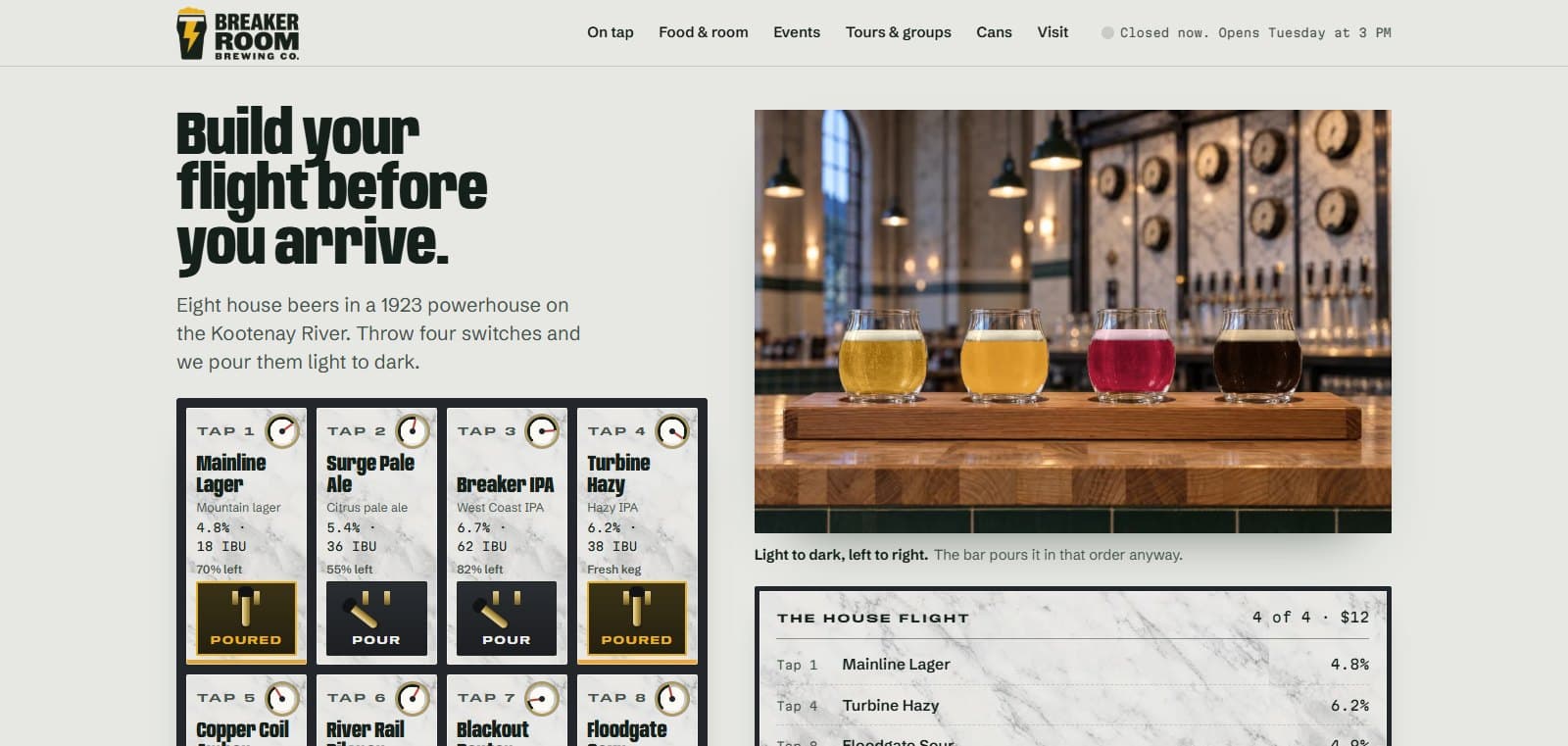
Breaker Room Brewing is the fictional brewery that proves the category end to end, set in a 1923 powerhouse on the Kootenay River. The homepage is The Flight Board: a visitor throws four switches on the old marble tap wall and builds a flight before they arrive, poured light to dark. Around it sit the answers a taproom gets phoned about, open right now, the kitchen, kids, dogs, the patio and the driver, plus a booking builder for groups and cans to order ahead.
- The Flight Board
- Open now, kids, dogs and the driver answered
- Group booking builder
- 29 sitemap URLs
Breaker Room Brewing is a fictional concept build created to demonstrate the category. The brewery, the town of Dynamo, and every beer are invented; no real producer affiliation should be implied, and the concept site sells nothing.
What a taproom-to-doorstep build covers
- 01
Tasting room answers before the drive
Hours, patio status, tour and tasting bookings, food and family policy, and one-tap directions, all current and all obvious on a phone. The visitor planning a Kootenay loop decides in seconds; the producer who answers first gets the stop, and the walk-in traffic follows the certainty.
- 02
A tap list your staff update from behind the bar
The tap list and current-pour board built as data, not a designer’s PDF. Kick a keg, add the new hazy, mark the last cases of the vintage, from a phone, in seconds. The site, the printed list, and what Google shows all stay in step without anyone emailing a web person.
- 03
The bottle shop that travels home with them
Age-gated ecommerce for cans, bottles, gift packs, and merch, with taproom pickup for locals and shipping set up to match what your licence permits. The summer visitor becomes a winter customer, and the margin stays with you instead of a marketplace.
- 04
Club, subscriptions, and the seasonal release
A club page that sells belonging, a signup that takes a minute, and release announcements that go to your own list first. Whether the club runs on your platform or mine, the site is where the pitch lands and the seasonal release gets a proper launch instead of a hopeful post.
- 05
Found by the trail, the town, and the search
Content structured for the searches that matter: brewery in Nelson, winery near Creston, cidery on the way to Rossland, distillery tour Kootenays. Aligned with your Google Business Profile and the trail listings, so the road-tripper, the local, and the powder-day crowd all land on your page first.
The standard that comes with every build I ship.
- Producer homepage that pours the story before the specs
- Practical age confirmation in front of purchase and promotion
- Staff-editable tap list and current-release board
- Age-gated bottle shop with pickup and licence-aware shipping
- Club and subscription signup pages built for the QR-at-the-bar moment
- Tasting room hours, tours, and booking paths
- Seasonal release announcement pages wired to CASL-compliant email
- WCAG 2.2 AA accessibility, fast Core Web Vitals, and analytics baked in

The tab a quiet website runs up between releases
A slow season rarely announces itself. It arrives as a tasting room quieter than the brewery two towns over, and a bartender reading the board down the phone all afternoon. The right column is what ends both.
A tap list still showing March in July
Costs them
They check the one page a beer drinker actually checks, see a winter stout, and assume the hours are stale too, so they pick a different stop.
Costs you
A route planned from a hotel bed the night before that quietly leaves you off it, and staff reciting what is pouring to every caller.
FixA tap list built as data your staff edit from a phone behind the bar, so kicking a keg updates the page, the printed list, and what Google shows.
Tasting room hours live in a social feed
Costs them
They scroll looking for whether you are open today, find a post from the May long weekend, and drive to the cidery that said so.
Costs you
Walk-in traffic handed to a producer down the valley, and a phone ringing through the busiest pour of the day to ask a question a page could answer.
FixHours, patio status, tours, food and family policy, and one-tap directions kept current on the page a phone lands on first.
The age gate swallows the entire site
Costs them
A full-screen wall asks for a birthday before they know who you are, and a road-tripper with three tabs open closes that one first.
Costs you
Story and visit pages that search engines never reach, so the searches for a brewery in your town find everybody except you.
FixA remembered, lightweight confirmation scoped to purchase and promotion, leaving the story and visit pages fully crawlable.
Nothing to buy once they drive home
Costs them
They fell for the seasonal release in July and have no way to get a case in November beyond hoping a liquor store happens to carry it.
Costs you
A summer visitor who converts into nothing, and the margin left with whichever distributor or marketplace stocks you instead.
FixAn age-gated bottle shop with taproom pickup for locals and shipping configured to exactly what your licence permits.
The club is pitched after the glass is empty
Costs them
They would have joined at the peak of a good flight, and by the time an email finds them the afternoon has faded into an ordinary Tuesday.
Costs you
Club members you never signed, and a release launched to whoever an algorithm felt like showing it to that week.
FixA club page that sells the belonging first, with a signup a bartender can open by QR code while the flight is still on the paddle.
Age gate, bottle shop, club: the trio that keeps pouring after close
Every producer site carries one requirement a bakery never faces: proving the visitor is of age before the selling starts. Done lazily, the age gate is a full-screen wall that annoys humans and starves search engines. I build it the practical way: a lightweight, remembered confirmation that sits in front of purchase and promotion, keeps the responsible-marketing posture your licence expects, and stays out of the way of the story pages Google needs to rank you.
Behind the gate, the bottle shop and the club do the compounding work. The bottle shop sells the case and the gift box with pickup at the taproom or shipping where your licence allows, so a July visitor can reorder from Calgary in November. The club turns the best visits into a standing order: seasonal release allocations, member pricing, and a signup a bartender can open by QR code while the flight is still on the paddle. One system, three jobs, and none of it depends on you remembering to post.
- Age confirmation that satisfies the gate without smothering search
- Bottle shop with taproom pickup and licence-aware shipping options
- Club signup built for the QR-at-the-bar moment
- Seasonal release pages that give every drop a launch, not just a post
Liquor marketing rules, handled without killing the brand
A site in this category is judged on more than looks. These are the obligations and reassurances I build in by default, so the business stays credible and protected.

Age gating done practically
Selling and promoting liquor online means confirming age before the pitch. I build the gate to do its job without wrecking the site: a remembered confirmation in front of purchase and promotional content, honest wording, and no dark patterns, so the posture is defensible and the visitor is not punished for arriving.
Responsible marketing, mirrored from your licence
Your licence and BC’s liquor rules shape what you can say, show, and ship, and those calls belong to you and your licensing advisor, not a web designer. My job is making the site mirror your rules faithfully: shipping promises that match what you can actually ship, marketing copy that stays inside what your licence allows, and easy edits when the rules or your licence change.
Card capture stays with the processor
Bottle shop orders, club payments, and gift cards all touch cardholder data. I keep card capture inside a compliant, tokenized processor such as Stripe, Square, or your club platform, so card numbers never live on your site, your liability stays contained, and a first-time buyer trusts the checkout.
CASL consent for release emails and club news
The seasonal release list is your most valuable marketing asset, and Canadian anti-spam law requires real, logged consent before you can use it. I build signups that capture express consent, identify you as the sender, and include a working unsubscribe, so release day lands in inboxes instead of spam folders or complaints.
Accessibility to WCAG 2.2 AA
I build to WCAG 2.2 AA: keyboard navigation, real contrast, labelled forms, and a tap list a screen reader can actually read, which a PDF never is. It widens who can buy from you and keeps you ahead of where the Accessible British Columbia Act is clearly heading beyond public bodies.
Want this standard on your site?
One conversation, no pitch deck. Tell me where the business is stuck and I will tell you what I would build.
What a build like this costs.
A focused presence site starts with the Trailhead: $2,000, or $500 today and $142 a month on Own It Monthly ($2,204 total). Plenty of businesses in this industry need exactly that and nothing more.
Bigger jobs usually land at $5,500, or $1,375 today and $386 a month on Own It Monthly ($6,007 total)
The Storefront · typical timeline 5 to 6 weeks
A producer site earns its keep the day the bottle shop goes live; the Storefront tier carries age-gated ecommerce, a living tap list, and club signup without paying for scope a single taproom does not need.
The honest answer depends on what you actually need, not on a package name. Start with the free check-up or the contact form, and I will book a proper 45-minute consultation with you, no pressure either way.
Comparing options right now? What a website should cost breaks down how to read any quote, and who actually owns your website covers what you keep if you ever leave, on any platform, including mine.
Untappd, your POS, and the club platform does the plumbing. KMD wins the decision.
The platforms run the transaction. They do not make a stranger in Nelson for the weekend pick your taproom over the other three, and they do not turn a great Saturday tasting into a club member who buys every seasonal release. That is the website’s job.
Untappd holds your check-ins, Square or your POS runs the till, and club platforms like Commerce7 manage winery memberships. Each is good at its slice. None of them is your address on the internet. A road-tripper searching for a taproom finds whoever published a page, and the story that sells a case only lives where you own it.
What the category tool covers
- Check-ins, ratings, and beer menus on the aggregator apps
- POS, till, and tasting room card payments
- Club billing, allocations, and member logins on the club platform
- Third-party marketplace and delivery listings
- Google Business Profile hours, photos, and reviews
Where the upgrade actually pays off.
- 01
Move the tap list out of Instagram stories and onto a page that ranks, prints, and stays current, because a story dies in 24 hours and a search result does not.
- 02
Give every seasonal release a page and an email, not just a post, so the launch reaches the people who asked to hear about it first.
- 03
Sell the club at the moment of highest enthusiasm: a QR code on the flight paddle beats a signup link in a bio every single time.
- 04
Keep Untappd and the trail listings as discovery, and route the purchase to your own bottle shop, where the margin and the customer relationship stay yours.
Related guides.
- What Should a Brewery Website Include?
- Logo and Brand: Before or After the Website?
- BentoBox Alternative: A Restaurant Website That Actually Gets Found
- Shopify vs Squarespace: Which One for a Canadian Small Business?
- A Local Shop Website That Earns the Visit
- Is Shopify Worth It for a Small Kootenay Store? The Honest Math
- When Shopify Is Not Enough: What Serious Product Brands Need Next
- What Product Photos, FAQs, and Shipping Info Do to Buyer Confidence
- How Much Does Logo Design Cost in Canada?
- What a Great Website for a Kootenay Restaurant, Cafe, or Food Business Needs
Questions I hear across the bar
How much does a brewery or winery website cost in BC?+
Most producer sites I build land in the Storefront package: $5,500, or $1,375 today and $386 a month on Own It Monthly ($6,007 total), typically live in 5 to 6 weeks. That covers the age gate, the staff-editable tap list, the bottle shop, and the club signup. A taproom-only presence can start smaller; a multi-brand producer with a heavy club program scopes higher.
Do I really need an age gate, and will it hurt my Google ranking?+
You need age confirmation in front of purchase and promotion; that is table stakes for a licensed producer marketing online. The ranking damage comes from doing it badly: a heavy wall that blocks crawlers from every page. I build a lightweight, remembered gate scoped to the commercial content, so your story and visit pages stay fully crawlable.
Can the site actually sell and ship from our bottle shop?+
It sells cans, bottles, gift packs, and merch through an age-gated checkout, with taproom pickup for locals and shipping configured to match what your licence permits. Where you can ship is a licensing question you answer with your advisor; my job is making the site enforce that answer cleanly so an order never lands somewhere it should not.
Can staff update the tap list without calling a web person?+
That is the core of the build. The tap list is data, not a design file: kick a keg, add the fresh hazy, flag the last cases of a vintage, from any phone, in seconds. The site, the schema Google reads, and the printable list all update together, so the page visitors check most is never the page that is wrong.
How does a club or subscription program work on the site?+
The site is the pitch and the front door: a club page that sells the belonging, the allocations, and the first crack at every seasonal release, with a signup that takes a minute. Billing and member management can run on the club platform you already use, or on the ecommerce stack I build, whichever fits how you pour.
Can it announce seasonal releases without me remembering to post?+
Every release gets a page and a send. The page gives the drop a permanent home that search and group chats can find; the email goes to the CASL-compliant list the site has been building all season. Socials still get their post, but the launch no longer lives or dies on the algorithm showing it to anyone.
Will Ale Trail visitors actually find us before they plan the route?+
That is the design goal. With more than 35 breweries, wineries, cideries, and distilleries across the East and West Kootenays, the route gets planned on a phone the night before. I structure the site for those searches, your town plus your category, and align it with your Google Business Profile and trail listings so you are on the route before they leave the hotel.
We are opening a new taproom and have no website at all. Where do we start?+
From zero is the cleanest build I do. I put the story, hours, and location up before opening day so the launch buzz lands somewhere you own, then the tap list, bottle shop, and club follow as the licences and the liquid come online. Half my clients start with no site at all; the sequencing is the service.

Who builds this
I am Brett, the person behind Kootenay Made Digital. I plan, design, and build every site myself from Castlegar, BC, so the person you email is the person doing the work.
Founder, Kootenay Made Digital · Castlegar, BC
Keep the taps selling after the tasting room closes
Summer visitors are already planning the stop on their phones, and your regulars are deciding whether the club is worth it. A site with a tap list that is actually current, a bottle shop that actually checks out, and a club page worth joining is how one tasting becomes a customer for years.
No website yet?
Start My First WebsiteAlready have one?
Get a Free Check-Up