


 hello@kootenaymade.ca
 Castlegar, BC. Serving the Kootenays and beyond.
Procurement-grade web work from a single accountable builder.
I build websites for local governments, post-secondary institutions, and public bodies: accessible by law and by craft, and evidenced by working software rather than promises. This page is written for the evaluation committee reading it.
The survey sweeps as you read. Three beacons mark the evidence below.
An independent practice is its own model, with named advantages.
One person holds the whole system
Architecture, design, build, accessibility, and performance are held by one accountable person. Nothing is lost in handoffs between departments, because there are none.
The person you evaluate is the person who builds
The one who answers the interview questions writes the code, designs the templates, and picks up the phone for the life of the engagement.
Budget goes into the work
One person is on the invoice. Your budget buys design, code, and content, with no agency margin stacked on subcontractors.
Built to survive its builder
Every project lives in version control with documented state, and you hold the code, content, and accounts from day one. Should anything take me off the field, any competent successor can open the repository and resume.
Capacity: engagements are scoped in writing with hours, weekly averages, and float named up front, and plans are deliberately booked below theoretical capacity so no phase requires heroics to hold. An AI-assisted toolchain under written governance raises throughput. It never substitutes for my verification of any deliverable.
Evidence you can open today.
Every project below is live today and labelled exactly what it is: client work, owned product, or concept. The portfolio holds the full survey, and these three are the most relevant to institutional evaluation.
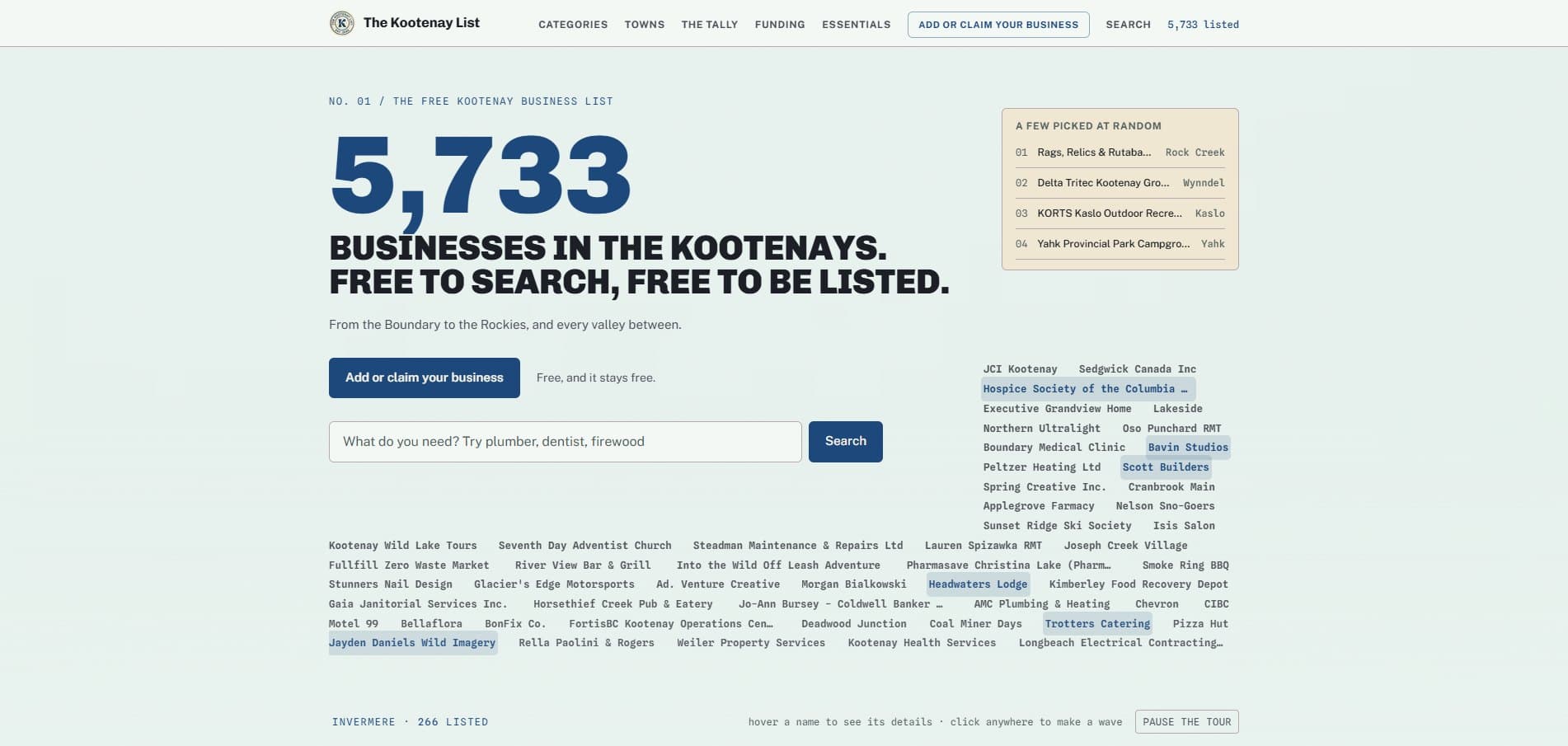
The Kootenay List
A free regional business register operated as public civic infrastructure: 5,836 businesses across 83 towns, served as 6,635 sitemap URLs when counted on September 10, 2026. Statically rendered with region-wide search, plus a grant and funding map and business-licence guides per town. Civic-scale information architecture with real uptime obligations.
Read the case study →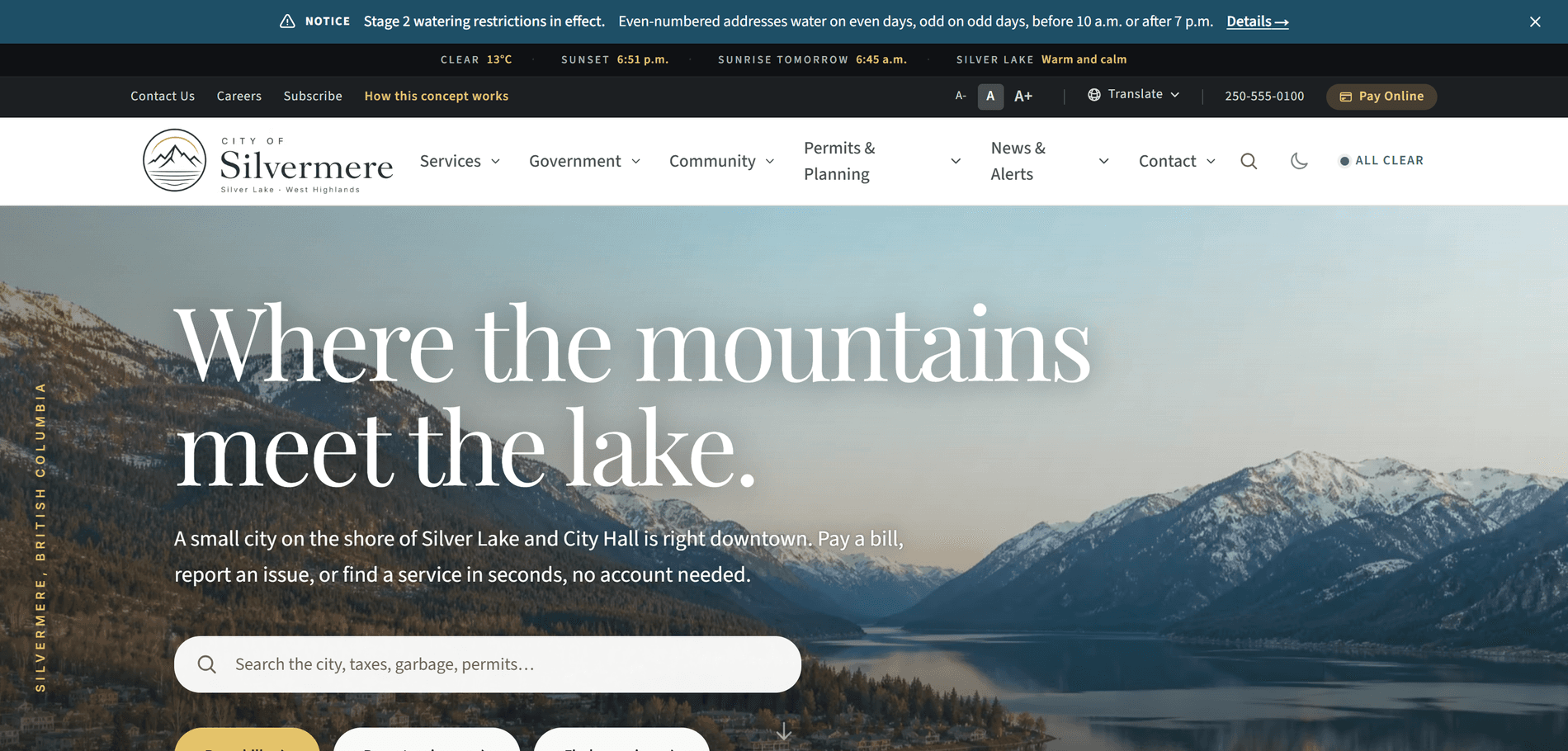
City of Silvermere
A complete 177-route municipal website concept with a working decoupled Drupal 10 authoring environment behind it: editorial workflow, roles, scheduled publishing, and translation. Built so evaluators can judge working software directly, and labelled as a concept everywhere it appears.
Read the case study →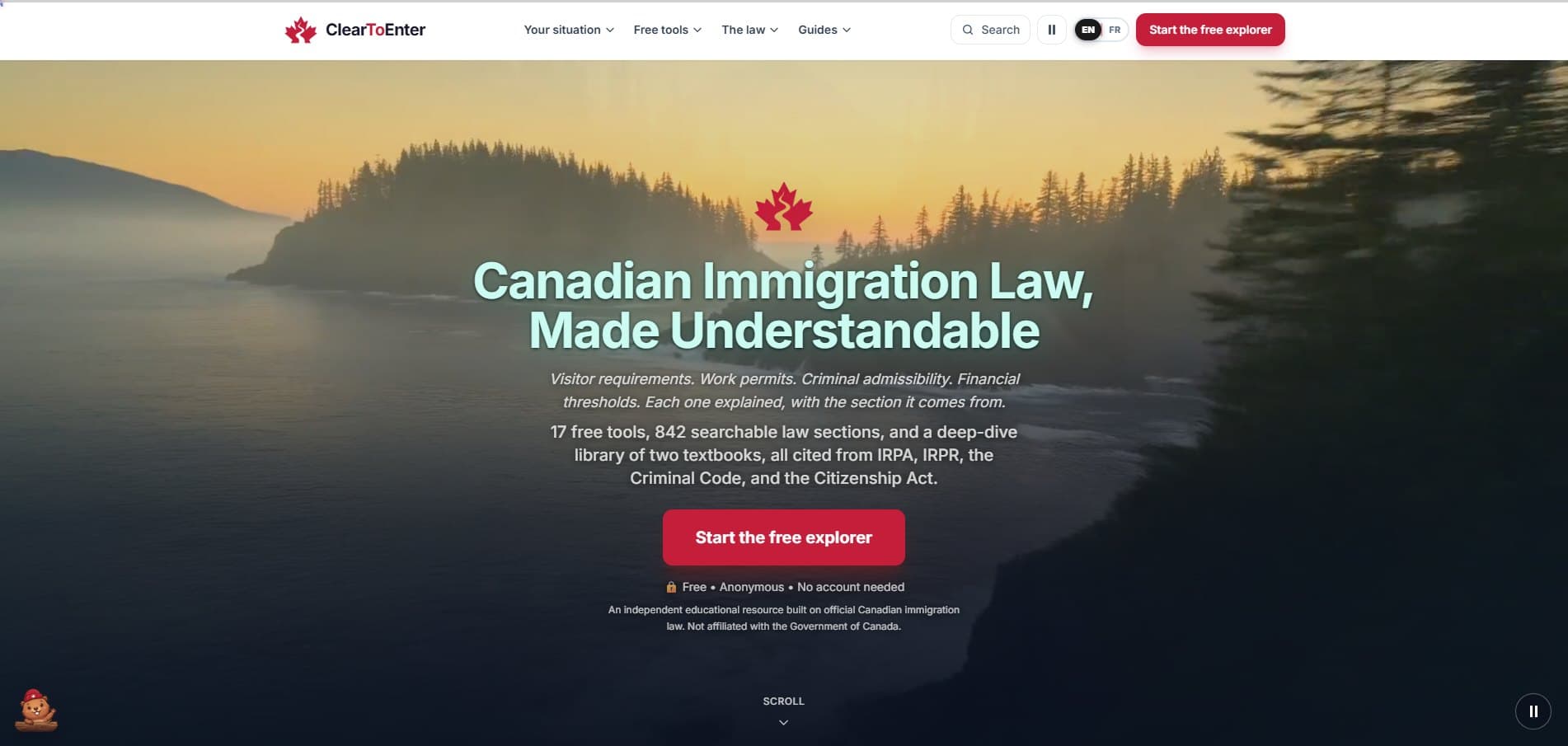
Clear to Enter
An immigration education platform run as a live product: a structured, bilingual content system with an 842-section legal reference library, served as 3,457 sitemap URLs when counted on September 29, 2026. Large-scale educational content architecture, the same shape of problem a post-secondary website is, in production today.
Read the case study →Five phases. Every gate is yours.
The schedule runs at the institution's pace. Phases end at client-controlled gates, review time is budgeted, and every plan carries named float.
Discovery
Content audit, stakeholder input, success metrics, and a production plan you approve before anything is designed. Migration is scoped here too: which pages carry forward, which get rebuilt, and who writes what, decided with you rather than discovered later. The gate is yours, and nothing advances until the plan earns sign-off.
Design
Information architecture built around your residents' or students' top tasks, then a design system your editors can hold. Every review happens against real content from day one.
Build
Template families land in your staging environment early, so evaluation happens on working software. Accessibility and performance are built in from the first commit.
Test
WCAG 2.2 AA verification, performance measurement, integration regression, and user acceptance on your side, with generous time budgeted for your review.
Launch and transition
Redirect mapping, analytics carryover, editor training built for your real team shape, and documented handoff. Hypercare follows launch, then a defect warranty. You hold every credential.
The policies are public, dated, and linked. Due diligence should not require asking.
I speak the process fluently.
I respond to RFPs, NRFPs, and RFIs through the standard BC channels, including Bonfire and BC Bid, with compliant documents built to the evaluation criteria: every mandatory answered in order, every claim evidenced inside the submission itself, and pricing built from the published scope, itemized so a committee can see where every dollar works.
Standard institutional requirements, including commercial general liability, errors and omissions, and WorkSafeBC registration, are arranged at award per each engagement's stated terms, with numbers quoted at bid time so no award waits on paperwork.
Every claim I make is verifiable against a live system or labelled as concept work. Every statistic traces to a source, every portfolio piece is my own build, and every proof point runs somewhere you can visit.
Smaller municipality weighing a resident-first rebuild rather than a formal procurement? The municipal websites page covers that architecture in depth.
Under the tender threshold
Many libraries, recreation commissions, societies and small boards can direct-award a website below their procurement threshold. For that lane I quote the same fixed packages every business gets: the Trailhead at $2,000, or the Trailhead's Full Coverage version at $3,200. The accessibility statement, the privacy policy, the security headers and the handover documents come attached to the quote, so the file is complete before anyone asks. If your threshold sits lower than the number, say so and I will scope to it.
What evaluation committees ask first.
Do your sites meet the WCAG 2.1 AA that BC procurements specify?
Every build targets WCAG 2.2 AA, which includes everything 2.1 AA asks for and adds newer criteria on top. The accessibility statement shows how I test and lists the limits I know about.
Who owns the code, content, and accounts?
You do, from day one. Every project lives in version control, and you hold the code, the content, and every credential.
What happens if you are unavailable mid-project?
Every project keeps documented state in its repository, so any competent developer can open it and resume. Plans are booked below capacity and carry named float, so no phase depends on heroics.
Can the site be bilingual?
Yes. The Silvermere concept runs translation inside its authoring workflow, and Clear to Enter publishes a bilingual content system in production today.
Do you work with public bodies outside BC?
Yes. I work from Castlegar and build for clients anywhere, and each submission is written to that jurisdiction's own procurement terms.
Read more before you decide.
The longer answers on civic sites, accessibility law, ownership, and rebuilds.
- What a Small City or Municipal Website Should IncludeIndustry Guides · 10 min
- Website Accessibility in Canada: WCAG, AODA, and the Accessible BC ActGrowth & SEO · 12 min
- Who Actually Owns Your Website? Wix, Squarespace, Shopify, and Custom ComparedGetting Started · 9 min
- Website Refresh vs Full Rebuild: How to Know Which One You Actually NeedGetting Started · 9 min
Evaluating vendors? Start with a conversation.
A 45-minute capability call costs nothing and answers the questions a website cannot. I will walk through methodology, live systems, and evidence on any project you pick.
Running a business rather than a public body? The same craft serves the packages: start there.
No website yet?
Start My First WebsiteAlready have one?
Get a Free Check-Up