


 hello@kootenaymade.ca
 Castlegar, BC. Serving the Kootenays and beyond.
The season is won months before anyone tightens a binding.
Adventure operator websites that sell the season out in the booking window, not the week of the opener.
I build adventure operator websites from Castlegar, BC where the trip page does the selling, so a fixed number of seats sells out inside the booking window instead of limping toward the opener. Cat skiing was invented in the Kootenays, and the Powder Highway now carries a hundred-plus owner-operated outfits chasing the same guests.

What a guest weighs before the deposit leaves the card
I treat an operator website as the part of the guest journey your guides never see. Trip pages rank for the activity and the region, honest difficulty and gear content qualifies the guest before the first email, guide bios and certifications earn the deposit, and the whole thing hands off cleanly into the booking platform and waiver tools you already run. The platform keeps the manifest straight. The website is why the manifest fills in the fall booking window instead of the week before the season opener.
- 01
The trip is rehearsed long before it is booked
A guest watches the video twice, forwards the trip page to the group chat, and imagines the line for a week before anyone pays. If the site cannot feed that rehearsal with real photos, honest terrain, and a trip they can picture themselves on, the daydream, and the deposit, go to another outfit.
- 02
Risk turns trust into the entire sale
A guest is handing strangers their safety in avalanche terrain or on moving water. They read guide bios like references, look for real certifications, and notice everything. A site with dead links and a schedule from two seasons ago whispers that the operation might be run the same way.
- 03
The booking window is short, early, and unforgiving
Winter seats sell in the fall; summer trips sell over the winter. Guest capacity is fixed, so a slow booking window cannot be made up on volume later. The operation that shows up ranked, answers the questions, and takes the deposit in October owns the season the other outfit spends discounting.
- 04
One organizer carries the whole group
Most bookings are one person convincing five friends. That organizer needs ammunition: a trip page with the price, the fitness bar, the gear list, and what is included, all forwardable in one link. Every unanswered question is a week of group-chat stalling, and stalled groups book with whoever answered.
Find your group at Powderhorn Basin.
Concept build from my portfolio, no real affiliation
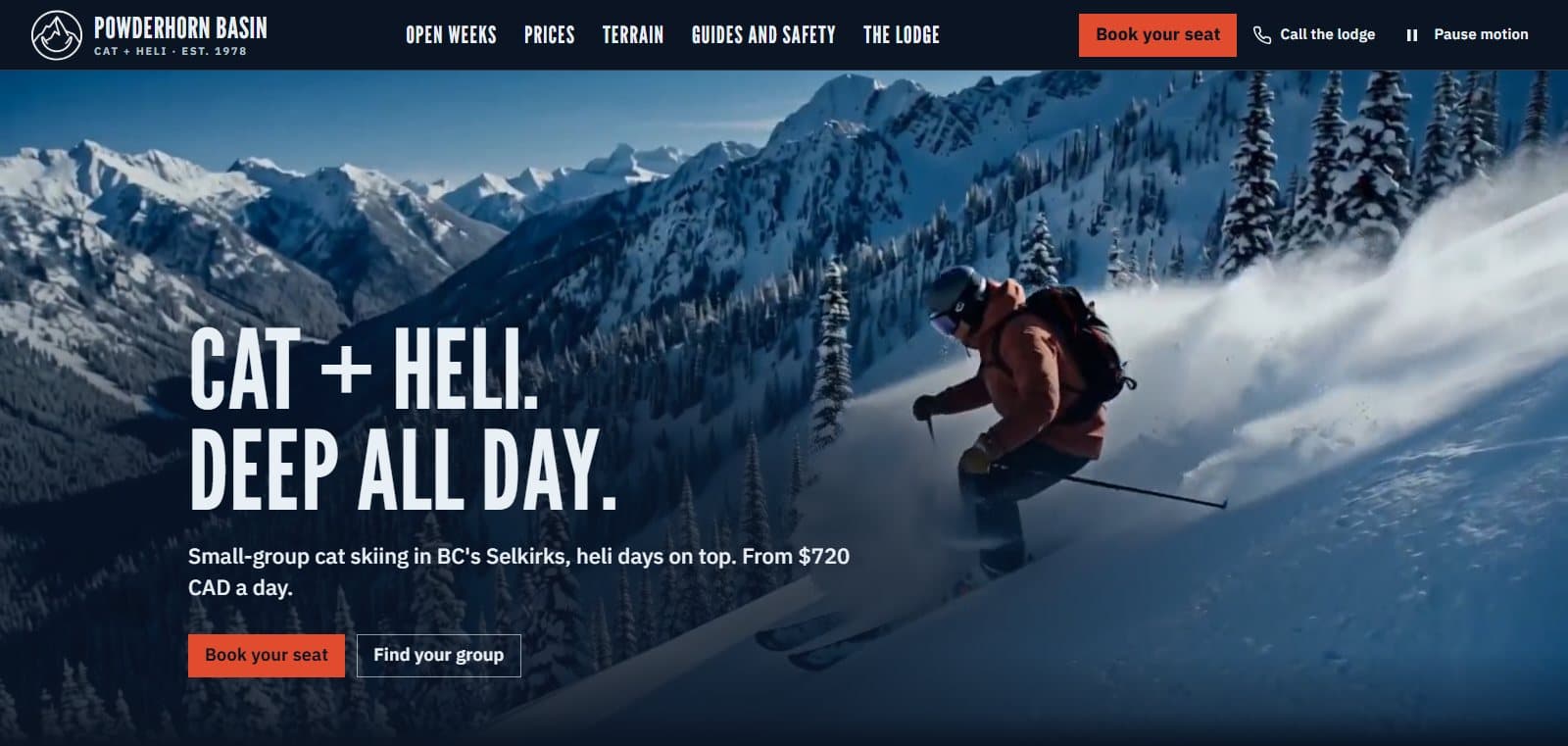
Powderhorn Basin is the fictional cat and heli operation that proves the category end to end. A first-timer picks one of four plain lines and a slate board seats them in a group, with its guide, its pace, its run list and the weeks that still have room. Scroll on and their group's line paints down the painted tenure map. Around it sit an open-weeks board, a bill with every tax in the total, a storm calculator that shows what comes back in dollars, and a booking form with five answers.
- Find your group in one tap
- Open weeks at a glance
- The whole bill with taxes
- 25 sitemap URLs
Powderhorn Basin is a fictional concept build created to demonstrate the category. The operation, the town of Muleshoe, and the terrain are invented; no real operator affiliation should be implied, and the concept site sells nothing.
What an operator build covers, first search to staging area
- 01
Trip pages that finish in your booking platform
Each trip gets a page built to close: dates, price, capacity, difficulty, gear, inclusions, and a book button that hands off into Checkfront, FareHarbor, Rezdy, or whatever engine runs your manifest. The guest never re-answers a question the page already settled, and the deposit lands where your operation already lives.
- 02
Guide bios and the trust wall
Guests are handing you their safety. Guide bios with the certifications you actually hold, ACMG and Avalanche Canada training where that applies, years in the terrain, and a plain statement of how weather and safety calls get made. In this category trust content is not decoration; it is the difference between an inquiry and a deposit.
- 03
Pre-trip info that saves your inbox
Gear lists, fitness prep, meeting points, waiver links, and what happens when the weather turns, published on pages guests can find again and sent automatically with the booking. Every question answered on the site is an email your one office person does not have to write in the middle of a season.
- 04
Condition updates and the season opener
A staff-editable updates feed for snow, water levels, road status, and openings. It keeps booked guests calm, gives locals a reason to check back, and turns the season opener into an announcement your email list and your search rankings both notice, instead of a story that disappears in a day.
- 05
Search that compounds season over season
Every trip page targets an activity plus region search that guests actually type. The pages accumulate: last winter's rankings lift this summer's, condition updates keep the site alive between seasons, and a small operation ends up owning searches the marketplaces would otherwise charge commission to intercept.
The standard that comes with every build I ship.
- Mobile-first operator homepage that leads with the trips, not the mission statement
- Trip pages with dates, difficulty grades, gear lists, inclusions, and guest capacity
- Clean handoff into Checkfront, FareHarbor, Rezdy, Peek, or the platform you run
- Guide bios and certification content built as trust proof
- Pre-trip information and waiver delivery wired to the booking
- Staff-editable condition updates and season opener announcements
- CASL-ready email capture pointed at the fall booking window
- WCAG 2.2 AA accessibility, fast loads on thin cell coverage, and analytics

What a vague trip page costs the guest and the manifest
Every question the trip page leaves open gets answered twice: once by a guest deciding whether to trust you with a day in serious terrain, once by your office in an email nobody had time to write.
Difficulty written to flatter instead of filter
Costs them
They work out on the first climb that they are the person holding the group back, on a day they paid for months ago.
Costs you
One mismatched guest slows a whole departure, the guides carry the risk, and the review ends up describing the day rather than the terrain.
FixHonest difficulty and fitness grades on every trip page, plus a plain hour-by-hour picture of what a typical day actually asks of a body.
The guides are anonymous on your own site
Costs them
They are handing strangers their safety in avalanche terrain or on moving water, with nothing to check but a logo.
Costs you
Enquiries that never turn into deposits, while the outfit whose bios read like references takes the booking you both quoted.
FixGuide bios carrying the certifications you actually hold, years in that terrain, and a plain statement of how weather and safety calls get made.
One organizer has to sell the trip for you
Costs them
The person rallying five friends cannot answer the price, the gear, or the fitness bar, so the group chat stalls for a week.
Costs you
A departure lost to a group that never converged, against fixed guest capacity you cannot make up later in the season.
FixOne forwardable trip page with dates, price, seats left, the gear list, and what is included and what is not, so the organizer sends a link.
Every weather call gets explained by phone
Costs them
They have driven from Calgary and cannot tell whether a storm means a refund, a rebooked date, or a day standing around.
Costs you
The same conversation all season, refunds argued at the counter, and chargebacks a published sentence would have prevented.
FixWeather, cancellation, rebooking, and trip-minimum terms on the trip page and repeated in the confirmation, in the words you use on the phone.
The site goes quiet between seasons
Costs them
They check in October to see whether you are running, find last season's schedule, and book the operation that looked awake.
Costs you
The booking window opens on a site search engines stopped visiting, so seats that should sell in the fall get discounted near the opener.
FixA staff-editable conditions and openings feed, posted from a phone in the staging area, keeping both guests and search engines returning.
The trip page is the unit of sale
Nobody books "a guiding company." They book six seats on the January steep camp, the two-day canyon run in June, a Saturday introduction to the alpine. Most operator sites hide those trips behind a photo wall and a generic inquiry form. I build the trip page as the atomic unit instead: dates and price first, guest capacity so the scarcity is real and honest, a difficulty grade that tells the truth, the full gear list, exactly what is included and what is not, and one book button that lands in your booking platform with nothing left to ask.
The second job is search. Every trip page is a landing page for an activity plus region query: cat skiing in the Kootenays, rafting near Nelson, a guided larch hike in September. Those pages compound. The authority a winter page earns lifts the summer pages, and a season of honest condition updates gives search engines and next year's guests a reason to keep returning. A brochure site advertises. A stack of trip pages ranks, answers, and books.
- Dates, price, and remaining guest capacity above the fold
- Difficulty and fitness grades written to filter, not flatter
- Gear list, inclusions, and meeting point on the page, not buried in a PDF
- Waiver and pre-trip info delivered the moment the booking lands
Waivers, deposits, and guest data, run clean
A site in this category is judged on more than looks. These are the obligations and reassurances I build in by default, so the business stays credible and protected.

Waivers signed before the staging area, not at it
Your release of liability comes from your lawyer and your insurer, and I do not rewrite a word of it. What I build is the delivery: the waiver linked from the trip page and the booking confirmation, signed digitally through the waiver or booking tool you use, and tracked, so departure morning is spent on gear checks instead of chasing signatures on a clipboard.
Guest information handled under PIPEDA
Pre-trip forms collect emergency contacts, medical conditions, and dietary needs, some of the most sensitive data a small business ever touches. I collect only what a trip actually requires, keep storage inside your booking or waiver platform rather than the website, and ship a plain-language privacy policy so guests know what you hold and why.
Deposits inside your booking platform's checkout
Trip deposits and balance payments stay inside your booking platform's compliant, tokenized checkout, so card numbers never touch the website itself. That keeps your liability contained and makes a stranger comfortable enough to prepay a four-figure trip they found through a search an hour ago.
Weather calls and cancellation terms, stated up front
Mountain and river operations cancel for weather and safety, and guests know it. Clear, published terms for refunds, rebooked dates, trip minimums, and what a weather call means keep the hard conversation short, keep chargebacks rare, and keep the advertised price honest the way BC consumer rules expect.
CASL consent for the season list
The email list is how the fall booking window gets announced, and Canada's Anti-Spam Legislation requires logged express consent, clear sender identity, and a working unsubscribe before that send goes out. I build the capture and the records properly, so the opener announcement reaches inboxes without putting the operation at risk.
Accessibility to WCAG 2.2 AA
Keyboard navigation, real contrast, labelled forms, and alt text, built in from the start. It widens who can plan and book a trip, it performs on the thin cell coverage guests hit on the drive in, and it keeps a small operator ahead of where BC accessibility law keeps expanding.
Want this standard on your site?
One conversation, no pitch deck. Tell me where the business is stuck and I will tell you what I would build.
What a build like this costs.
A focused presence site starts with the Trailhead: $2,000, or $500 today and $142 a month on Own It Monthly ($2,204 total). Plenty of businesses in this industry need exactly that and nothing more.
Bigger jobs usually land at $6,500, or $1,625 today and $457 a month on Own It Monthly ($7,109 total)
The Engine · typical timeline 4 to 5 weeks
An operator site has to carry a full trip-page system, booking handoff, and trust content at once, and every trip page is a search asset that compounds season over season; Engine is the tier where that whole system ships together.
The honest answer depends on what you actually need, not on a package name. Start with the free check-up or the contact form, and I will book a proper 45-minute consultation with you, no pressure either way.
Comparing options right now? What a website should cost breaks down how to read any quote, and who actually owns your website covers what you keep if you ever leave, on any platform, including mine.
Your booking platform and the marketplaces does the plumbing. KMD wins the decision.
The platform runs the manifest. It does not win the guest. A checkout widget dropped into a template site looks like every other outfit on the same platform, and nobody hands a four-figure deposit to a site that feels interchangeable.
Checkfront, FareHarbor, Rezdy, and Peek run the operational spine: live availability, guest capacity per departure, deposits, manifests, and digital waivers. Marketplaces and resort activity desks bring volume and take a cut of every guest they send. None of them makes a stranger in Calgary trust you with a week in avalanche terrain.
What the category tool covers
- Live availability and guest capacity per departure
- Deposits, balances, and refunds inside compliant checkout
- Digital waivers, manifests, and guest reminders
- Marketplace and activity-desk listings, at the price of a commission on every guest they send
- Rebooking, gift certificates, and promo codes on the platform side
Where the upgrade actually pays off.
- 01
Grade difficulty honestly so the wrong guest self-selects out before the staging area, not at it.
- 02
Post condition updates on your own site where they rank and persist, instead of only in stories that vanish in a day.
- 03
Sell the summer program to the winter list: the guest who cat skied in February is the rafting lead in June.
- 04
Let marketplaces fill the last seats at commission while trip pages and your email list sell the first eighty percent direct.
Where I would start.
- Custom websitesThe Engine is where most builds for this kind of business land, and every tier is priced on the page.
- Custom web appsWaivers, guide schedules and trip rosters become a tool of their own once a spreadsheet stops keeping up.
- The Lantern, short story videosA place film shows the terrain and the season your trips run in, made for Instagram and Facebook with no shoot day.
Related guides.
- How an Adventure Tour Operator's Website Fills Seats
- Own Videos or a Produced Ad? Two Different Jobs
- How Kootenay Tourism Businesses Can Win Visitors Before They Arrive
- How to Prepare Your Website for Ski Season in a Ski Town
- The Best Online Booking System for a Small Business in Canada
- How to Get Listed on HelloBC, Now SuperNaturalBC, and Kootenay Rockies Tourism
- Tourism Season Is Coming: Is Your Website Ready for the Rush?
Questions operators ask between seasons
How much does an adventure tour operator website cost in BC?+
Most guiding and adventure operations land in the Engine build: $6,500 full, or $1,625 today and $457 monthly on the Own It Monthly plan ($7,109 total), and it typically ships in 4 to 5 weeks. That covers the trip page system, booking platform handoff, trust content, and pre-trip infrastructure. A single-activity outfit can start smaller; a multi-season lodge operation scopes higher.
Can the site book directly into Checkfront or FareHarbor?+
Your booking platform stays exactly where it is; my job is to feed it. Guests get the trip, the grade, the gear, and the trust on the pages I build, then land in Checkfront, FareHarbor, Rezdy, or Peek for live availability, deposits, and the waiver. The manifest never moves. The front door finally pulls its weight.
Can guests sign the waiver online before they arrive?+
That is the goal. The waiver itself comes from your lawyer and insurer, unchanged, and gets signed through the digital waiver or booking tool you already use. The site links it from the trip page and the confirmation email, so signatures are collected days ahead and departure morning is for gear checks, not clipboards.
Will the trips show up when someone searches cat skiing in the Kootenays?+
That is the design target. Each trip page is structured around one activity plus region search, backed by condition updates and trust content that keep the site alive between seasons. Rankings in this category compound: a page that earns its position this winter defends it next winter, while marketplace listings charge commission just to be findable.
My season already fills by word of mouth. Why build a website?+
Word of mouth ends at a search box: the friend hears the recommendation, then looks you up. If what they find is a dated brochure or a marketplace listing beside three competitors, the referral leaks. A real site also sells the shoulder offerings, catches guests planning from Alberta and overseas, and fills the departures word of mouth leaves thin.
Can my staff post condition updates without calling a developer?+
That is how the updates feed is built. Anyone on the team can post snow, water, road, or wildlife notes from a phone in the staging area, with nothing to break. Fresh conditions keep booked guests informed, cut the day-of phone calls, and quietly signal to search engines that the operation is alive.
Can one site carry both winter and summer programs?+
It should, because that is where the compounding lives. The February cat-ski guest is next July's rafting lead, and the email list built for the season opener sells the summer departures. The build keeps whichever season is booking out front and lets the site pivot between them without a redesign.
Do you only build for Kootenay operators?+
The Kootenays are home and the Powder Highway is the terrain I know best, but the trip-page system travels. I have built for BC businesses well outside the region, and an operation in the Rockies, on the coast, or anywhere in Canada works the same way over video calls and shared documents.

Who builds this
I am Brett, the person behind Kootenay Made Digital. I plan, design, and build every site myself from Castlegar, BC, so the person you email is the person doing the work.
Founder, Kootenay Made Digital · Castlegar, BC
Sell the season inside the booking window
Next winter's guests are researching trips right now, months ahead of your booking window. Trip pages that rank, answer, and book are how a small operation with fixed guest capacity sells out in the fall instead of sweating the opener.
No website yet?
Start My First WebsiteAlready have one?
Get a Free Check-Up