


 Castlegar, BC. Serving the Kootenays and beyond.
Trust is decided before anyone picks up the phone.
A professional services website that earns the retainer before the first consult.
Retainers are won on trust, and trust forms before anyone phones the office. I design professional services websites from Castlegar, BC that make your judgement legible, qualify intake before it costs billable time, and turn referrals into booked consults, for law, accounting, advisory, and consulting practices across the Kootenays.

How a client chooses who to trust with the matter
I treat a professional services website as the firm's most patient rainmaker: positioning sharp enough to name the client and the matter, expertise made legible through process and proof, intake that qualifies before it costs billable time, and every claim written to survive a regulator's read. The right client should feel understood before the engagement letter is ever drafted.
- 01
They are buying certainty, not a service
A client facing a legal, financial, or strategic decision rarely knows the answer. They are choosing someone to reduce risk and guide the call. The site has to signal that this firm sees the problem clearly and can be trusted to handle it with care.
- 02
Expertise has to be visible to count
Credentials and years in practice are table stakes. Real judgement shows through specificity: the problems named precisely, the process explained, and the anonymized patterns that show this firm has handled this exact situation before.
- 03
Discretion is part of the pitch
Before a prospect shares anything sensitive, they are asking whether their information is safe here. A secure, clearly explained intake and a plain privacy commitment are part of how trust forms, not legal afterthoughts.
- 04
Bad-fit inquiries cost the firm twice
A mismatched lead wastes a consultation and crowds out the right one. Intake that captures matter type, scope, timeline, and context lets the firm qualify and redirect before anyone spends an hour they cannot bill.
- 05
Referrals verify before they call
Most firm work in the Kootenays arrives by word of mouth, and every referred client checks the website before acting on the recommendation. A site that reads like a stock template cools a warm introduction. A site that shows judgement confirms it, and the consult gets booked instead of deferred.
See the Marlowe & Fenn concept in the wild.
Concept build from my portfolio, no real affiliation
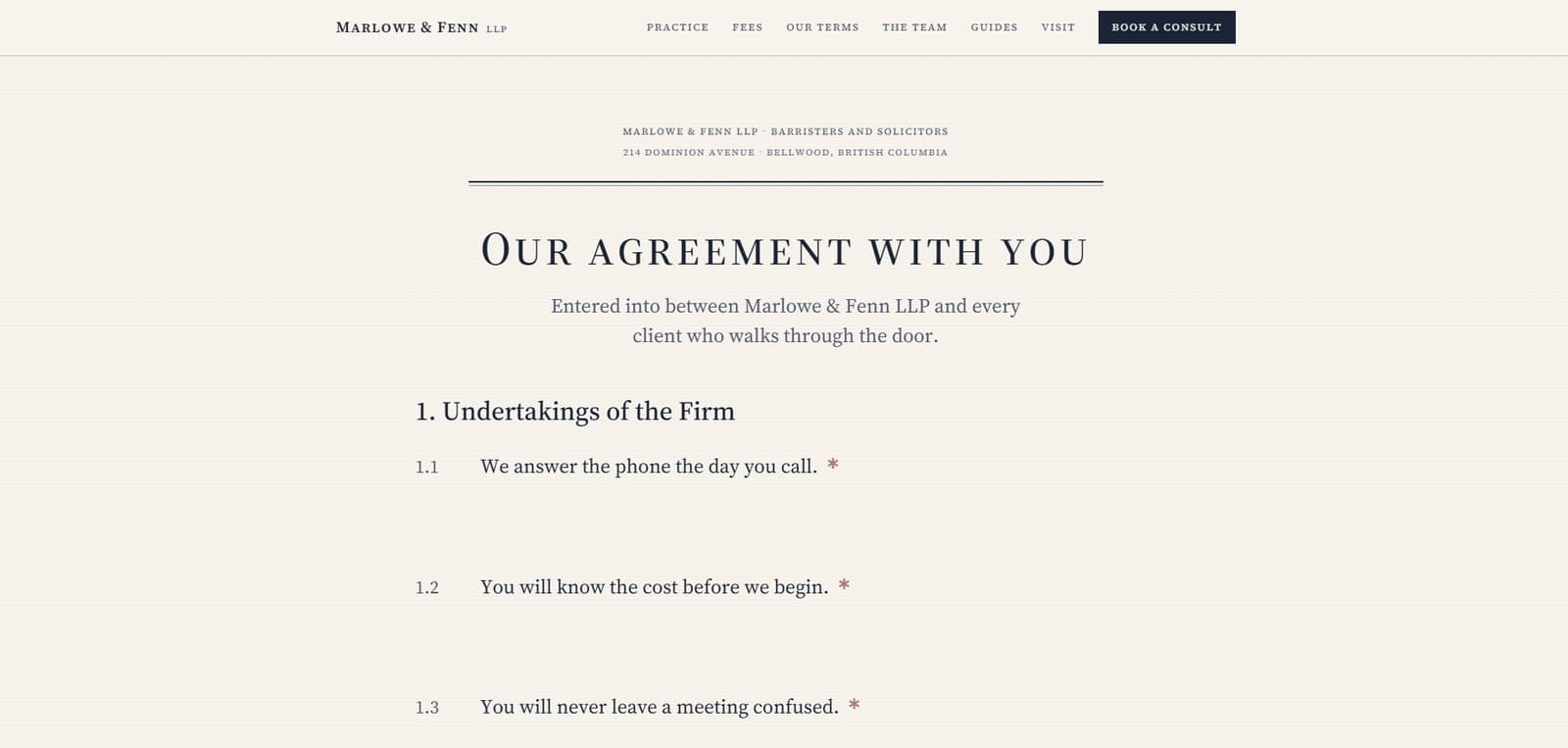
Marlowe & Fenn LLP is the fictional four-lawyer firm that proves the system end to end: a 31-URL build whose homepage is drafted as the firm's agreement with its clients, a public fee schedule annotated with what each number actually buys, six practice areas that state what happens next and what it costs, ten BC legal guides with facts verified against primary sources, and an oxblood Plain-English Margin that re-says the drafting in everyday words on touch.
- The Plain-English Margin
- Fees published up front
- Verified BC legal guides
- 31 sitemap URLs
Marlowe & Fenn LLP is a fictional concept build created to demonstrate the category. No real firm affiliation, client matters, case outcomes, or practice results should be implied, and nothing on the concept site creates a lawyer-client relationship.
What goes into a firm website that books consults
- 01
Positioning and client-fit clarity
Define exactly who the firm serves, which problems it solves best, what makes the approach stronger, and what kind of client should reach out. Specificity is the differentiator in a category where everyone claims to be experienced and trusted.
- 02
Practice and problem pages that name the decision
Pages built around the situations clients actually arrive with: the estate question a Nelson family brings in, the year-end mess a Cranbrook CPA untangles, the succession plan a financial advisor in Trail keeps getting asked about. Claims stay accurate and verifiable, with no guaranteed-outcome language, so the copy reads like judgement instead of advertising.
- 03
A proof and authority system
Bios, credentials, designations, process explainers, anonymized case patterns, testimonials where permitted, and insight articles that make judgement tangible. Authority content compounds in search and gives referrals something concrete to confirm.
- 04
Consult bookings and secure intake
Consult booking, referral, and contact paths that capture matter type, scope, timeline, and conflict-relevant detail, delivered over encrypted forms with a clear privacy notice. The firm gets better first conversations and the client gets a confident first impression.
- 05
Insight and resource library
A structured place for articles, FAQs, guides, and updates that answer the questions clients actually search, build trust over time, and position the firm as the clear authority in its niche and region.
The standard that comes with every build I ship.
- Positioning homepage that names the client and the matter
- Practice-area and problem pages written to advertising standards
- Bio, credentials, and proof structure that makes judgement legible
- Consult booking with an intake qualification gate
- PIPEDA-aware privacy notice and encrypted, consent-aware forms
- Insight, resource, and FAQ library with local SEO foundations
- WCAG 2.2 AA accessibility baseline

The unbillable cost of a site that reads like every other firm
None of this appears on a docket, which is exactly the problem. Each friction costs a prospective client their confidence and costs the firm hours nobody can bill.
Practice areas listed as a menu of services
Costs them
Someone carrying one specific problem, an estate, a year-end mess, a succession question, cannot tell whether you handle their exact situation, so they keep looking.
Costs you
Competing on hourly rate against every other firm in the category, because a list of services is the only thing you gave anyone to compare.
FixPages built around the situation the client actually arrives with, naming the decision, the process, and what happens next, with every claim accurate and verifiable.
Anyone can book a consult in two clicks
Costs them
The client with a real matter waits behind inquiries you were never able to take, and the first available slot is weeks out for no good reason.
Costs you
Hours nobody can bill, conflicts discovered after the meeting is already in the calendar, and rate shoppers occupying the time a live matter needed.
FixA short intake gate before the calendar opens: matter type, scope, timeline, and how they found you, captured over an encrypted form into a controlled inbox.
The contact form is a name and a message box
Costs them
They are asked to describe something sensitive into a blank field with no sign of where it lands or who reads it, so they write almost nothing.
Costs you
Confidential detail arriving in plain email, and first conversations that start from zero because the form asked for zero.
FixEncrypted intake that collects only what qualifies a matter, a plain-language privacy notice, and a named contact for privacy inquiries.
A referral lands on a page that says nothing
Costs them
They were told you were the right call, and the site gives them no way to confirm it, so a warm introduction goes cold overnight.
Costs you
Work you already earned that never books, and a referral source who slowly stops sending people your way.
FixBios, credentials, process explainers, and anonymized proof patterns, so a referred client confirms the recommendation in a minute instead of deferring the call.
Your expertise lives in your head and nowhere else
Costs them
They search the question at eleven at night and land on a national content mill instead of the practice two blocks from their office.
Costs you
Answering the same question free on the phone all year while search quietly hands the matter to a firm that wrote it down.
FixAn insight and FAQ library answering the questions clients actually search, structured for local search so it compounds while you bill hours.
The consult-booking and intake gate
A first consult is the most expensive thing a firm gives away. When anyone can book one with two sentences and a phone number, the calendar fills with matters you cannot take, conflicts you discover too late, and shoppers comparing hourly rates. The intake gate fixes the economics before the meeting ever gets booked.
I build consult bookings as a short, respectful qualification: matter type, scope, timeline, and how they found you, captured over an encrypted form and routed to a controlled inbox. Good-fit clients glide through in a minute. Poor-fit inquiries get a courteous redirect before they cost an hour nobody can bill. And referrals arrive at the consult already half-committed, because the intake read like the firm itself: precise, discreet, organized.
- Matter-type and scope questions that steer each inquiry to the right desk
- Timeline and conflict-relevant detail collected before the calendar opens
- Booking links that offer consult slots only after qualification
- A plain-language privacy notice, so discretion is visible from the first field
Advertising rules, privacy, and privilege, respected in the copy
A site in this category is judged on more than looks. These are the obligations and reassurances I build in by default, so the business stays credible and protected.

Professional advertising standards
Regulators set the bar for what a firm can claim. The Law Society of BC Code, Chapter 4, requires legal marketing to be true, accurate, and verifiable, and bars the title specialist unless authorized. CPABC Rule 217.1 prohibits misleading or deceptive advertising and ties advertised services to actual licence categories. I write copy that stays inside those lines and keep every claim defensible.
No misleading or guaranteed-outcome claims
Across the legal, accounting, and advisory professions, results cannot be promised and comparisons must be supportable. I frame proof through process, anonymized patterns, and honest credentials rather than outcome guarantees, so the site builds confidence without crossing a conduct rule.
Privacy and client confidentiality (PIPEDA)
Any contact form collecting personal information is subject to PIPEDA, with no small-business exemption. I build a plain-language privacy notice, name a contact for privacy inquiries, limit collection to what intake needs, and structure forms so sensitive detail is handled responsibly, supporting the confidentiality your profession already requires.
Secure intake and data handling
Inquiries often carry confidential matter details. Forms run over encrypted connections, submissions land in controlled inboxes rather than insecure channels, and if document upload or payment is ever added I build it to recognized security practice, including PCI DSS for card handling.
Accessibility to WCAG 2.2 AA
An accessible site is both an inclusion standard and a credibility signal for a trust-based firm. I build to WCAG 2.2 AA for contrast, keyboard navigation, structure, and screen-reader support, in step with where the Accessible British Columbia Act and the Accessible Canada Act are taking the standard.
Email consent and lawful follow-up (CASL)
Newsletters, client updates, and nurture emails fall under Canada anti-spam law. I set up forms and lists to capture proper consent, include sender identification and a working unsubscribe, and keep commercial messages compliant so authority-building outreach stays clean.
Want this standard on your site?
One conversation, no pitch deck. Tell me where the business is stuck and I will tell you what I would build.
30 of the 82 Accountants & bookkeeping on The Kootenay List have no website, as of September 3, 2026. The ones that do are the ones a customer can find.
What a build like this costs.
A focused presence site starts with the Trailhead: $2,000, or $500 today and $142 a month on Own It Monthly ($2,204 total). Plenty of businesses in this industry need exactly that and nothing more.
Bigger jobs usually land at $6,500, or $1,625 today and $457 a month on Own It Monthly ($7,109 total)
The Engine · typical timeline 4 to 5 weeks
A firm needs positioning, practice-area depth, proof, and a qualifying intake more than raw scale, and Engine ships all four with room to grow an insight library.
The honest answer depends on what you actually need, not on a package name. Start with the free check-up or the contact form, and I will book a proper 45-minute consultation with you, no pressure either way.
Comparing options right now? What a website should cost breaks down how to read any quote, and who actually owns your website covers what you keep if you ever leave, on any platform, including mine.
Directory profiles and firm templates does the plumbing. KMD wins the decision.
The market does not need another page of service bullet points. It needs a reason to believe this firm understands the problem more clearly than the alternatives, and the assurance that what they share will be handled properly.
A directory listing or a stock firm template gives serious expertise the same flat presentation as everyone else in the category. When a prospect is deciding who to trust with a sensitive matter, sameness is the problem. The site has to show judgement, not just availability.
What the category tool covers
- A profile, contact details, and a list of practice areas or services
- A basic bio, credentials, and a headshot
- A contact form or phone number for inquiries
- A presence in a searchable directory of similar firms
- A general, one-size-fits-all template layout
Where the upgrade actually pays off.
- 01
Stop sounding interchangeable: name the client and the matter you serve best
- 02
Make judgement visible with process and proof before the first call
- 03
Gate the consult calendar so intake filters by matter type, scope, and timeline
- 04
Give referrals a site that confirms the recommendation instead of diluting it
- 05
Build insight content that compounds in search while the firm bills hours
Where I would start.
- Custom websitesThe Engine is where most builds for this kind of business land, and every tier is priced on the page.
- The Brain, an AI knowledge basePrecedents, templates and the way your firm does things, organised so staff and AI tools can use them.
- The Survey, an AI and software assessmentPractice software overlaps fast, and The Survey sorts out what to keep, cancel or build.
Related guides.
- What to Expect When Working with a Web Designer
- Domain Names in Canada: .ca or .com, and Who Should Own It
- Business Email: Stop Using Gmail for Your Company
- What Are Claude Skills, and Should Your Business Care?
- AI Setup vs AI Operator: Which One Does Your Business Actually Need?
- My Website Was Hacked. What Now?
- Website Refresh vs Full Rebuild: How to Know Which One You Actually Need
- How to Show Up in ChatGPT and AI Search as a Small Business
- Google Ranking vs AI Answers: Two Different Fights
- What Actually Happens When Someone Googles Your Business Name
Questions firms ask before signing an engagement letter
Do you have an example of a law firm website?+
Yes. Marlowe & Fenn LLP is my full working law firm concept, clearly labelled as fictional: a homepage drafted as the firm's agreement with its clients, a public fee schedule, and margin marks that re-say the legal drafting in everyday words. The case study and live site are in my portfolio, so the standard is inspectable before any engagement.
How much does a professional services website cost in BC?+
Most law firm, accounting practice, and advisory sites I build in British Columbia land in my Engine package: $6,500, or $1,625 today and $457 a month on Own It Monthly ($7,109 total), live in 4 to 5 weeks. One scoped price agreed before work starts, the web equivalent of a fixed-fee engagement: no hourly surprises and no open-ended retainers. A smaller practice can start leaner and a multi-office firm scopes higher; I will say which applies before anything begins.
Can clients book a consult without phoning the office?+
Yes. I wire consult bookings straight into your calendar behind a short intake gate, so a client picks a slot only after matter type, scope, and timeline are captured. Good-fit clients book in a minute, poor-fit inquiries get a courteous redirect, and your front desk stops playing telephone tag.
Will the site stay inside my profession advertising rules?+
That is the baseline. I write to the standards your regulator sets, including the Law Society of BC Code, Chapter 4, for legal marketing and CPABC Rule 217.1 for accountants, which require claims to be accurate, verifiable, and not misleading. I avoid guaranteed-outcome language and restricted titles like specialist. I am not your compliance counsel, so final claims can be reviewed by you or your regulator, and I build the site to make that review easy.
Do professional services really need case studies?+
Usually, but they can be anonymized or framed as proof patterns when confidentiality applies. The goal is to make your judgement visible, the kind of problem, the approach, the result, without exposing client details or breaching privilege.
How does the site handle confidential inquiries?+
Intake forms run over encrypted connections, submissions land in a controlled inbox rather than plain email, and I limit what the form collects to what you actually need to qualify a matter. A clear privacy notice tells the client how their information is handled, which supports both PIPEDA and your own confidentiality obligations.
Can I send newsletters or client updates from the site?+
Yes, and I set it up to respect Canada anti-spam law. Forms capture proper consent, and every message identifies you and includes a working unsubscribe, so authority-building email stays compliant rather than becoming a liability.
What if I practise in more than one area or serve different client types?+
I structure the site so each practice area or audience gets a focused, well-positioned page rather than one muddled overview. That improves search visibility for each niche and lets a prospect immediately recognize that you handle exactly their situation.

Who builds this
I am Brett, the person behind Kootenay Made Digital. I plan, design, and build every site myself from Castlegar, BC, so the person you email is the person doing the work.
Founder, Kootenay Made Digital · Castlegar, BC
Ready when the next retainer is
Most firms land in the Engine build: positioning, proof, and a gated consult intake, live in four to five weeks, usually before the next referral goes looking.
No website yet?
Start My First WebsiteAlready have one?
Get a Free Check-Up