


 hello@kootenaymade.ca
 Castlegar, BC. Serving the Kootenays and beyond.
They have the photo. They have no idea what to call it, or what it costs.
Salon and barbershop websites for the client who does not know what to book yet.
I build salon and barbershop websites from Castlegar, BC for hair, barbering, nails, esthetics and spa studios. Booking software was solved a decade ago. Deciding was not. A price list with a ceiling, a look book, and a page per chair turn a nervous scroll into a booking that shows up.

The nerves that sit between a photo and a booking
I treat a salon site as the answer to a question the customer is embarrassed to ask. What is this called, what will it cost me, and can my hair even do it. So the price list carries a ceiling, the booking page names the service for them, each chair gets a page stating what that stylist does and does not take, and the look book lives on your own domain where search can read it. Your booking app keeps the calendar. The site wins the decision that fills it.
- 01
They arrive with a photo and no vocabulary
The reference picture is long hair, styled, under perfect light. The client does not know whether it is balayage, a full head of foils, or three visits away. A site that names it for them removes the exact fear that has kept the appointment unbooked for a month.
- 02
A starting-at price reads as a warning
A number that only goes up tells a careful person to wait. A ceiling does the opposite. Publish what a service can cost at the top and the visitor stops calculating risk and starts picking a day.
- 03
Loyalty attaches to the chair
Clients follow the person who cuts their hair, whatever the sign over the door says. A stylist page with their work, their specialities and a line about what they do not take converts better than any amount of copy about the salon, and it makes rebooking feel like a standing appointment.
- 04
The room matters before the service does
How loud it is, whether there is a step at the door, where to park, which days smell like colour, and whether anyone has to make conversation. Nobody publishes it and plenty of people decide on it.
- 05
Walk-ins are a search result now
A barbershop lives on people two blocks away asking their phone who is open. Accurate hours, an obvious address, and a booking link that works with a thumb is most of that battle, and it runs on a Google profile and a site that agree with each other.
Walk through Mica Hair Studio, the salon concept build.
Concept build from my portfolio, no real affiliation
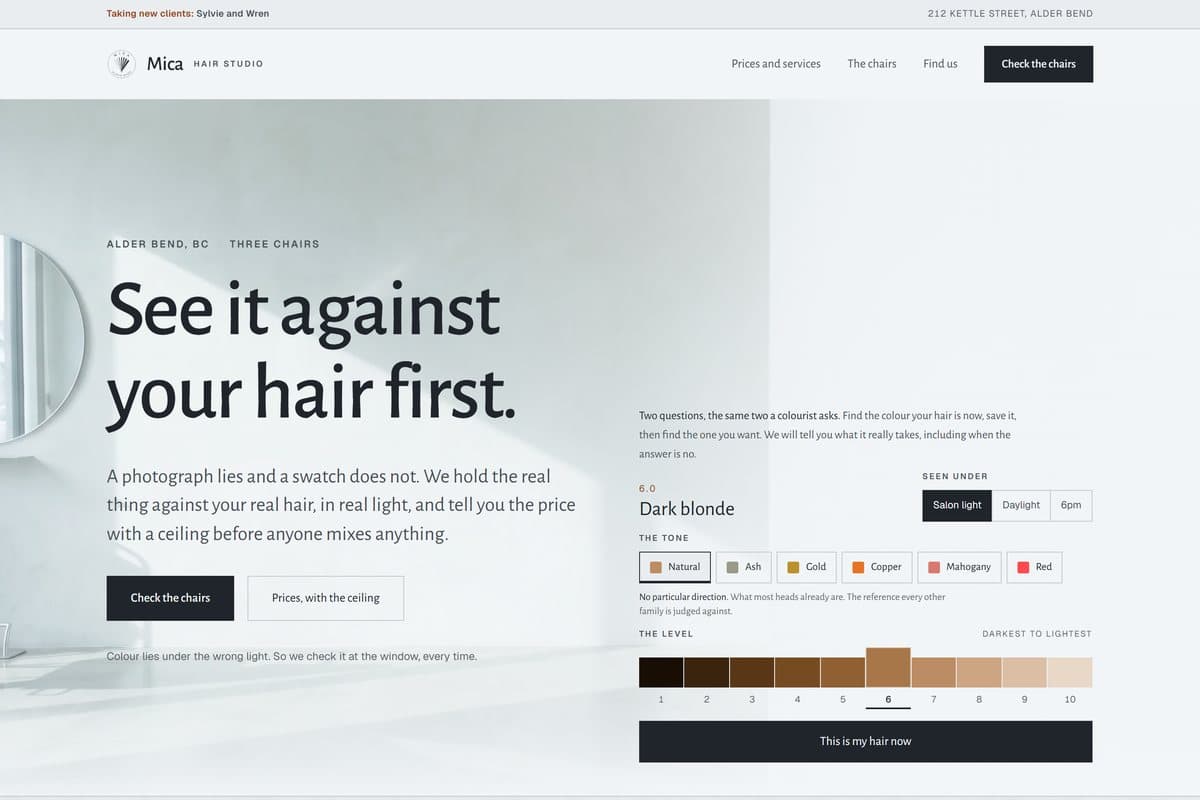
Mica Hair Studio is my labelled concept build for this category: a fictional three-chair salon that spends its whole effort on the hours before the booking. The homepage is a working swatch ring you can view under salon light, daylight, or six in the evening, because colour changes with the light you judge it in. Underneath sit prices with ceilings, a naming tool instead of a jargon menu, and a page per stylist stating what that stylist does not take.
- Trailhead concept build
- The swatch ring, seen under three lights
- Prices quoted to a ceiling, never a starting-at
- A page per chair, including the work that stylist does not take
- Access facts published: step-free entry, a measured 32-inch door
- Fictional salon and town, used to keep the showcase verifiable
Mica Hair Studio is a fictional concept build created to demonstrate the Trailhead package for the salon category. Alder Bend, BC does not exist, and neither do the stylists, the prices, or the policies. No real salon, stylist, client, or outcome should be implied. The build and the measurements are real.
The pages that fill a chair between regulars
- 01
The price list, with a ceiling on every line
Every service priced to a top number rather than a starting point, with the honest note about what moves it: length, thickness, how much colour is already in there. This is the page people share with a friend, and the one that ends the conversation at the till.
- 02
A page for every chair
Each stylist or barber gets a real page: the work, the specialities, whether they are taking new clients, how far out they book, and what they do not do. Saying no in public is the fastest trust move a specialist can make, and almost nobody in this trade makes it.
- 03
The look book, on your own domain
Your best work organised by service and hair type, compressed to load in a blink, captioned with what it took and how it grows out. Instagram can keep a copy. The originals belong somewhere a search engine can read them and an algorithm cannot bury them.
- 04
Walk-ins, hours, and the shop as a place
Where to park, how to get in, what the room sounds like, whether kids are welcome, and the real walk-in hours rather than the ones from three summers ago. Accurate hours on the site and the Google profile at once is quietly the highest-return work in this category.
- 05
Gift cards, retail, and the quiet months
Gift cards sold from the site through your existing processor, the products you actually stock, and a seasonal push written once and reused. January and November are decided in advance, and a site that can carry a promotion earns its cost in a single season.
The standard that comes with every build I ship.
- Service and price list quoted to a ceiling
- Describe-your-hair intake that names the service before booking
- A page per stylist or barber, with specialities and limits
- Look book organised by service and hair type
- Clean handoff into your existing booking app
- Walk-in hours, parking, access, and room facts
- Gift card and retail paths through your processor
- Spam-filtered forms, privacy policy, and CASL-ready email capture
- Accessibility to WCAG 2.2 AA, performance, and analytics baked in

What the unasked question costs a three-chair shop
Most of what a salon site leaves out gets paid for at the till, or in a chair that sat empty. Each row is the same friction seen from both sides, and the build decision that ends it.
Prices start at a number and stop nowhere
Costs them
A client cannot tell whether they are agreeing to $120 or $400, so they keep putting the appointment off.
Costs you
An awkward conversation at the till, and a filter that keeps only the least price-sensitive client.
FixA price list quoted to a ceiling, with what moves the number, so the total is agreed before anyone sits down.
The menu is written in the trade’s language
Costs them
Balayage, a root retouch, a gloss, a toner. A first-timer guesses, and often books the wrong service.
Costs you
The wrong block of time. Four hours of work rushed into two, or a chair held open for nothing.
FixA booking page that asks about their hair in plain words and names the service, the ceiling, and the visit count.
Nobody knows who does what
Costs them
They want the stylist who does curls or the barber who does a proper fade, and cannot tell them apart.
Costs you
Requests land on whoever is free, specialists get booked for work they do not enjoy, and rebooking suffers.
FixA page per chair: what that stylist does, what they do not take, whether they are taking new clients, how far out they book.
The look book lives on Instagram
Costs them
They scroll a grid on a platform that decides what they see, then lose the photo they wanted to show you.
Costs you
Your best work is rented to an app, and none of it shows up when somebody searches your town.
FixA look book on your own site, sorted by service and hair type, that a search engine can actually read.
Walk-ins have no idea if you are busy
Costs them
They drive over on a Saturday, see six people waiting, and get a haircut somewhere else.
Costs you
A door that swings on luck, and quiet Tuesdays nobody knew were quiet.
FixHonest walk-in hours, a live-ish wait note you control, and the online booking link on every page.
Booking that does not need a phone call
A first-time client will not phone. They read, decide, and either tap the button or close the tab. So the booking path starts before the calendar: the client describes their hair in ordinary words, the page names the service that actually fits, quotes it to a ceiling, and says how many visits it takes. Then it hands them to the app you already run, with the right service and the right stylist chosen for them.
Your calendar, deposits, reminders and rebooking stay exactly where they live now. What changes is who arrives: booked for the correct block of time, aware of the price, and no longer surprised three hours in. The phone goes back to being for the clients who prefer it.
- Describe-your-hair intake that names the service and the ceiling price
- A clean handoff into Square, Fresha, Booksy, Vagaro, or whatever you run
- The right stylist and the right block of time chosen before the booking
- Walk-in hours and the phone number one tap away on every page
Price honesty, gift cards, and client information
A site in this category is judged on more than looks. These are the obligations and reassurances I build in by default, so the business stays credible and protected.

Prices stated the way BC expects them
Advertised prices have to be reachable. A starting-at number that nobody ever pays is the construction the trade has been warned about for years. Quoting to a ceiling with the variables named keeps the page honest and takes the argument out of the till.
The gift card somebody redeems in July
Most gift cards in British Columbia cannot carry an expiry date, and the terms have to be disclosed clearly. I put the terms beside the buy button in plain language, so a card bought in December still works in July and nobody arrives holding a dead one.
Client information under PIPA
Booking notes, allergies, patch tests and photos are personal information, and British Columbia has its own privacy legislation covering them. Forms collect only what a purpose needs, and the privacy policy says in plain words what you keep and why.
Client photos and consent
A look book runs on other people’s faces and hair. I set up a simple written consent step for photos before they go on the site, and a way to pull an image down fast when somebody changes their mind.
What the December gift-card email needs
Canada’s Anti-Spam Legislation needs real, logged consent before a promotional send. Sign-up forms capture express consent, name the salon as the sender, and carry a working unsubscribe, so the December gift-card push lands safely.
Accessibility to WCAG 2.2 AA
The Accessible British Columbia Act keeps moving, and this is a category where access facts also sell. I build to WCAG 2.2 AA, with keyboard navigation, contrast, labelled booking forms, and alt text on every look-book image.
Want this standard on your site?
One conversation, no pitch deck. Tell me where the business is stuck and I will tell you what I would build.
35 of the 86 Spas & esthetics on The Kootenay List have no website, as of September 3, 2026. The ones that do are the ones a customer can find.
What a build like this costs.
Most builds here start at $2,000, or $500 today and $142 a month on Own It Monthly ($2,204 total)
The Trailhead · typical timeline 2 to 3 weeks
A salon needs three things live and correct: what you charge, who does it, and how to book. That is the Trailhead, and it is my starter tier, so there is no smaller step to point you at. Studios adding retail, memberships, or a page for each of several locations grow into the bigger tiers later.
The honest answer depends on what you actually need, not on a package name. Start with the free check-up or the contact form, and I will book a proper 45-minute consultation with you, no pressure either way.
Comparing options right now? What a website should cost breaks down how to read any quote, and who actually owns your website covers what you keep if you ever leave, on any platform, including mine.
Booking apps, and the grid on your phone does the plumbing. KMD wins the decision.
The app takes the booking that was already decided. The deciding happens somewhere else, usually at night, usually by somebody holding a photograph and hoping.
Square Appointments, Fresha, Booksy, Vagaro and GlossGenius run the calendar: online booking, deposits, reminders, retail and rebooking prompts. Instagram carries the look book. All of it is useful, and none of it is yours. A booking link cannot explain what a service costs, and a grid cannot tell a stranger whether their hair can get there.
What the booking app and the grid already handle
- Online booking, deposits, reminders, and no-show policies
- Client history, rebooking prompts, and gift-card sales
- Card processing and the retail till
- A photo grid the platform decides who sees
Where the upgrade actually pays off.
- 01
Quote every service to a ceiling and watch the price question stop arriving by direct message.
- 02
Name the service for a first-timer instead of handing them a jargon menu to guess from.
- 03
Give every chair its own page, including the work that stylist does not take.
- 04
Move the look book onto your own domain where search can read it and no algorithm buries it.
- 05
Publish the room facts, the parking, the noise, the step at the door, because plenty of people decide on those.
Where I would start.
- Custom websitesThe Trailhead is where most builds for this kind of business land, and every tier is priced on the page.
- The Survey, an AI and software assessmentBooking apps, card terminals and loyalty tools overlap, and The Survey sorts out which ones are worth paying for.
- The Signal, social media postingI turn the cuts and colour you already photograph into weekly posts, so new clients see the work before they book.
Related guides.
- A Salon or Barber Website That Books While You Cut
- Wix Pricing in Canada: Every Plan and Every Extra Fee (2026)
- Do I Need SEO Right Away, or Can It Wait?
- Squarespace Alternative for Small Businesses: When a Custom Site Wins
- Why a One-Page Website Is Sometimes Enough, and Sometimes a Trap
- Why Booking Friction Quietly Costs Local Service Businesses Money
- The Best Online Booking System for a Small Business in Canada
- Can AI Really Help a Small Business, or Is It Just Hype?
- Jane App Is Great for Booking. Your Clinic Website Is a Different Job.
- What a Great Website for a Kootenay Clinic or Wellness Business Needs
Asked from behind the chair
I already use a booking app. Why pay for a website?+
Because the app takes a booking that was already decided somewhere else. A booking link cannot show a price ceiling, introduce the stylist, or rank when somebody searches your town. The site does the deciding, then hands the client straight into the app you already run.
How much does a salon or barbershop website cost?+
Most salons land on the Trailhead: $2,000, or $500 today and 12 monthly payments of $142 on Own It Monthly, which is $2,204 all in, typically delivered in 2 to 3 weeks. That covers the price list, the chairs, the look book and the booking handoff. Multi-location studios and retail-heavy spas scope higher.
My salon is on Instagram and it works. Is that enough?+
It works until it does not. Instagram owns the audience, decides who sees a post, and disappears the moment a search happens instead of a scroll. Keep posting. Keep the look book, the prices and the booking path on something you own, and let the grid point at it.
Do I really have to publish prices?+
You have to publish a range with a ceiling, and it is the single highest-return decision in this category. A number that stops somewhere lets a careful person book. Hiding it filters your clientele down to whoever is least worried about money, which is a smaller room than it sounds.
What if a stylist leaves?+
Stylists live as data on my builds, so a chair changing hands is one edit rather than a redesign. You update the page yourself from a phone: new name, new specialities, new availability. Nobody has to email a designer because somebody moved shops in March.
Can it take deposits so people stop no-showing?+
Your booking app almost certainly already does deposits and reminders, and that is the right place for them. The site links straight into it and states the policy in plain words on the page, which is usually where the no-show problem actually starts.
Do barbershops need this, or is it a salon thing?+
Barbershops often need it more. On The Kootenay List, the register of 5,836 Kootenay businesses I built and maintain, 71 percent of the barbers listed have no website at all, and 84 percent of the nail salons do not either. In a category that busy, being the shop that answers first is a real advantage.
Who takes the photos?+
You do, and I will tell you exactly how. A phone by the window at the right time of day beats a hired session for a look book, because the work has to look like your work. I direct the shot list, the lighting and the crop, and I handle the compression so nothing loads slowly.
How long before it is live?+
Typically two to three weeks for a Trailhead build once I have your price list and photos, and you get a live preview link in the first week so you are watching it come together rather than waiting in the dark.

Who builds this
I am Brett, the person behind Kootenay Made Digital. I plan, design, and build every site myself from Castlegar, BC, so the person you email is the person doing the work.
Founder, Kootenay Made Digital · Castlegar, BC
Fill the chair without answering the phone
Every week somebody in your town searches for a colourist, a fade, or a fill, and books whoever answered the question first. Publish the prices, the chairs and the look book, and that answer is yours.
No website yet?
Start My First WebsiteAlready have one?
Get a Free Check-Up