

 hello@kootenaymade.ca
 Castlegar, BC. Serving the Kootenays and beyond.
 9 min read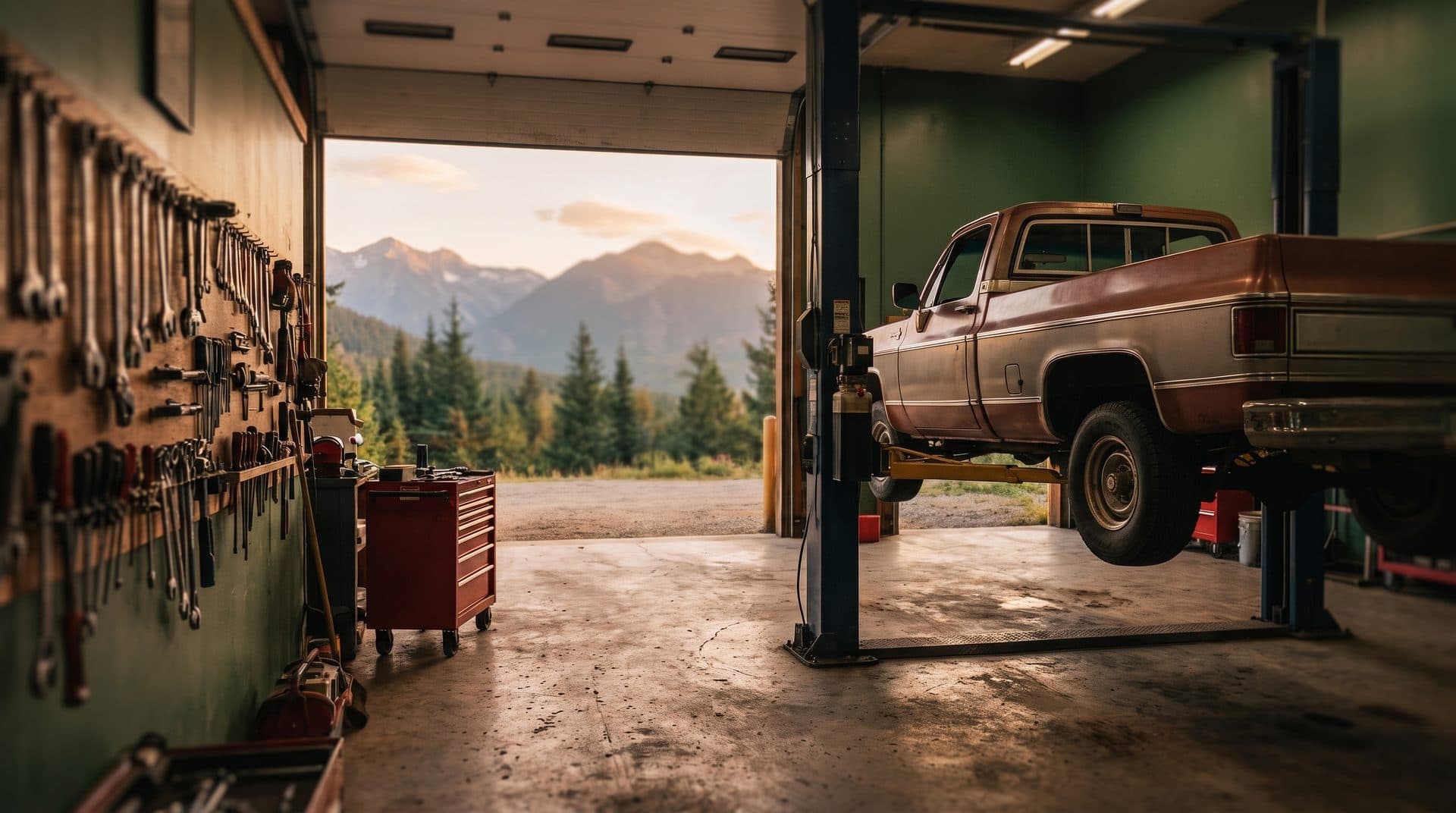
Key takeaways
- Publish the jobs you can price, the shop rate, and the diagnostic hour. It is the whole advantage over a chain.
- Show how a bill gets built, including the parts policy and a sample invoice a stranger can read.
- A booking request needs three things: vehicle, symptom, and two times that work.
- Real photographs of your bays and your driveway beat any stock image of a showroom.
- Put the changeover page up in September, because the calm bookings happen before the first snow.

On this page
What should an auto repair shop website include?
A shop website needs seven things: the jobs you can price with prices beside them, your shop rate and diagnostic hour, a one-sentence parts policy, a written estimate promise, a booking request that takes thirty seconds, real photographs of your bays, and a changeover page that goes up in September. Built that way, the call you get is a booking rather than a price hunt.
Nobody wants to phone a shop to find out what it costs. That one sentence explains most of what belongs on a garage website. The driver is not shopping for entertainment. They are protecting themselves against a bill that lands bigger than the conversation, because that has happened to them or to someone they know.
- The jobs you can price, priced. Oil and filter, brakes per axle, a changeover, an alignment, a pre-purchase inspection.
- Your shop rate and your diagnostic hour, with a line on whether the diagnostic fee comes off the repair bill.
- The parts policy in one sentence. At cost plus a named percentage reads better than the word fair.
- A written estimate promise: what you quote, when you call, and what happens if the job grows.
- A booking request that takes vehicle, symptom, and two workable times, with the phone number beside it.
- Real photographs of your bays, your crew, and the building from the road, so a first-timer knows the turn.
- A changeover page that goes live in September, with the deadline and the storage terms.

Why the price question decides who gets the call
Drivers arrive braced. They call three shops and treat every honest quote as an opening offer. A shop that publishes its rate skips the whole ritual, because the driver has already compared you and decided.
That suspicion costs a good shop twice. It costs the phone time your advisor spends quoting instead of booking. It costs the customer who never called at all, because your site gave them nothing to compare and the chain down the highway publishes numbers.
The fix is not a price list that ties your hands. Show the mechanics of how a bill gets built at your shop. Publish the rate and the diagnostic hour. Say whether diagnosis comes off the repair. Name the parts policy as a number rather than an adjective, and be straight about the jobs that need to be looked at first.
A franchise can copy your prices. It cannot copy a page that explains how your bill gets built.
The estimate promise, and why it belongs on the page
Consumer Protection BC says the automobile repair industry is not regulated in this province, with no governing body overseeing repair shops. It tells drivers to get a written quote and to ask the shop to call before the cost goes past it. That advice is a gift to any shop willing to publish the promise first.
Read what the province is telling your customer. Get it in writing. Ask to be contacted before the repair exceeds the quote. Those are the two sentences a careful shop already lives by, and almost nobody puts them on a website.
So put them there. Write the estimate and approval process in three plain sentences. Say that you photograph the problem before the work starts, because that habit ends most billing arguments before they begin. Then show a real itemized invoice with the names changed, so a stranger can read a whole bill before they ever receive one. A driver who has read your invoice format approves the extra hour by text instead of bracing for a phone call.
From a noise to a booked bay
The path from a strange sound to a scheduled appointment runs through six moments, and a shop website can win or lose at any of them. Most sites are absent for the first four and only turn up at the contact form.
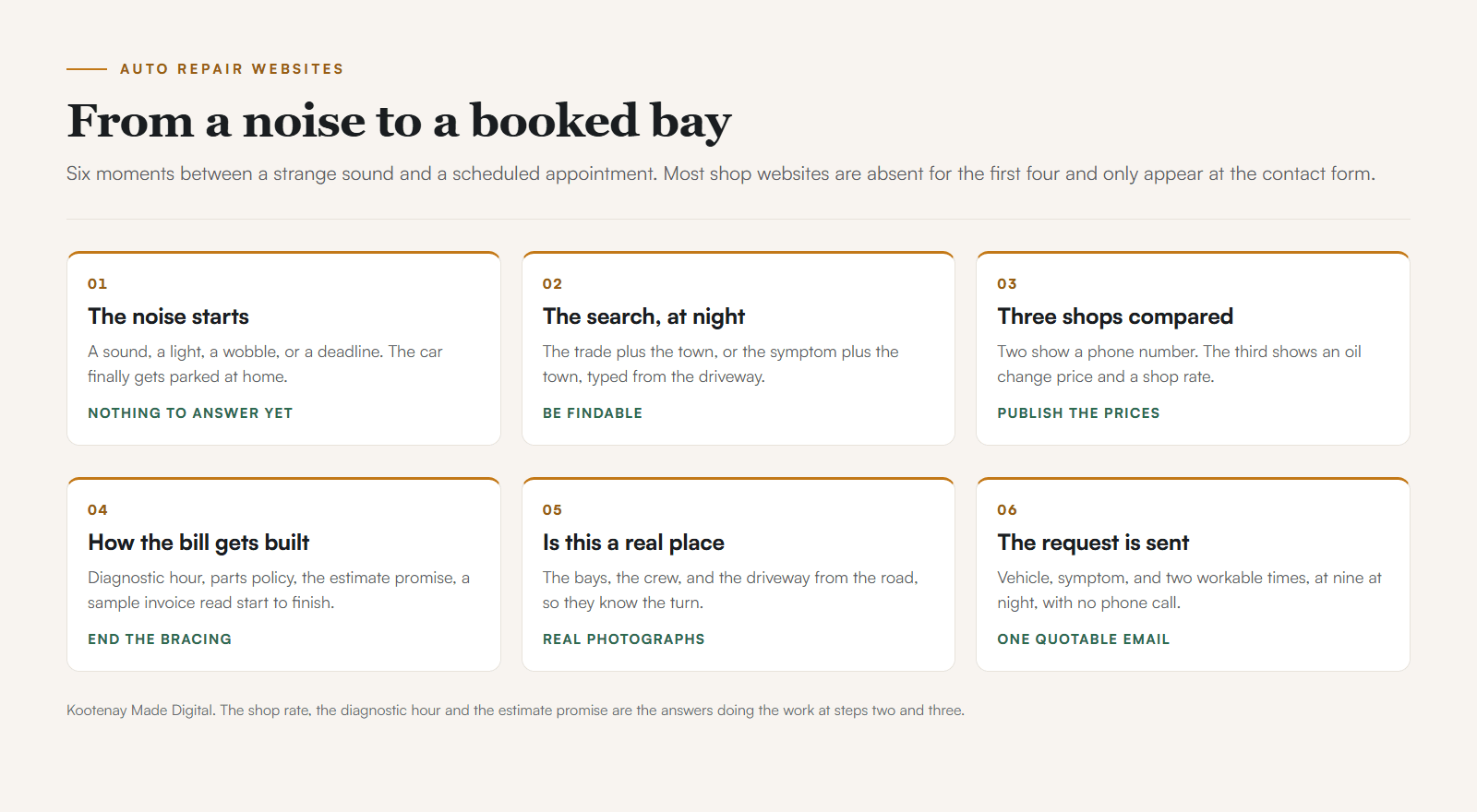
- 01A noise starts on the way home. The driver parks and searches the trade plus the town from the driveway, usually at night.
- 02Three shops come back. Two show a phone number and a stock photo. Yours shows an oil change price and a shop rate.
- 03They read what a diagnostic costs and whether it comes off the repair. This is where most shops lose the job.
- 04They check the bays and the crew in real photographs, then find the building from the road.
- 05They send the vehicle, the symptom, and two times that work, at nine at night, without picking up the phone.
- 06You open one email in the morning with enough in it to sequence the day.
Step four is the one shops underrate. A first-time customer wants to recognize the building when they pull in, so photograph the driveway from the road, the bay doors open, and the person who will meet them at the counter. My guide to photos that build trust covers what to shoot and what to skip.
What each page of a shop site owes a driver
A garage site does not need to be big. It needs a handful of pages that each do one job well, and every one of them has to load fast on two bars of signal in a parking lot.
- Home
- Which town, what you fix, and the shop rate inside the first screen. A driver holding a noise wants to know they are in the right place before they scroll.
- Services and prices
- The core jobs named the way a driver describes them, each with a price or an honest range. Grinding when braking, shakes at highway speed, check engine light on.
- How a bill gets built
- The shop rate, the diagnostic hour, the parts markup, the approval steps, and a sample invoice a stranger can read start to finish.
- Book a bay
- Vehicle, symptom, two times that work. A form that asks for a VIN and an account before it asks what is wrong loses the after-hours booking.
- The shop
- Photographs of the bays, the lift, the crew, and the driveway from the road. Skip the gleaming showroom nobody in your town has ever seen.
- Changeover and seasons
- Winter tire dates, storage terms, pass conditions, and cold-start work. Live in September, quiet in June, and yours to edit.
Notice what the services page is doing. Almost nobody searches for auto repair. They search the symptom and the town, or the job and a price, or the season and a deadline. A page that names the noise, says what it usually means, and gives a range answers all three. That is the same discipline behind my auto repair website design work, and it is why service pages bring better leads than a bulleted list of nouns.
Changeover season decides your whole year
In this region the calendar drives the phone, and the winter tire deadline is the loudest date on it. The province requires winter tires or chains on most routes from October 1 to April 30. On select highways outside mountain passes and high-snowfall areas, the requirement ends March 31.
Highway 3 over the Kootenay Pass, the Salmo hill, the Bonnington stretch between Castlegar and Nelson, the climb out of Trail: those are the drives sitting in the back of a driver's mind in late September. A page that names the deadline, states the storage terms, and opens bookings early moves the rush out of two frantic weeks and across a whole month.
The same rhythm runs the rest of the year. Pass conditions in January, road salt in February, cold-start work at minus twenty, and pre-trip inspections before road season. A site that speaks to the month it actually is reads as a local shop rather than a template with a town name dropped in.
Where independent shops stand in the Kootenays
Being findable is still an advantage in this trade rather than a baseline. Plenty of good shops in Castlegar, Trail, Cranbrook, and Nelson run on reputation with nothing a stranger can check.
On The Kootenay List, the register of Kootenay businesses I built and maintain, 57 of the 104 mechanics & auto repair listed have no website at all, as of September 3, 2026. The breakdown by town and trade sits in the Kootenay business web census.
More than half the trade is invisible to a driver searching from a parking lot, so the shop that publishes a rate and a booking form is competing against silence. It also means drivers here have been trained to expect nothing, which makes the first page that answers them properly memorable. Trail sits near the bottom of the region for how many of its businesses have a site at all, and the web design in Trail page carries that town's numbers.
Five mistakes I see on shop websites
None of these are design problems. They are decisions about what to say and what to leave out, and each one costs bookings quietly enough that nobody notices.
- 01
Every price hidden behind a phone call
A driver comparing three shops reads silence as the expensive option. They call anyway to be sure, and it costs your advisor an hour to quote an oil change.
- 02
A form that wants a VIN before a symptom
Long forms are built for the shop. Vehicle, symptom, and two times is all you need to sequence a day. The rest can wait for the conversation.
- 03
Stock photos of a shop that is not yours
A polished bay with a European sedan on the lift reads as a stock library to anyone who has driven past your building. Photograph your own bay, on an ordinary day, and the people driving past recognize it.
- 04
Hours that disagree with the Google listing
Two different sets of hours is the fastest way to look closed. Pick the true one, put it in both places, and change both when the season turns.
- 05
A changeover page that appears in October
By the first snow on the Bonnington hill the calm bookings are gone. September pricing and open dates spread the rush across a month.
The hours mistake is the cheapest to fix and the most expensive to leave. My Google Business Profile guide for Kootenay businesses walks through getting the listing and the site to agree.
What a shop website costs, and where to start
Most independent shops need three pages that work hard: what you fix and what it costs, who you are, and how to book. That is a Trailhead build at $2,000, typically delivered in 2 to 3 weeks.
Shops running fleet accounts, a tire storage program, or more than one location land nearer the Engine at $6,500, which carries a page for every town you serve. The Own It Monthly plan spreads the Trailhead: $2,000 once, or $500 today and 12 monthly payments of $142, which is $2,204 all in and yours outright at the final payment. Kootenay businesses get the 10% neighbours discount off any build. What you pay depends on what the shop actually needs, not on a package name.
- 01Write down the ten jobs you quote most often and put a price or an honest range beside each one.
- 02Publish the shop rate and the diagnostic hour, and say whether the diagnostic fee comes off the repair bill.
- 03Write your estimate and approval process in three sentences, and say that you photograph the problem first.
- 04Shoot the bays, the crew, and the driveway from the road on a phone, in daylight, and lead with those.
- 05Build a booking request that asks for vehicle, symptom, and two times, with the number tappable everywhere.
- 06Put the changeover page up in September with the deadline, the storage terms, and open bookings.
- 07Match your hours and services to your Google Business Profile so the map and the site agree.
If you already have a site, the free website check-up reads it and names the missing steps. If there is no site yet, start with an auto repair website built for you. Either way, somebody in your town is comparing three shops right now with winter coming and a noise they do not like.
Sources and further reading
- Consumer Protection BC: automobile repairs
States that the automobile repair industry is not regulated in BC, with no governing body overseeing repair shops, and tells drivers to get a written quote and ask to be called before costs exceed it. Read September 2026.
- Province of BC: designated winter tire and chain routes
The province requires winter tires or chains on most routes from October 1 to April 30, ending March 31 on select highways outside mountain passes and high-snowfall areas. Read September 2026.
- Google Business Profile help: edit your business hours
How to keep regular and special hours current, so the map listing and the shop website never disagree about whether the bays are open.
- Google Search Central: SEO starter guide
Google on titles, headings, and useful content. A services page written the way drivers describe their problem is the version both people and search understand.
Frequently asked questions
Should an auto repair shop really publish prices?
For the jobs you can price, yes, and it is the biggest advantage an independent shop has over a chain. Publish the flat jobs, the shop rate, and the diagnostic hour, then say straight out that some work needs eyes on it first. The phone starts ringing to book rather than to ask.
Will publishing my shop rate get me undercut?
The driver who picks purely on the lowest number was never going to be a good customer, and the chains already publish. What you win is the larger group who are afraid of being taken advantage of, and who choose the shop that behaved openly before they called.
What pages does a garage website need?
Home, a services and prices page, a page explaining how a bill gets built, a booking request, a page of real shop photos, and a seasonal changeover page. Fleet and account work gets its own path when you serve business customers.
Can drivers book a bay online?
Yes, and I keep it simple. Vehicle, symptom, and two times that work, sent straight to you. Calendar sync is possible where your shop system supports it, though a clean request form usually converts better, because the advisor still gets to sequence the day.
Does the website replace Mitchell 1, Tekmetric, or Shop-Ware?
No. The website sits in front of whatever you run and hands work to it. Booking requests route into your existing intake, and where a system offers a real integration path I will use it. Nobody gets moved off software their team already knows.
How much does an auto repair shop website cost?
Most independent shops fit the Trailhead at $2,000, typically delivered in 2 to 3 weeks, with a 12-month payment plan available. Shops running fleet accounts, tire storage, or several locations land nearer the Engine at $6,500. Kootenay businesses get the 10% neighbours discount off any build.
I have run on word of mouth for twenty years. Do I need this?
Word of mouth still works, and a website makes it work harder. When someone recommends you at a barbecue, the next thing that happens is a phone search, and what the stranger finds decides whether the recommendation turns into a booking.
Related pages
- Auto repair and tire shop websites
- Trades and contractor websites
- Web design in Castlegar
- Web design in Trail
Kootenay Made Digital
I build websites, local presence, and calm AI setups for Kootenay small businesses. Plain language, published prices, and clear work that makes you easier to find and easier to choose.