

 hello@kootenaymade.ca
 Castlegar, BC. Serving the Kootenays and beyond.
 9 min read
Key takeaways
- Most businesses that want growth, trust, search visibility, or better leads need an owned website sooner than they think.
- Some businesses can wait, especially if they are fully booked, testing an offer, or only need a clean public listing for now.
- Social media is discovery, Google Business Profile is local visibility, and the website is the owned decision point.
- The minimum useful site is small: clear first screen, service detail, real proof, local facts, mobile contact, and Google alignment.
- Build the smallest trustworthy version first, not a giant site that delays the day customers can choose you.

On this page
Do small businesses still need a website in 2026?
Yes for most growing local businesses, but not for every business in every moment. A website earns its keep by making you easier to find, understand, trust, and contact. If customers need more than hours, photos, reviews, and a phone number, social media and a Google profile are probably not enough on their own.
Instagram, Facebook, TikTok, Google Business Profile, marketplace listings, and word of mouth all matter. Around the Kootenays, plenty of businesses get real traction from community groups, referrals, and familiar names. The mistake is assuming those channels can do every job. As of September 3, 2026, 2,527 of the 5,836 businesses on The Kootenay List have no website at all.
That regional number hides a wide spread between towns. In the same snapshot, 483 of Cranbrook’s 1,027 businesses have no site, close to half the town. Fernie runs the other way, with 76 percent of its 400 businesses online. In Fernie, being the one without a website makes you conspicuous. In Cranbrook it is still ordinary, which buys you time and takes away your excuse at the same time.
They cannot. Some channels create attention. Some verify public facts. Some keep existing customers warm. A website does a different job: it gives the business one controlled place where a stranger can slow down, compare, trust, and take the next step without being dragged through a feed.
A website should not be a vanity purchase. It should do the decision work the other channels cannot.
When is social media or Google Business Profile enough?
Social media and a Google profile can be enough when demand is already full, the offer is still changing, and customers only need a few public facts. That is not failure, it is sequencing. The moment strangers start comparing you online or the same questions keep repeating, the math changes and a site usually costs less than not having one.
If several lines below are true, you can reasonably clean up Google Business Profile, post consistently, gather reviews, and wait on a website for now.
- You are fully booked through referrals and do not want more demand yet.
- The business is a temporary test, pop-up, hobby, or early offer that may still change.
- A marketplace already handles trust, payment, fulfillment, and customer support for now.
- Customers only need hours, address, phone, and reviews, and your Google profile is complete.
- The budget is better spent on photos, pricing, signage, or the offer before a website project.
But once any of these become true, a profile-only presence starts leaking customers who were ready to choose you.
- Customers compare you to other businesses before they call, book, visit, or request a quote.
- People ask the same questions repeatedly because posts and profile fields do not explain enough.
- You need local search visibility for services, towns, products, or seasonal offers.
- The offer needs proof: before and after photos, menus, project examples, credentials, or FAQs.
- You depend on one platform for reach and would be exposed if the account or algorithm changed.

Website vs social media and Google Business Profile: which do you need?
A website is owned space you control; social media and Google Business Profile are rented space inside someone else's system. Rented channels are excellent for discovery and local visibility. An owned website is where you explain offers, show proof, control the buying path, and build a durable hub Google can fully understand.
| What is being compared | Social and Google profile | Owned website |
|---|---|---|
| Who controls it | The platform sets reach and rules | You own the domain and the experience |
| Primary job | Discovery and local visibility | Explain, prove, and convert |
| Detail it can hold | Hours, photos, reviews, short posts | Services, pricing, proof, FAQs, policies |
| Search visibility | Limited crawlable context | Crawlable pages, titles, and structured data |
| Buying path | Surrounded by feeds and competitors | One clean path with only your story |
| Stability | Reach and access can change overnight | A durable record you can rely on |
| KMD fit | Keep both current alongside the site | Trailhead presence site, $2,000 |
This is not website versus social. The right setup uses all three. The question is which job each channel should do, and whether your customers need a stable place to decide that only an owned site can provide. If budget is the worry, my guide to what a website should cost shows how to read a quote without feeling out of your depth.
What does each channel actually do well?
Each channel has a different job. Social media gets attention and shows personality. Google Business Profile makes you visible in local Search and Maps. The website turns that attention into confidence and action. Word of mouth still sends people online to verify you. The sane version is a clear division of labour, not one channel doing everything.
- Social media
- Discovery and personality. Great for showing life, new work, and reminders, but the platform controls reach and important details get buried in the feed.
- Google Business Profile
- Local visibility. Shows hours, reviews, photos, and directions in Search and Maps, but it cannot fully explain offers or control the buying path.
- Owned website
- The decision point. One stable place you control where a stranger can slow down, compare, trust, and take the next step without algorithm noise.
- Word of mouth
- Referral trust. Powerful in the Kootenays, but new customers still go online to verify you before they commit.
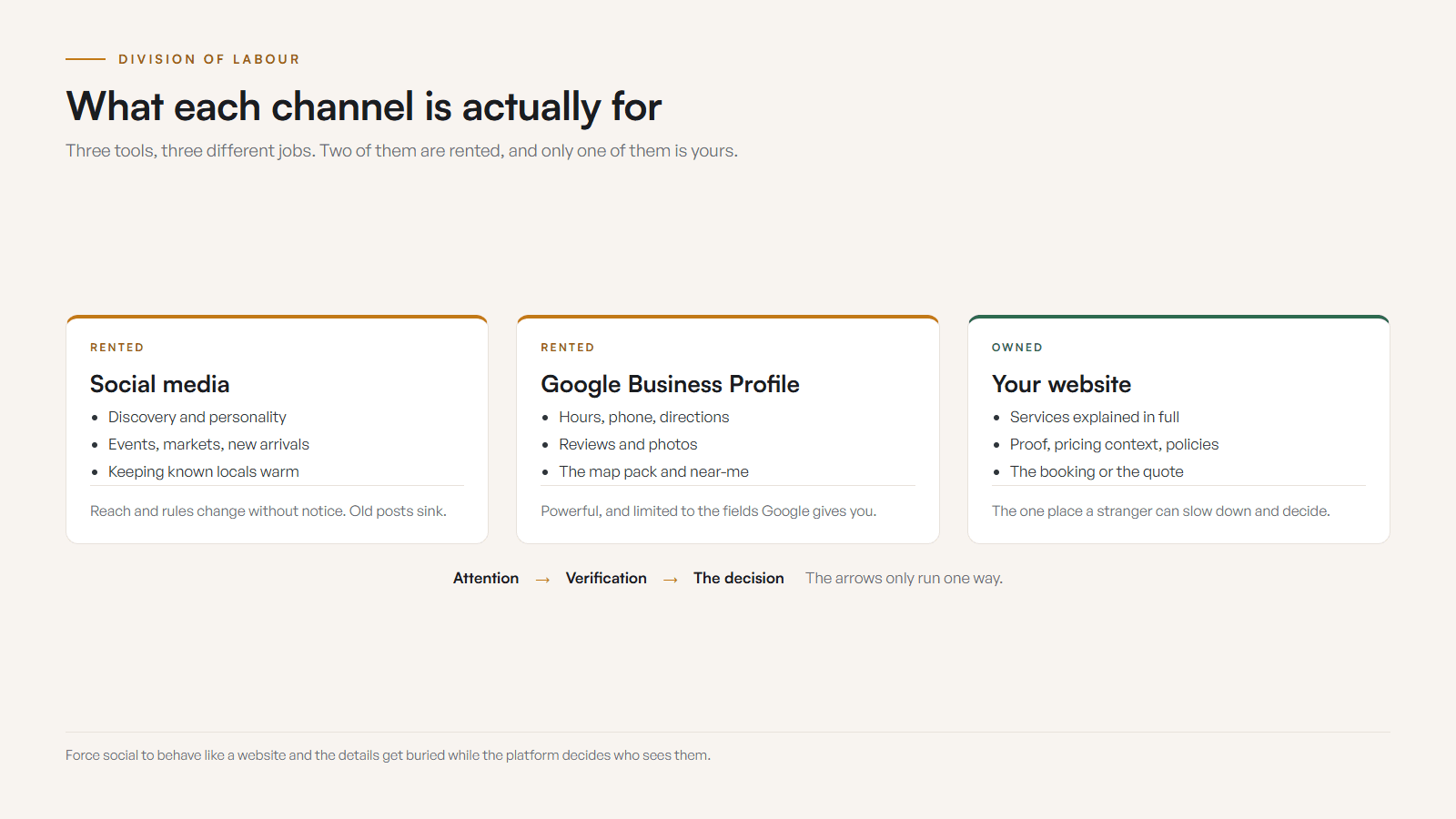
Use social to get attention. Use Google Business Profile to show up locally. Use the website to turn that attention into confidence. When you force social to behave like a website, important details get buried, old posts linger, and the platform decides how much reach you get.
What is the minimum useful website a local business needs?
The minimum useful website is not huge. It needs a clear first screen, real service detail, honest proof, current local facts, a working mobile contact path, and alignment with your Google profile. Those six pieces answer the questions that block action. Everything else can wait until the trust path works.
- 01
A clear first screen
Say what you do, who it is for, where you work, and what to do next before the visitor has to scroll far.
- 02
Service or offer detail
Name the services, products, rooms, treatments, or project types with enough detail to remove basic uncertainty.
- 03
Real proof
Use reviews, photos, credentials, project examples, team presence, or before and after results customers can verify.
- 04
A mobile contact path
Make call, quote, book, reserve, order, or get directions easy from a phone, with readable text and usable buttons.
- 05
Local business facts
Keep hours, address, service area, phone, parking, and seasonal changes aligned with your Google profile.
- 06
Simple measurement
Track calls, forms, booking clicks, direction clicks, and quote requests so you know which pages create action.
Many owners hear website and picture ten pages, a blog calendar, a portal, a chatbot, and a committee arguing over button colours. That is not the right starting point. If one page can make you easy to trust and easy to contact, start with one page. If you have multiple services, towns, or buyer types, a focused multi-page site usually makes more sense. My one-page website guide walks through where the line sits.
What does a useful website look like by Kootenay business type?
Different local businesses need different proof before a customer is willing to move. Town names alone do not make a site useful. The website has to answer the local buying moment: service area, drive time, seasonal hours, availability, policies, and proof that the business is active right now.
- Contractors and trades
- Castlegar roofers, Trail electricians, and Nelson landscapers need service areas, project photos, quote expectations, warranty context, and seasonal booking notes. A Facebook page rarely carries enough proof.
- Restaurants and cafes
- Menus, hours, patio status, online ordering, dietary details, reservations, parking, and current food photos need one dependable place that stays true.
- Tourism and accommodation
- Cabins, guides, and Kootenay Lake stops need availability, policies, drive time, ferry or highway context, weather notes, and real seasonal photos before travellers choose.
- Clinics and wellness
- Counsellors, massage therapists, and studios need practitioner bios, service fit, privacy comfort, booking rules, accessibility details, and contact expectations.
- Retail and local makers
- Nelson shops, Creston farm stands, and Castlegar makers need products, pickup, shipping, market schedules, return clarity, and local-made proof.
Local does not mean simple. A Nelson visitor choosing dinner, a Trail homeowner needing an emergency repair, and a Kootenay Lake traveller planning a route all need different proof. The owned site is where those local details live in one dependable place that strengthens your social channels and Google profile rather than competing with them.
How do I decide whether to wait or invest now?
You can usually decide in an afternoon. Audit your current public presence for mismatches, write your minimum website promise, gather the launch assets, and choose a path. Wait if demand is full or the offer is still changing weekly. Invest now if customers compare you, ask repeated questions, or growth depends on search and trust.
- 01Open Google, Instagram, Facebook, and your current site, then list every mismatch in hours, phone, services, links, and photos.
- 02Write the minimum website promise: what you do, who it is for, where you work, your strongest proof, your main action, and the top five questions customers ask.
- 03Gather launch assets: logo, real photos, reviews, service details, price context, service area, map link, booking link, and contact details.
- 04Decide the path: profile-only for now, a one-page site, a focused five-page site, or a deeper growth system.
- 05Park everything that does not help the first useful version go live.
If budget is tight, do not start with the dream site. Start with the trust path: a clean homepage, one strong offer page, proof, real photos, accurate business facts, and a working mobile contact path. That can outperform a larger but unfinished site. A Trailhead presence site is $2,000 once, or $500 today and 12 monthly payments of $142, $2,204 all in on the Own It Monthly plan if paying over the year is easier. Blog libraries, deep SEO campaigns, automation, and portals can compound later. When you want the honest read on which path fits, the free check-up is the fastest place to start, and my services page shows the ladder from a presence site to a full growth build.
Sources and further reading
- Google Search Central: SEO Starter Guide
Google rewards clear, helpful content, descriptive titles, and logical links. A social profile alone cannot carry that full site structure.
- Google Business Profile help
Covers keeping business information, services, hours, and photos current. Your website should support and match that public record.
- Google Search Central: page experience
Frames helpful content, Core Web Vitals, HTTPS, and mobile usability. Those basics belong on the owned site you control.
- WCAG 2.2 quick reference
Readable contrast, headings, labels, and usable forms help more customers finish the action they came for.
Frequently asked questions
Do small businesses still need a website in 2026?
Most small businesses that want steady growth, trust, search visibility, and lead control should have a website in 2026. Some can wait, especially if they are fully booked through referrals or only need a basic Google profile for now. The deciding question is whether customers need more than social media and a profile can reliably provide.
When is social media enough for a business?
Social media can be enough when the business is very small, not trying to grow, already full through referrals, or selling through a platform that handles the transaction. It is less safe when customers need service details, prices, booking, proof, or local search visibility to choose you.
Is Google Business Profile enough without a website?
Google Business Profile is essential for local discovery, but it is not a full website replacement. It can show hours, reviews, photos, and directions. It cannot fully explain offers, answer complex questions, show detailed proof, or give the business a durable owned hub you control.
What is the minimum website a local business needs?
The minimum useful website explains what you do, who you help, where you work, why people should trust you, and the next step. For many Kootenay businesses that means a focused homepage, one strong offer page, proof, photos, contact details, Google alignment, and a clean mobile experience.
Can a one-page website be enough?
Yes, a one-page website can be enough when the offer is simple, there is one primary action, and the page answers the key trust questions. It becomes limiting when there are multiple services, towns, buyer types, complex pricing, or SEO goals that each need their own focused page.
Does a website help with local SEO?
Yes, when it is structured properly. A website gives Google crawlable pages, titles, service details, location context, internal links, and structured data. A weak site will not magically rank. Having no owned site usually limits what Google can understand about your business.
Related pages
- Farm and agriculture websites
- Auto repair and tire shop websites
- Web design across the West Kootenay
- Why a Facebook Page Is Not a Website for a Growing Business
- What a Small Local Business Actually Needs Online First
- What Pages Should a Small Business Website Have?
Kootenay Made Digital
I build websites, local presence, and calm AI setups for Kootenay small businesses. Plain language, published prices, and clear work that makes you easier to find and easier to choose.