


 hello@kootenaymade.ca
 Castlegar, BC. Serving the Kootenays and beyond.
Harkness Auto & Tire
A garage site where the price is posted and the bill matches it.
10
Jobs priced on the page
20
Guides answering driver questions
5
Community pages around the shop
72
Frames in the year-long hero
People brace themselves before they call a repair shop.
The bill is a surprise by default.
Drivers often find out the cost after the work is done, and a shop site with no numbers on it keeps it that way.
And it costs the businessThe shop takes price calls mid-job, loses the driver who wanted a number before calling, and ends up arguing over the bill at pickup.
Honesty is easy to claim.
Honest and reliable are easy words to put on a homepage, and a stranger has no way to test them.
And it costs the businessWithout proof a driver can check, an independent shop ends up competing on price against chains built for volume.
Drivers describe what the car is doing.
They notice a grind when braking or a pull to one side. A price list written in job names leaves them guessing which job they need.
And it costs the businessEach of those drivers has to phone to find out what the problem might cost, and the counter stops to take the call.
Built to show the number before the wrench comes out.
Numbers on the wall.
Ten common jobs carry a from-price, the book hours and the parts rule, with the shop rate posted beside them.
Symptoms turn into an estimate.
Pick what the vehicle is doing and the work order fills in with the same lines the counter would quote.
Photos before any work.
A sample inspection report shows a photo of each problem, the price worked out in the open, and a yes or not today on every line.
A page for every road in.
Five community pages tie each road's wear to the posted prices, and 20 guides answer what drivers search before they call.
A warranty put in writing.
The shop page sets BC's rules beside Ontario's and the shop's own written warranty, so a driver sees what is promised beyond the law.
The thinking behind the build
Harkness Auto & Tire is a concept build: a fictional two-bay garage in the invented town of Coppervale, BC, opened in the story by Del Harkness in 1987 and run now by his daughter Rae. It is built as the Trailhead, Full Coverage, so it shows both halves of that package: an entry-level site that carries a real idea, and the community pages and guides that get it found across a valley. The idea is that a driver approves a number before any work starts, and the bill matches it.
Auto repair carries a familiar fear: the bill that arrives bigger than expected. A garage website that hides its numbers behind a phone call leaves that fear in place. Harkness is a fictional shop, labelled as a concept everywhere it appears, built on the scope a real Trailhead, Full Coverage client gets: the Trailhead's core pages, a page for every community the shop serves, and 20 guides. The question it answers is what a modest site can do for a trade that runs on trust, and how far it reaches once each town and each common question has a page of its own.
The concept came from the counter. A garage already runs on objects people trust: the posted rate, the work order and the sign out front. So the site uses them. Prices sit on a board, the estimate arrives as a work order, and three standing deals hang as signs a visitor lifts to read the terms. The palette is enamel-sign navy and cream, and the type is heavy and industrial.
People do not phone about brake service per axle. They say it grinds when they stop. So the services page lists eight symptoms in a driver's own words, from a check engine light to a climbing temperature gauge, and each one writes its likely lines onto a work order at the posted prices. The symptoms and the vehicle carry into the booking form, so the request arrives with its estimate already written.
Trust comes from things a driver can check. The homepage promises photos before any work, so the site shows the report a driver would get: a photo and a measurement for each finding, the price worked out from book hours and the parts rule, and a choice on every line. Work order No. 4187 walks through one finished brake job, and the shop page sets BC's rules beside Ontario's and the shop's own written warranty.
Full Coverage is where the site reaches past its own town. Each of the five communities around Coppervale gets a page written from its own road: the gravel of a Forest Service Road, the long grade off a mountain pass, a ferry lineup on a cold morning. Each page ties those roads to the posted prices, the right guides and a booking that already says where the driver is coming from. The 20 guides answer what drivers type before they call, from BC's winter tire dates to whether servicing away from the dealer affects a warranty.
The site also works for the shop. The changeover picker spreads tire season by showing which weeks are quiet, and every booking arrives with the vehicle, the symptoms and the week filled in. A demo page shows the shop's side: what lands on the counter, and the calls the site now answers.
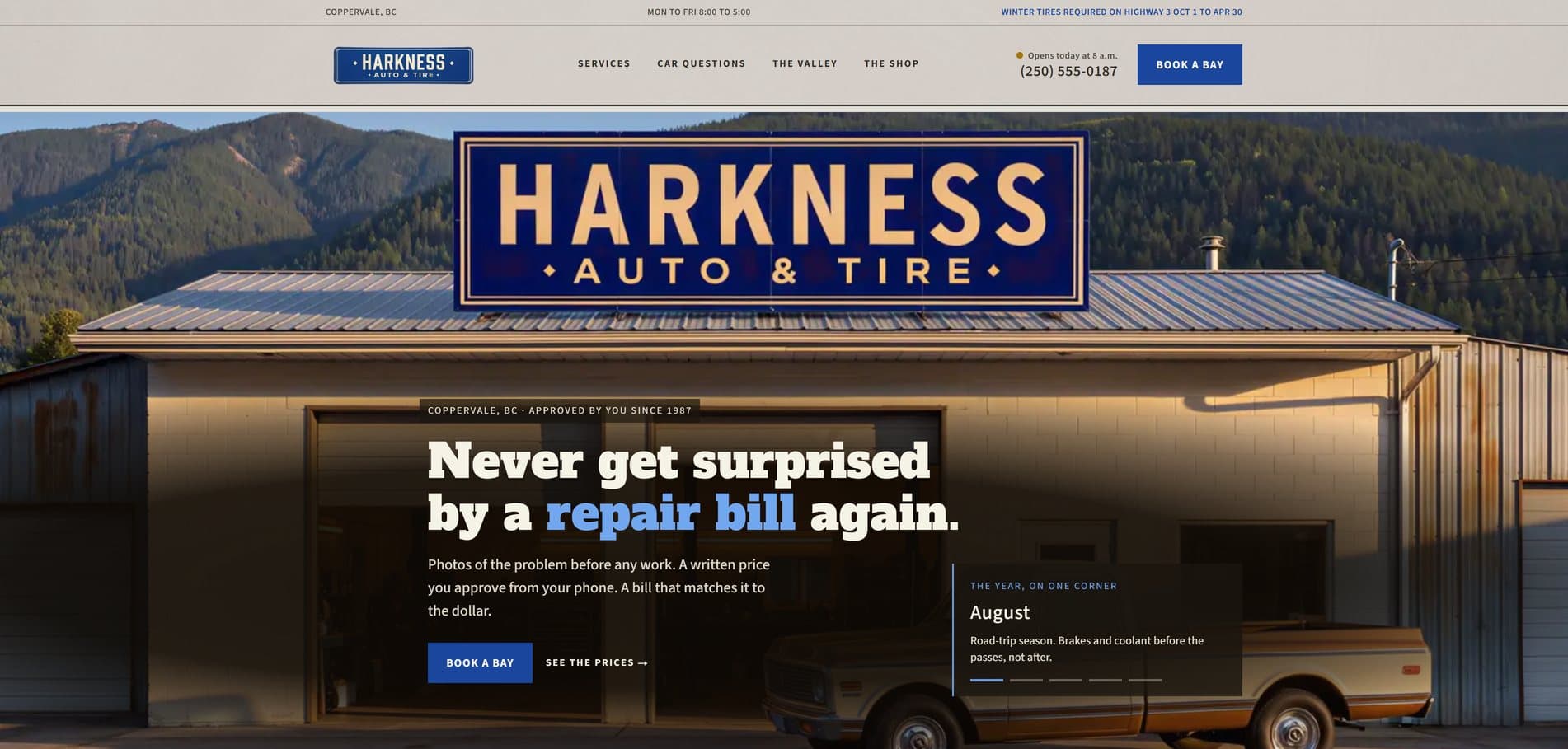
The homepage hero is one year at the shop. A single generated clip, held on one locked camera, was cut into 72 frames that move with the scroll, so the building passes through summer, the tire changeover, midwinter and the spring melt. Phones, visitors who turn off motion and browsers without JavaScript get a still photo of the shop, cropped for their screen.
The shop, the towns around it, the family, the reviews and the phone number are invented. What transfers is the system. For a working garage, the same pages take their own rate, their job list, their warranty and the communities they really serve, with the hero showing their own building through their own year.
What a driver knows before handing over the keys.
The number comes first
The rate, the parts rule and a from-price for ten jobs are on the page, so the phone call becomes a confirmation.
Proof at both ends
A photo of the problem arrives before any work is approved, and the old parts come back in a bag.
The first visit is easy
Directions, hours and the after-hours key drop are on the booking page, along with what happens after the request is sent.
Everything that shipped.
I built Harkness as the Trailhead, Full Coverage: the Trailhead's homepage, services and shop pages, plus a page for each of the five communities around the shop and 20 guides answering what drivers type before they book. The homepage hero is a year at the shop in 72 frames that move with the scroll. The services page carries ten priced jobs and an estimate desk that hands the symptoms and the vehicle to the booking form. A sample inspection report lets a visitor approve or decline each repair line, and a changeover picker shows which tire weeks are quiet before anyone books.
Highlights
- A year at the shop in 72 frames that move with the scroll, cut from a 2K master
- Ten common jobs with a from-price, book hours and the parts rule on one board
- An estimate desk that turns eight everyday symptoms and the vehicle into a written work order
- A sample inspection report with photos, measurements and an approve or decline on every line
- A changeover picker that marks each tire week quiet or busy and carries the chosen week into booking
- Five community pages, each written from what that road does to a vehicle, with a hand-drawn valley map
- Twenty guides answering what drivers search, with every legal claim checked against BC and federal sources
- Fleet accounts with a held bay, a set approval limit per truck and one monthly invoice
- A phone dock and header that show whether the counter is open right now, on the shop's own time

Pages and surfaces
- Home (a year at the shop)
- Services and prices (the board and the estimate desk)
- Tire changeover week picker
- A sample inspection report
- Fleet accounts
- Five community pages and a valley map
- Car questions (twenty guides)
- Shop questions
- The shop (story, warranty and hiring)
- Book a bay
- The counter side (what the shop sees)
- Privacy, terms and accessibility
Real code. Real routes. Production ready.
- The year hero draws 72 stored frames on a canvas and blends neighbouring frames, so the scroll reads as motion
- Large and high-density screens load a 1600-pixel frame set cut from a 2K master, and smaller screens load a lighter 1280 set
- Phones, reduced-motion settings and browsers without JavaScript get a still hero photo cropped for their screen
- Prices, guides, community pages, share cards and the llms.txt file all read from one data source, so every number matches the board
- The estimate desk adds only the lines that always apply and counts a shared job once, so the total it shows is a floor
Stack
How it was built
Harkness Auto & Tire is a fictional business built as a concept to show the Trailhead, Full Coverage package for auto repair, and the site says so in its footer. Coppervale, BC and the five communities around it do not exist, and neither do Del or Rae Harkness, the reviews, the prices, the phone number or the shop's history. No real garage, customer or result is implied. Counts read from the live site on October 6, 2026.
Put your numbers where drivers can see them.
The same price board, estimate desk, inspection report and community pages can be built around your shop, your rate and the towns you really serve. Start with the free check-up and I will show you where drivers stall on your current site. No website yet? Tell me about your shop and I will show you where to begin.
No website yet? Start your first one here
Built as The Trailhead, Full Coverage, $3,200. Builds this size bill by milestone, paid as agreed stages go live.
In this industry yourself? Read the auto repair and tire shop website design playbook.
More work
02 / 23