

 hello@kootenaymade.ca
 Castlegar, BC. Serving the Kootenays and beyond.
 9 min read
Key takeaways
- Reviews do three jobs at once: support local visibility, reduce perceived risk, and help turn a searcher into a call or booking.
- Google says local results are mainly relevance, distance, and prominence. Complete profile info, positive reviews, and helpful replies support prominence.
- The healthiest profiles are recent, specific, believable, answered, and aligned with accurate Google Business Profile details.
- Reviews work hardest when the best proof sits on service pages, quote forms, and booking paths, not just the homepage.
- Keep the ask honest: real customers, consistent requests, and no incentives or gating.

On this page
Do reviews affect local search rankings?
Yes, indirectly. Google says local results are based mainly on relevance, distance, and prominence, and review count plus positive ratings feed the prominence signal. Reviews do not override a closer or more relevant competitor, but among similar nearby businesses, a complete, active, well-reviewed profile carries a cleaner signal.
That distinction matters. A Nelson searcher still needs a nearby, relevant result, so reviews alone will not float a Cranbrook business into Nelson Maps results. But when several similar businesses compete in the same town, the listing with useful reviews, current photos, accurate hours, service details, and owner responses looks more known and more trusted than a neglected one.
This is why reviews belong inside the broader local SEO foundation for a Kootenay business. Reviews help Google read public confidence. Your website then has to prove the same promise after the click. The two work as one chain, not separate hobbies.
Reviews are not decoration. They are public proof attached to search visibility, trust, and the next action.
- 01
Prominence
Google says local ranking weighs how well known a business is, and review count plus positive ratings feed that prominence signal. Reviews support visibility, but they do not override relevance or distance.
- 02
Profile completeness
Accurate categories, services, hours, phone, service area, photos, products, and a working website link help both customers and Google understand exactly what you do and where.
- 03
Recency
Recent reviews make a business feel active right now. A long silence makes even a strong rating feel stale, which hurts seasonal operators and owner-run shops most.
- 04
Response pattern
Owner replies show the business is listening. A steady response habit also gives the next customer another way to judge tone, care, and professionalism before they call.
- 05
Customer language
Reviews that naturally name the service, town, problem, outcome, or staff member reinforce what you are known for, without anyone resorting to fake keyword stuffing.
Review count vs review quality: which matters more?
Both matter, but quality keeps volume believable. A high average rating means little if the text reads thin and identical. A natural profile has texture: customers naming the job, the town, the staff member, or the problem solved. Empty five-star bursts read weaker than steady, specific, recent proof.
Customers read patterns, not just the number. They notice whether the praise is specific, whether the newest reviews are current, whether the same complaint repeats, and whether the owner sounds human when replying. A suspicious profile feels thin, repetitive, and weirdly perfect. That is not premium. That is a mannequin wearing a nametag.
| What is being compared | Vanity review profile | Working review profile |
|---|---|---|
| Main goal | Inflate the star rating | Prove the business is active and trusted |
| Review text | Short, generic, interchangeable | Specific: names the job, town, staff, outcome |
| Recency | Old cluster, then silence | Steady rhythm that matches real work |
| Owner replies | None or copy-paste gratitude | Calm, specific, current responses |
| Profile match | Hours and details out of date | Aligned with the website and service area |
| Effect on calls | Looks staged, raises doubt | Lowers risk and earns the next step |
Here is what specific reads like in practice. Kim, who owns Family Designs & Creations in Castlegar, wrote: “Highly Recommend Brett, He goes out of his way to make thing’s perfect and with such creativity. Very quick and very reliable.” Her shop already had 41 Facebook recommendations sitting where almost nobody would find them, so the build surfaced them on the site itself. Brody at Summit Handyman in Langley named a feature instead, the estimate request form, and said what it does to his week. Both quotes sit on the case studies, checked September 2026.
Are your reviews actually working for you?
Before chasing more reviews, check whether the current system is wasting the proof you already have. Most local businesses do not need a reputation platform first. They need the obvious leaks patched: an outdated profile, unanswered reviews, and strong proof stuck on the homepage instead of the pages that convert.
Run this honest checklist. If several lines are false, the fix is patching the system, not buying a hundred more stars.
- A stranger can tell what you do, where you serve, and how to reach you from the Google result alone.
- Your newest reviews are recent enough to prove the business is active now.
- Reviews mention the services, towns, outcomes, and staff you want to be known for.
- Owner responses are specific, calm, and current, not generic copy-paste gratitude.
- The profile has accurate categories, hours, phone, services, photos, service area, and website link.
- Your strongest reviews appear on the matching service pages, not just the homepage.
- Mobile visitors can call, book, or request a quote without hunting after reading proof.
- The review request habit is honest, consistent, and free of incentives or pressure.

Where should reviews go on my website?
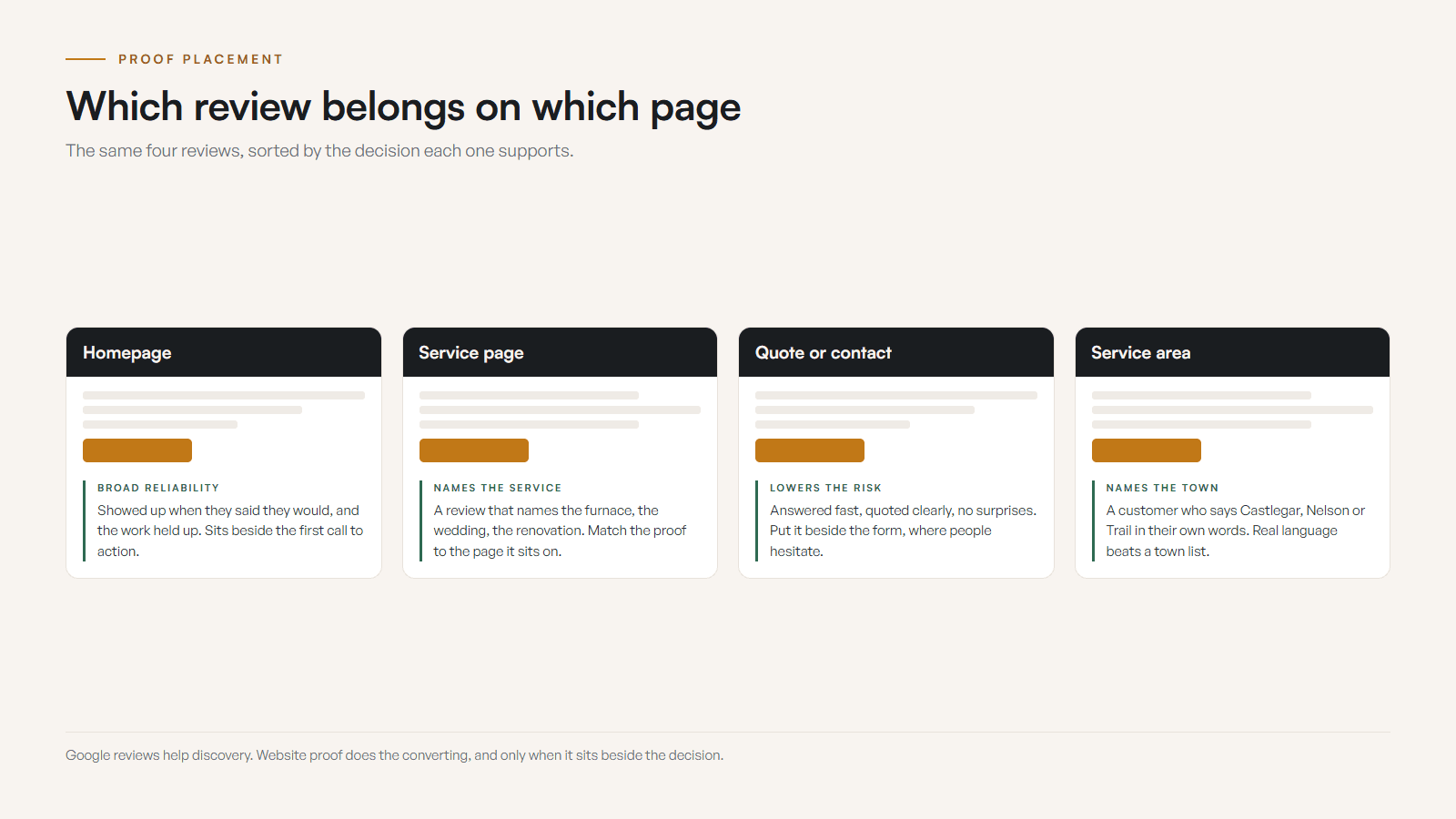
Place reviews beside the decision they support. A glowing review on the homepage helps less than the same review sitting on the matching service page, beside the quote form, or near the mobile call button. Google reviews help discovery, but website proof drives conversion once the visitor arrives.
Do not script customers into awkward keyword parroting. Ask in your own words, then use the strongest specific language where it belongs. If a review proves the service, put it on that service page. If it proves the location, put it near the local section. If it proves responsiveness, put it beside the quote or contact action. You can see this approach in my portfolio, where proof sits next to the decision, not in a lonely testimonials tab.
- Homepage
- Use one or two broad reviews that prove reliability and the main promise, placed near the first call to action rather than buried below a scenic photo gallery.
- Service pages
- Match the review to the page. Furnace proof belongs on the furnace page, wedding proof on the wedding page, naming the service, result, town, or speed.
- Contact and quote path
- Use reviews that lower risk: responsiveness, clear pricing, clean work, easy booking. Put them beside the form, phone block, or estimate button where people hesitate.
- Location and service-area pages
- Use reviews that mention Castlegar, Nelson, Trail, Rossland, Cranbrook, or Creston naturally, so real customer language proves the business actually works here.
Before
A Castlegar service business had decent Google reviews but no replies, stale photos, a thin services page, and a phone link buried below generic copy. The profile drew people in, then the website made the next step feel uncertain.
After
The cleanup connected the chain: accurate profile details, calm owner replies, service-specific reviews on the matching pages, clearer service-area language, and a visible mobile call path. The business looked easier to trust and easier to contact.
Composite example based on common local review and website gaps. No call lift, ranking gain, or revenue number is claimed.
How do I ask customers for reviews without breaking the rules?
Ask real customers after a real experience, send the direct review link, and keep it neutral. Never offer an incentive, apply pressure, or screen for who is likely to be happy. Google prohibits incentives and fake engagement, and the FTC warns marketers not to solicit only likely-positive reviewers. Honest and consistent wins.
Manipulating reviews is where the floor opens. Review gating, paid praise, and recruiting friends or staff to pose as customers all create a misleading picture that platforms and regulators treat as a real compliance risk. The simple version: ask everyone the same way, every time, and let real customers speak.
- Ask after the value lands: just after the install, pickup, appointment, meal, stay, tour, or solved problem.
- Ask for an honest review, not a five-star review. The tone should feel like a normal follow-up, not a hostage negotiation.
- Share the direct Google review link or a QR code so customers never have to search, guess, or abandon the thought.
- Skip incentives. Do not trade discounts, gifts, or contest entries for reviews unless platform rules and the law clearly allow it.
- Ask everyone consistently. Do not screen for happy customers only, and never recruit staff, friends, or family to pose as buyers.
A request this simple works well: "Thanks again for choosing us. If you have a minute, a Google review helps other local customers decide whether we are the right fit. Here is the direct link." Save that link, attach it to your normal follow-up, and you have a system that runs itself.
What does a good review habit look like by business type?
The right review habit depends on the work, the timing, and the customer moment. A seasonal rental, a clinic, a contractor, and a retail shop should not ask at the same point or use proof in the same place. Here is what the pattern looks like for common Kootenay business types.
- Home services
- Trail HVAC, Castlegar roofers, Nelson plumbers, and Cranbrook electricians ask once the job is finished, name the service in the request, and place proof on matching service pages.
- Tourism and seasonal operators
- Rossland rentals, Nakusp cabins, and Kootenay Lake tours collect reviews right after the visit, while the route, staff, weather, and experience are still fresh.
- Clinics and personal services
- Massage, dental, physio, and wellness businesses keep requests privacy-safe, avoid sensitive details in replies, and use proof about comfort and professionalism.
- Retail and local shops
- Nelson boutiques, Castlegar pet shops, and Creston farm stands request reviews after helpful service, special orders, or a locally made product experience.
- Restaurants and cafes
- Patios, bakeries, breweries, and food trucks keep hours current, reply quickly, and surface reviews mentioning atmosphere, dietary clarity, and signature items.
- Professional services
- Accountants, consultants, realtors, and estimators want reviews that reinforce communication, process clarity, and whether the client felt guided instead of sold to.
Two trades lean on this proof harder than the rest. A driver choosing a garage is buying trust sight unseen, which is why auto repair and tire shop website design puts customer proof beside the posted rates and the booking path. A traveller planning a week here reads reviews and itineraries in the same sitting, so tourism and resort websites where the reviews and the trip planning live together keep both on the owned site instead of handing the decision back to a listing.
What should I do with a negative review?
Respond calmly, protect privacy, address the concern, explain the next step if one exists, and move complex details to a private channel. Handled well, a professional reply can build trust, because future customers see how the business handles friction. A defensive or absent response does the opposite.
But first, decide what the review actually is. Weak reviews are not always a marketing problem. Sometimes they are a business problem wearing a marketing jacket. Triage which one you face before asking fifty more people to describe the same leak.
- 01
Outdated profile
Fix categories, hours, phone, services, photos, service area, and booking links first, before anything else.
- 02
No response habit
Reply to the backlog calmly, then set a weekly rhythm so new reviews never sit ignored.
- 03
Thin review quality
Improve request timing so customers still remember the service, result, town, and reason they chose you.
- 04
Repeated complaints
Fix the operation before chasing reputation polish. The public reads patterns, and a real fix shows up in future reviews.
- 05
Website proof gap
Move specific reviews onto service pages, quote pages, and contact sections where they reduce hesitation.
How do I fix a neglected review system this afternoon?
Do not start with a giant reputation strategy document. Start with the signal chain from Google result to website proof to call path, in this order. Most of it takes an afternoon, and it patches the leaks that quietly waste the proof you already earned.
- 01Audit the profile: categories, services, phone, hours, website link, service area, photos, and booking links.
- 02Answer the silence: reply to unanswered reviews, thank specific positives, and address concerns calmly without sharing private details.
- 03Move proof to pages: add your strongest specific reviews to the matching service, location, contact, and quote sections.
- 04Create the ask: write one short request, save the Google review link, and attach it to your normal follow-up after good work.
- 05Triage reputation risk: list repeated complaints, fix the operational cause where you can, and note the improvement in future replies.
- 06Check the call path: walk from Google result to website to call on a phone, removing dead links, tiny buttons, and unclear next steps.
After that, keep the habit boring: ask consistently, respond weekly, update the profile when operations change, and keep proof close to the action. Very few habits improve search visibility, buyer confidence, conversion, and calls at the same time. Reviews can, which is why neglecting them is an expensive little hobby. If you want a second set of eyes on the whole chain, use the Contact page or run the free check-up below.
Sources and further reading
- Google Business Profile: improve your local ranking
Google explains that local results are based mainly on relevance, distance, and prominence, and that review count and rating feed the prominence signal.
- Google Business Profile: tips to get more reviews
Google says reviews help you stand out in Maps and Search, but prohibits incentives, fake engagement, and other forms of misleading review activity.
- Google Business Profile: read and reply to reviews
Documents how verified businesses share a review link and use public replies to show they are responsive to customers.
- FTC: soliciting and paying for online reviews
Warns marketers not to ask only likely-positive reviewers, invent reviews, or condition incentives on positive sentiment. Useful even outside the US as a clear honesty standard.
Frequently asked questions
Do Google reviews affect local search rankings?
Yes, indirectly. Google says local results are mainly shaped by relevance, distance, and prominence, and review count plus positive ratings feed prominence. Reviews support that picture best when the profile is complete, active, and accurate.
What matters more, review count or review quality?
Both, but quality keeps volume believable. A healthy profile has real customer detail, recent reviews, natural language, service-specific comments, and owner responses. Empty five-star bursts read weaker than steady, specific proof.
Can I ask customers for Google reviews?
Yes, if you keep it honest. Ask real customers after a real experience, send the direct review link, and never offer incentives or pressure anyone for positive reviews. The best ask is simple, timely, and neutral.
What is review gating, and why avoid it?
Review gating means screening customers and sending only the happy ones to Google. It paints a misleading picture and breaks platform and FTC guidance. Ask everyone consistently and let real customers speak for themselves.
Should I put reviews on my website too?
Yes. Google reviews help discovery, but website proof drives conversion. Place specific reviews on service pages, location pages, quote forms, booking pages, and contact sections where people decide whether to call.
What should I do with a negative review?
Respond calmly, protect privacy, address the concern, and move complex details to a private channel. A professional reply can build trust, because future customers see how the business handles friction.
Related pages
- Auto repair and tire shop websites
- Wellness and clinic websites
- Trades and contractor websites
- Web design in Castlegar
- Web design in Rossland
- How to Get More Google Reviews Without Begging
- You Got a Bad Google Review. Here Is What to Do
Kootenay Made Digital
I build websites, local presence, and calm AI setups for Kootenay small businesses. Plain language, published prices, and clear work that makes you easier to find and easier to choose.