


 Castlegar, BC. Serving the Kootenays and beyond.
The sale is won in the moment before checkout.
Retail and ecommerce website design for Kootenay shops, makers, and product brands.
Shoppers decide in seconds, and most abandoned carts die on surprise shipping rates, not price. I design retail and ecommerce websites from Castlegar, BC for shops and makers across the Kootenays: honest product pages, shipping shown early, POS sync, local pickup, and a checkout people trust.

What shoppers weigh before the buy button
Kootenay Made builds retail sites around the quiet questions a shopper asks before handing over a card: what is this made of, will it fit, what are the shipping rates, what happens if it is wrong, and who is behind it. I pair brand storytelling and honest photography with a clean path to buy, transparent shipping and returns, a secure checkout, and a consent-based email list that turns one order into a regular.
- 01
Trust is the real currency
A shopper handing payment details to a brand they just met is taking a risk. Clear policies, real reviews, honest photography, visible contact info, and a secure checkout are what convert that risk into a sale.
- 02
Friction kills the cart
Surprise shipping rates at checkout, vague return rules, a forced account, or a slow payment step are the moments shoppers quit. Most abandoned carts are a confidence problem, not a price problem.
- 03
Products need context to sell
Good products still lose when the page fails to explain materials, fit, use, origin, care, and who the gift is for. Detail is not clutter. It is the difference between a maybe and a buy.
- 04
The marketplace owns your customer
Etsy, Amazon, and Facebook Marketplace take their fees, hide your buyer list, and rank you against everyone else. A store of your own keeps the margin, the customer email, and the ability to run product drops on your terms.
- 05
The second sale is where the money is
Retail compounds through product drops, holidays, markets, and repeat buyers. A site that captures email with consent and supports seasonal campaigns earns far more than one that sells once and goes quiet.
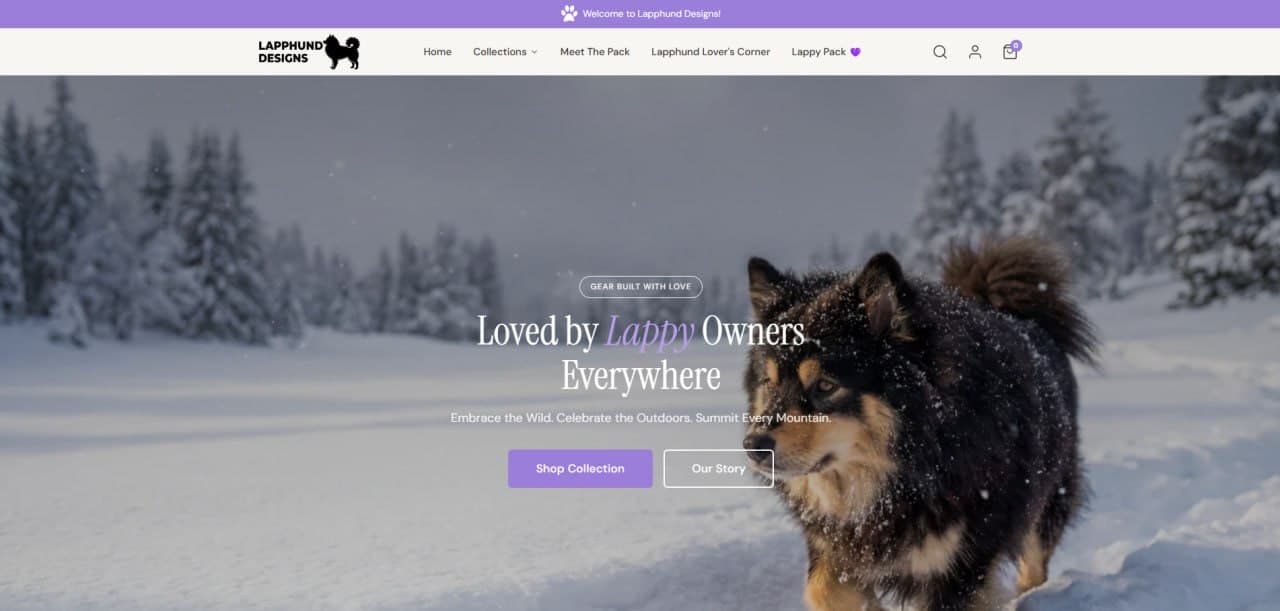
See Lapphund Designs, the store I run myself.
Client build
Lapphund Designs is a live Shopify store built and operated by KMD: 480 products across breed-first collections, a custom theme, blog content, email marketing, and translated storefronts. Every piece of ecommerce advice on this page comes from a seller, not a reseller.
- 509 public store URLs
- 480 products in breed-first collections
- Custom Shopify theme direction
- Email marketing and customer flows
- Finnish and French translated surfaces
- Secure Shopify checkout and payments
Lapphund Designs is Kootenay Made Digital's own store: built, run, and grown in-house, so the numbers and the lessons are first-hand.
What goes into a store that closes the sale
- 01
Collection and product architecture
I organize the catalogue around how people actually shop: by use case, gift recipient, season, material, size, style, price, and best sellers. Filters, search, and gift guides that match shopper intent shorten the path from landing to add-to-cart.
- 02
Product pages that close
Each page carries the detail that removes doubt: honest photography, materials and dimensions, care, sizing guidance, real reviews, shipping estimate, and stock status. The buy button stops being a leap of faith.
- 03
Shopify or catalogue build path
I build on Shopify when checkout, inventory, and shipping matter, or as a custom catalogue and brand hub when the goal is inquiry, wholesale, or market visibility. I also run my own Shopify store, Lapphund Designs, so small business Shopify setup advice here comes from a seller, not a reseller.
- 04
Checkout, shipping rates, and trust signals
Shipping rates and timelines shown early, all-in pricing with no surprise fees, clear returns and exchanges, secure payment badges, accepted payment methods, and visible support. The fewer questions at checkout, the fewer abandoned carts.
- 05
POS sync, local pickup, and the hybrid counter
For shops that sell in person and online, I make local pickup, store hours, and market dates obvious, and sync inventory with your POS so a busy Saturday at the counter never oversells the online store. A Baker Street boutique in Nelson and its web store should feel like one business, because they are.
The standard that comes with every build I ship.
- Retail homepage with brand story and a clear path to buy
- Product, collection, and gift-guide architecture
- Shopify setup or custom catalogue structure
- POS sync and local pickup configuration
- Shipping rates, returns, and exchange policy pages
- Secure checkout configuration and trust-signal placement
- Consent-based email capture with abandoned cart recovery planning
- Product-drop and seasonal campaign foundations
- Accessible, mobile-first build with fast product imagery

The abandoned cart is only half the bill
A sale that never happened leaves no record, so nobody goes looking for it. It turns up instead as stock that did not move and an evening spent answering the same shipping question by hand.
Shipping cost appears only at the final step
Costs them
They build a cart around a price they believed, watch it grow on the last screen, and close the tab feeling worked on.
Costs you
Carts that emptied themselves overnight, and the same message answered by hand every evening asking what shipping to Calgary runs.
FixRates, timelines, and the local pickup option shown on the product page, with any free-shipping threshold stated before the cart rather than after it.
The counter and the online stock disagree
Costs them
They buy a one-of-a-kind piece that sold on the shop floor an hour earlier, and a refund email arrives where a parcel should have.
Costs you
An apology, a refund, a review you cannot take back, and a Sunday spent reconciling counts by hand after a busy market day.
FixPOS sync so a sale at the till or the market booth comes off the online count the moment it rings through.
Product pages that stop at a price
Costs them
They cannot tell the size, the material, or whether it suits the person they are buying for, so they save it for later and later never comes.
Costs you
Sizing questions filling the inbox, returns you pay to ship both directions, and the shopper who bought the same thing from a page that explained it.
FixMaterials, dimensions, care, and fit guidance on every page, with honest photography and reviews placed beside the doubt they answer.
Regulars in town do not know you sell online
Costs them
They order from a warehouse in Ontario and wait a week for something sitting on a shelf four blocks from their house.
Costs you
Margin handed to a marketplace, and a foot-traffic customer quietly trained to shop elsewhere through the months your street is empty.
FixLocal pickup as a real checkout option, with pickup windows, market dates, and the shop address visible from every product page.
Product drops announced only on social
Costs them
The people who wanted the run most never saw the post, and hear about it once the piece they wanted is gone.
Costs you
A launch that lives or dies on what the feed decided to show, and inventory sitting through the season you built it for.
FixWaitlist and back-in-stock capture on every product, consent-based, so each drop goes to a list you own before the algorithm gets a vote.
The product-drop rhythm
Kootenay makers already know the cycle: build inventory through the winter, sell it across the summer market circuit, and watch marketplace fees take a cut of everything in between. A drop model flips that. You announce a limited run to an email list you own, it sells at full margin in days, and the marketplaces go back to being a discovery channel instead of a landlord.
I build the whole loop into the site: a drop page shoppers can join before launch, consent-based email capture, abandoned cart recovery for the stragglers, and sold-out archives that make the next drop easier to sell than the last.
- Waitlist and back-in-stock capture on every product
- Launch emails that go out on your schedule, not an algorithm's
- Sold-out states that build demand for the next run instead of killing the page
- POS sync so a market-day sale never oversells the online drop
Selling online in BC, by the book
A site in this category is judged on more than looks. These are the obligations and reassurances I build in by default, so the business stays credible and protected.

Secure payment handling (PCI DSS)
I build on hosted, tokenized checkout from your platform or gateway, so card data never lands in a place you have to secure yourself. That keeps most merchants in the simplest PCI DSS path. Under PCI DSS v4.0.1, I also manage the scripts that load near your payment page, so review widgets, chat, and analytics do not put checkout at risk.
Clear returns, refunds, and shipping
BC's Business Practices and Consumer Protection Act requires return, refund, and cancellation terms to be disclosed clearly and, for online sales, in a form the buyer can keep and print. I build policy pages and checkout disclosures that state your terms, with shipping rates and timelines shown before, not after, the buyer commits.
Honest, all-in pricing
Canada's Competition Act now treats drip pricing as a deceptive practice: the advertised price must be attainable, with only government-imposed taxes added later. I present prices, shipping, and any fees up front, and keep product claims and any environmental or quality statements accurate and supportable.
Email consent done right (CASL)
Canada's Anti-Spam Legislation governs every marketing email you send. I set up opt-ins that capture express consent, keep your sender identification and unsubscribe link in every message, and structure flows so an abandoned cart alone is never treated as permission to email.
Privacy and customer data (PIPEDA)
Collecting names, addresses, and order history brings privacy obligations under PIPEDA. I pair the store with a clear, accurate privacy policy, sensible cookie and analytics consent, and data practices that tell customers what you collect and why, which is also what builds the confidence to buy.
Accessibility built in (WCAG 2.2 AA)
I build to WCAG 2.2 AA: keyboard-navigable product pages, real alt text, readable contrast, labelled forms, and a checkout that works with assistive technology. It is the right standard for the direction BC accessibility law is heading, and it widens the audience that can actually complete a purchase.
Want this standard on your site?
One conversation, no pitch deck. Tell me where the business is stuck and I will tell you what I would build.
71 of the 117 Grocery stores on The Kootenay List have no website, as of September 3, 2026. The ones that do are the ones a customer can find.
What a build like this costs.
A focused presence site starts with the Trailhead: $2,000, or $500 today and $142 a month on Own It Monthly ($2,204 total). Plenty of businesses in this industry need exactly that and nothing more.
Bigger jobs usually land at $5,500, or $1,375 today and $386 a month on Own It Monthly ($6,007 total)
The Storefront · typical timeline 5 to 6 weeks
Storefront exists for exactly this: a real catalogue, a trustworthy checkout, shipping rates and local pickup handled, without paying for pages a small shop will never use.
The honest answer depends on what you actually need, not on a package name. Start with the free check-up or the contact form, and I will book a proper 45-minute consultation with you, no pressure either way.
Comparing options right now? What a website should cost breaks down how to read any quote, and who actually owns your website covers what you keep if you ever leave, on any platform, including mine.
Your commerce platform does the plumbing. KMD wins the decision.
The platform handles the transaction. The site decides whether anyone trusts you enough to start one, and whether they come back for the next order.
Shopify and the platform layer give you a hosted cart, payment processing, inventory, shipping rates, taxes, and a library of themes and apps. What they do not give you is a brand worth buying from, a collection structure that matches how people shop, or a path that removes hesitation before the buy button. That decision layer is where carts are won or lost, and it is exactly what I build.
What the category tool covers
- Hosted checkout, payment processing, inventory, and order management
- Product variants, collections, search, filters, discount codes, and gift cards
- Shipping rates, pickup, tax calculation, and fulfillment workflows
- App ecosystem for reviews, subscriptions, email, and abandoned carts
- Theme library, hosting, SSL, and platform-level PCI compliance
Where the upgrade actually pays off.
- 01
Use Shopify for the engine, but never let a generic theme erase the brand or flatten the product story.
- 02
Show shipping rates, the local pickup option, and return terms before the cart, not as a surprise at checkout.
- 03
Build collections around customer intent and gift occasions, not internal SKU categories.
- 04
Sell product drops to your own list first, and let the marketplaces be a discovery channel instead of a landlord.
- 05
Turn each seasonal moment into a repeatable, consent-based email campaign instead of a last-minute social post.
Related guides.
- Why Most Small Business Homepages Confuse People in 5 Seconds
- Shopify vs Square for a Small Store in Canada
- Shopify vs Squarespace: Which One for a Canadian Small Business?
- Best Website Builder for a Small Business in Canada (2026)
- Who Actually Owns Your Website? Wix, Squarespace, Shopify, and Custom Compared
- The Difference Between a Website and a Growth System
- A Local Shop Website That Earns the Visit
- Why Your Website Looks Bad on a Phone (and the Fix)
- Etsy vs Your Own Store: The Honest Math for Canadian Makers
- Is Shopify Worth It for a Small Kootenay Store? The Honest Math
Straight answers on retail and ecommerce builds
How much does an ecommerce website cost in BC?+
Most Kootenay retail and ecommerce builds land in my Storefront package: $5,500 full price, or $1,375 today and $386 a month on Own It Monthly ($6,007 total), live in five to six weeks. Larger catalogues, custom functionality, or heavy integrations move into Engine territory, and I will tell you which one you actually need before anything is signed.
Can it sync with my POS and handle local pickup?+
If you run Shopify POS or Square, inventory lives in one place: a sale at the counter or a market booth comes off the online count automatically, so you never oversell a one-of-a-kind piece. Local pickup shows up as a real option at checkout with clear instructions, which matters in the Kootenays, where half your buyers would rather swing by than pay to ship across town.
Should I use Shopify or something custom?+
If you need online checkout, inventory, shipping rates, and taxes handled reliably, Shopify is usually the right base, and it keeps payment security largely on the platform. I make the brand, structure, and conversion path feel custom instead of theme-generic. If you sell mostly in person or by inquiry, a custom catalogue and brand hub can come first.
Can this work for makers who sell mostly at markets?+
That is where many Kootenay makers start. The site can launch as a product catalogue, brand story, wholesale inquiry path, market schedule, and email capture engine, then add full ecommerce when you are ready. Plenty of makers grow into checkout once the brand and the list are in place, and the summer market circuit becomes the top of the funnel instead of the whole business.
What happens to abandoned carts?+
First I reduce them: shipping rates shown before checkout, no forced accounts, and a fast payment step, because most abandoned carts are a confidence problem. For the rest, I plan recovery emails that go to shoppers who gave express consent, structured so CASL is satisfied and the follow-up reads like help, not a chase.
Is my checkout actually secure and PCI compliant?+
When you use a hosted, tokenized checkout from Shopify, Stripe, or a similar gateway, card data is handled on their PCI-compliant systems, which keeps most small merchants in the simplest compliance path. I configure it correctly and manage the scripts loading near your payment page, which PCI DSS v4.0.1 now requires.
How do you keep my returns and pricing on the right side of the rules?+
I write clear return, refund, and shipping policy pages and surface them before checkout, which BC consumer protection law expects for online sales. I also show all-in pricing with only taxes added at the end, since Canada's Competition Act now treats hidden mandatory fees, known as drip pricing, as deceptive.
Can you help me collect emails the legal way?+
The list is where product drops and repeat sales come from, so I treat it as core build work. I set up consent-based opt-ins that satisfy CASL, with proper sender identification and an unsubscribe link in every message, then plan welcome, abandoned cart, post-purchase, seasonal, and drop announcement flows so the list actually drives revenue.
Will the site be fast and work on phones?+
Yes. Most retail traffic is mobile, and slow product imagery is a top cause of abandonment. I build mobile-first, optimize images, and keep the path from landing to buy short, so the store loads quickly and converts on the device most of your customers use.

Who builds this
I am Brett, the person behind Kootenay Made Digital. I plan, design, and build every site myself from Castlegar, BC, so the person you email is the person doing the work.
Founder, Kootenay Made Digital · Castlegar, BC
Ready to sell past the counter?
Whether this is your first website or your counter has outgrown its current one, most Kootenay shops land in the Storefront build and go live selling in five to six weeks.
No website yet?
Start My First WebsiteAlready have one?
Get a Free Check-Up