


 hello@kootenaymade.ca
 Castlegar, BC. Serving the Kootenays and beyond.
 10 min read
Key takeaways
- Shopify charges a flat 15 cents on in-person Interac debit on every plan. Square charges 0.75% plus 7 cents, so Shopify is cheaper on debit sales over about $10.67.
- Online, the two are almost identical: 2.8% plus 30 cents on Square Online Plus at $36 a month and on Shopify Basic at $37.
- Square Online Free is a real $0 store, and the web address stays a Square one until you buy an annual paid plan.
- Shopify Grow at $99 a month only pays for itself past roughly $31,000 a month in online sales, on the published rates.
- All figures read from squareup.com/ca/en and shopify.com/ca/pricing in September 2026.

On this page
Shopify or Square: which one suits a small Canadian store?
Square when the till is the business and the website is a side door. Shopify when shipping and online orders are the business, or will be within two years. At the volumes most small shops actually do, the plan prices are close enough to ignore, so the decision lands on capability and on one Canadian rate that nobody puts in a comparison chart.
This is written for an owner with a shop, a market table, or a studio, choosing where to put a catalogue for the first time. It is not for a business already running a full Shopify store with apps wired in, because moving that is a project rather than a decision.
Both companies publish Canadian pricing, and I read both pages on September 4, 2026 from a computer in Castlegar. Every number below traces back to those pages. The worked examples are the math on those published rates and nothing else.
What does each one charge in Canada?
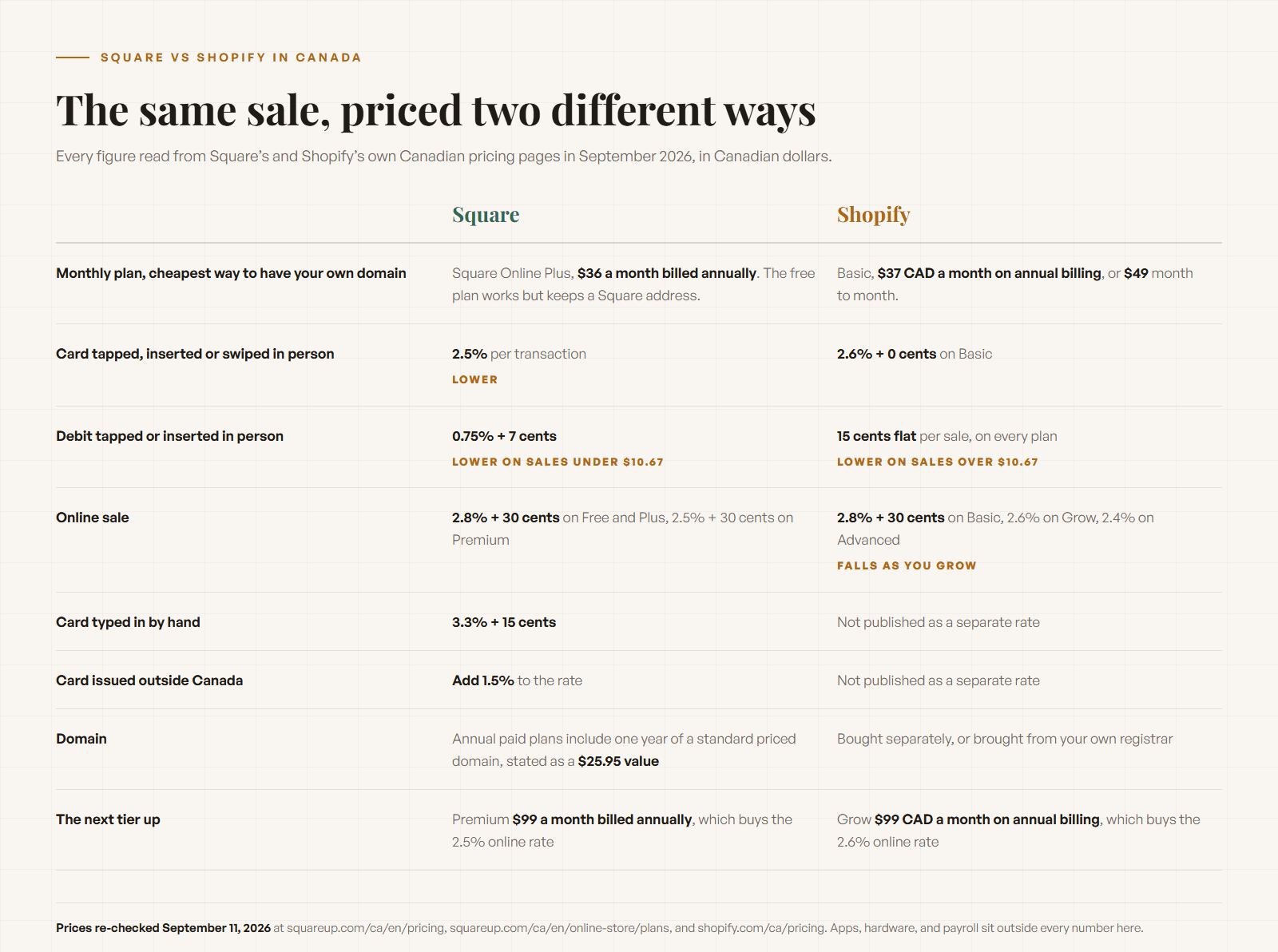
Square: 2.5% for a card in person, 0.75% plus 7 cents for debit in person, 2.8% plus 30 cents online. Shopify Basic: $37 CAD a month on annual billing, 2.6% for a card in person, 15 cents for debit in person, 2.8% plus 30 cents online. Checked September 2026.
| What is being compared | Square | Shopify |
|---|---|---|
| Cheapest plan with your own domain | $36 a month billed annually on Square Online Plus. Free at $0 works, on a Square web address. | $37 CAD a month on Basic, annual billing, or $49 month to month. |
| Card tapped or inserted in person | 2.5% per transaction. | 2.6% and no per sale fee on Basic. |
| Interac debit in person | 0.75% plus 7 cents. | 15 cents flat per sale, on every plan. |
| Online sale | 2.8% plus 30 cents on Free and Plus. Premium at $99 a month drops it to 2.5%. | 2.8% plus 30 cents on Basic. Grow at $99 drops it to 2.6%, Advanced at $389 to 2.4%. |
| Card typed in by hand | 3.3% plus 15 cents. | Not published as a separate rate. |
| Card issued outside Canada | Add 1.5% to the rate. | Not published as a separate rate. |
| Store machinery | Enough for a small catalogue with pickup and local delivery. | The full set: variants, calculated shipping, abandoned checkout, feeds, apps. |
| Where it strains | A growing catalogue with real shipping and stock movement. | A counter-only shop paying a monthly plan fee for store machinery it never uses. |
Read the table for what is missing as much as for what is there. Shopify publishes an in-person card rate and a flat debit rate, and does not break out cards typed in by hand or cards from outside Canada. Square publishes four rates and a surcharge for foreign cards. That difference in disclosure is useful information when you are trying to forecast a month.
The plan price is the number everyone compares. The processing rates are the number that actually shows up on the statement.
What does the debit rate do to a Kootenay counter?
Interac debit is a large share of counter sales in small BC towns. Shopify charges a flat 15 cents per in-person debit sale on every plan. Square charges 0.75% plus 7 cents. On any sale over about $10.67, the flat 15 cents is the cheaper of the two.
Here is the math on the published rates. Take 300 debit sales in a month averaging $40 each, which is $12,000 through the machine. Square charges 0.75%, so $90, plus 7 cents a sale, so $21. That is $111. Shopify charges 15 cents a sale, so $45. Add the $37 Basic plan and Shopify still comes in lower, at $82 for the month.
Two things pull the other way. Credit cards cost a little less on Square, at 2.5% in person against 2.6% on Shopify Basic, so $10,000 in credit sales is $250 on Square and $260 on Shopify. And on small tickets the flat fee loses. A $5 coffee costs about 11 cents in debit fees on Square and 15 cents on Shopify.
That matters more here than it would in a city. On The Kootenay List, compiled September 3, 2026, Kimberley shows 318 businesses with 205of them running without a website, and the shops on that main street live on walk-in trade through a long ski season. When most of the year’s money crosses a counter, the counter rates deserve a real calculation.
Check your own mix before you take my word for it. Open last month’s statement and split the sales into debit, credit, and online, then note your average sale. Run both sets of rates on those real numbers, with Shopify’s plan fee added. The answer depends on your mix and your ticket size, and it can go either way. If you are weighing a processor without a store attached, I have Stripe, Square, PayPal and Shopify Payments fees compared in one place.
Online, the two are close to a tie
Square Online Plus at $36 a month billed annually charges 2.8% plus 30 cents. Shopify Basic at $37 a month on annual billing charges 2.8% plus 30 cents. On $8,000 a month in online sales that is roughly $260 against $261. The dollar is not the deciding factor here.
The next tiers are worth checking before anyone talks you up one. Shopify Grow costs $99 a month on annual billing and buys a 2.6% online rate. Against Basic, that trade only breaks even at about $31,000 a month in online sales. Square Premium at $99 buys 2.5% and breaks even against Plus at about $21,000 a month. Below those numbers, the higher tier costs you money.
So online, choose on machinery. Shopify has more of it: variants that behave, calculated shipping by weight and destination, abandoned checkout recovery, discount codes, gift cards, and a product feed for Google Shopping. Square Online covers a small catalogue with pickup and local delivery capably and stops sooner. I go through what a full store actually changes for a small shop in is Shopify worth it for a Kootenay store.
When Square is the right call
When the counter is where the money is, sales are small or lean on credit cards, and the website mostly needs to show hours, stock, and a reason to drive over. That describes a lot of good businesses, and none of them need a store platform.
- Most of your money crosses a counter, and the website is the place people check hours and see what you carry.
- Your average sale is under about $10, like coffee or baking, where Square’s debit rate comes in below a flat 15 cents.
- You already run Square hardware and do not want two inventory systems disagreeing with each other.
- Online is a handful of items, a gift card, and local pickup rather than a full catalogue.
- You want a working online store this month for nothing, and Square Online Free at $0 covers it.

The regional picture supports being unhurried about this. The Kootenay List’s largest retail category, grocery stores, shows 71 of 117 businesses with no website at all as of September 3, 2026. Plenty of shops here are still deciding whether they want an online catalogue, and starting free on Square Online is a reasonable way to find out.
One caution on the free plan. Square states that a custom domain requires an annual paid plan, so the free store lives at a Square address. Buy your domain anyway, at your own registrar, in your own name, before you build anything. It costs about fifteen dollars a year and it is the one asset that follows you between platforms. The Canadian domain guide covers the .ca question and who should hold it.
When Shopify earns the extra work
When parcels leave the building. Shipping rates by weight and destination, stock that stays true across a hundred variants, and a checkout that recovers the cart somebody abandoned at eleven at night are all real machinery, and they only pay for themselves when there is real volume moving through them.
- Shipping is a real part of the revenue, with rates by weight and destination rather than a flat guess.
- The catalogue has variants, sizes, colours, and stock counts that move.
- You want abandoned checkout emails, discount codes, gift cards, and a product feed working while the shop is closed.
- Visitors arrive from search rather than from the sign on your door, so product pages have to earn rankings.
- You expect the online side to outgrow the counter within two years.
The tourist economy is the argument I make most often around here. A visitor loves your shop in Nelson in July, drives home to Calgary, and remembers you in November. Nelson has 714 businesses on The Kootenay List with 72 percent of them online, the highest share in the region, so the visitor comparing two Nelson shops in November is comparing two websites. The one with a working store and an email list gets the order.
Shipping from the Kootenays deserves its own thought. Parcels from here are heavy on distance, and a flat rate that works for Nelson to Castlegar loses money on Nelson to Halifax. Calculated rates are the thing worth having, and they are a genuine reason to pick Shopify over a simpler store. The wider platform comparison lives in the best ecommerce platform for a Canadian small business.
Should you run both?
Only with your eyes open. Square at the till and Shopify online means two systems that each believe they know your stock, and by Saturday one of them will be wrong. It is a workable setup with an integration and a rule about which system is the source of truth.
- Pick one source of truth
- Decide which system owns the inventory count before you sell anything. Every reconciliation argument afterward traces back to skipping this.
- Budget the connector
- Keeping two catalogues in sync is either an app subscription or your Sunday evening. Price it as a real line item rather than assuming it is free.
- Watch the second plan fee
- Two platforms means two monthly fees. At $36 and $37 that is around $73 a month before a single sale, which is fine if the split earns it and silly if it does not.
For most shops I would rather see one system done properly. If the counter dominates, run Square and give the website one honest job. If parcels dominate, run Shopify and put a card reader on the counter. Splitting is for the shop where both halves are genuinely large. Once the platform is settled, a Shopify store set up and stocked for you is the part I build.
Whichever way it goes, the store is a rented platform and the domain and the customer list are yours. Keep both in your own accounts. Who owns your website covers what that means in practice, and the website cost guide puts a five year number on any of these paths so you can see what you are signing up for. For the store side alone, my guide on what an online store costs in Canada adds up the whole year.
Sources and further reading
- Square pricing, Canada
Fetched September 4 and re-checked September 11, 2026 from Square’s Canadian pricing page. Card present 2.5%, card not present 2.8% plus 30 cents, debit present 0.75% plus 7 cents, keyed in 3.3% plus 15 cents, and an additional 1.5% on cards issued outside Canada.
- Square Online plans, Canada
Fetched September 4, 2026. Free $0, Plus $36 a month billed annually, Premium $99 billed annually. Square states a custom domain requires an annual paid plan and that annual plans include one year of a standard priced domain, a stated $25.95 value.
- Shopify pricing plans, Canada
Re-checked September 11, 2026, prices labelled CAD. Basic $37 a month on annual billing or $49 month to month, Grow $99 annual, Advanced $389 annual. Online rates 2.8%, 2.6% and 2.4% plus 30 cents. In-person card rates 2.6%, 2.5% and 2.4%. In-person Interac debit 15 cents flat on every plan. POS Pro is a separate $119 a month per location.
- The Kootenay Business Web Census
The Kootenay List snapshot behind the regional counts quoted here, restated through the site helper rather than typed in by hand.
Frequently asked questions
Is Square or Shopify better for a small Canadian store?
Square when the counter is the business and online is a side door. Shopify when shipping and online orders are the business. At small volumes the platform fees are close enough to ignore, so decide on what the store has to do rather than on the monthly price. Rates and plans checked September 2026.
What does Square cost per transaction in Canada?
From Square’s Canadian pricing page, checked September 2026: 2.5% for a card tapped, inserted or swiped in person, 0.75% plus 7 cents for debit in person, 2.8% plus 30 cents online or on an invoice, and 3.3% plus 15 cents for a card typed in by hand. A card issued outside Canada adds 1.5%.
What does Shopify cost per month in Canada?
Basic is $37 CAD a month on annual billing or $49 month to month, Grow is $99 annual, Advanced is $389 annual, and Plus starts at $3,400. Online card processing on Basic is 2.8% plus 30 cents, falling to 2.6% on Grow and 2.4% on Advanced. Checked September 2026.
Can I use Square for the till and Shopify for the website?
You can, and plenty of shops do, but you are then running two systems that both think they know your stock. Either pay for an integration that keeps them honest or accept that one of them will be wrong by Saturday. If you go this route, decide in advance which system is the source of truth for inventory.
Is the free Square Online plan good enough to start with?
For a first year it often is. You get a working store and pay only the 2.8% plus 30 cents on what sells. The catch is the web address stays a Square one, because Square states a custom domain requires an annual paid plan. Buy your domain separately and in your own name anyway, so it is ready when you upgrade.
Which is cheaper for a shop that takes mostly debit?
Shopify, on most sale sizes. Shopify charges a flat 15 cents per in-person Interac sale on every plan, and Square charges 0.75% plus 7 cents. On 300 debit sales averaging $40, that is about $45 a month on Shopify against about $111 on Square. Add the $37 Basic plan and Shopify is still lower at $82. On sales under about $10.67, Square’s rate is the lower one. Rates checked September 2026.
Does either one help tourists buy from me after they go home?
Both can, and only if you build the list while they are standing in front of you. Shopify has more of the machinery for it: abandoned checkout recovery, discount codes, and a product feed. Square can take the reorder too. The part that actually decides it is whether you collected the email in July.
Related pages
- Retail and ecommerce websites
- Restaurant and cafe websites
- Craft beverage websites
- Web design for Canadian businesses
- Web design in Nelson
Kootenay Made Digital
I build websites, local presence, and calm AI setups for Kootenay small businesses. Plain language, published prices, and clear work that makes you easier to find and easier to choose.