

 hello@kootenaymade.ca
 Castlegar, BC. Serving the Kootenays and beyond.
 9 min read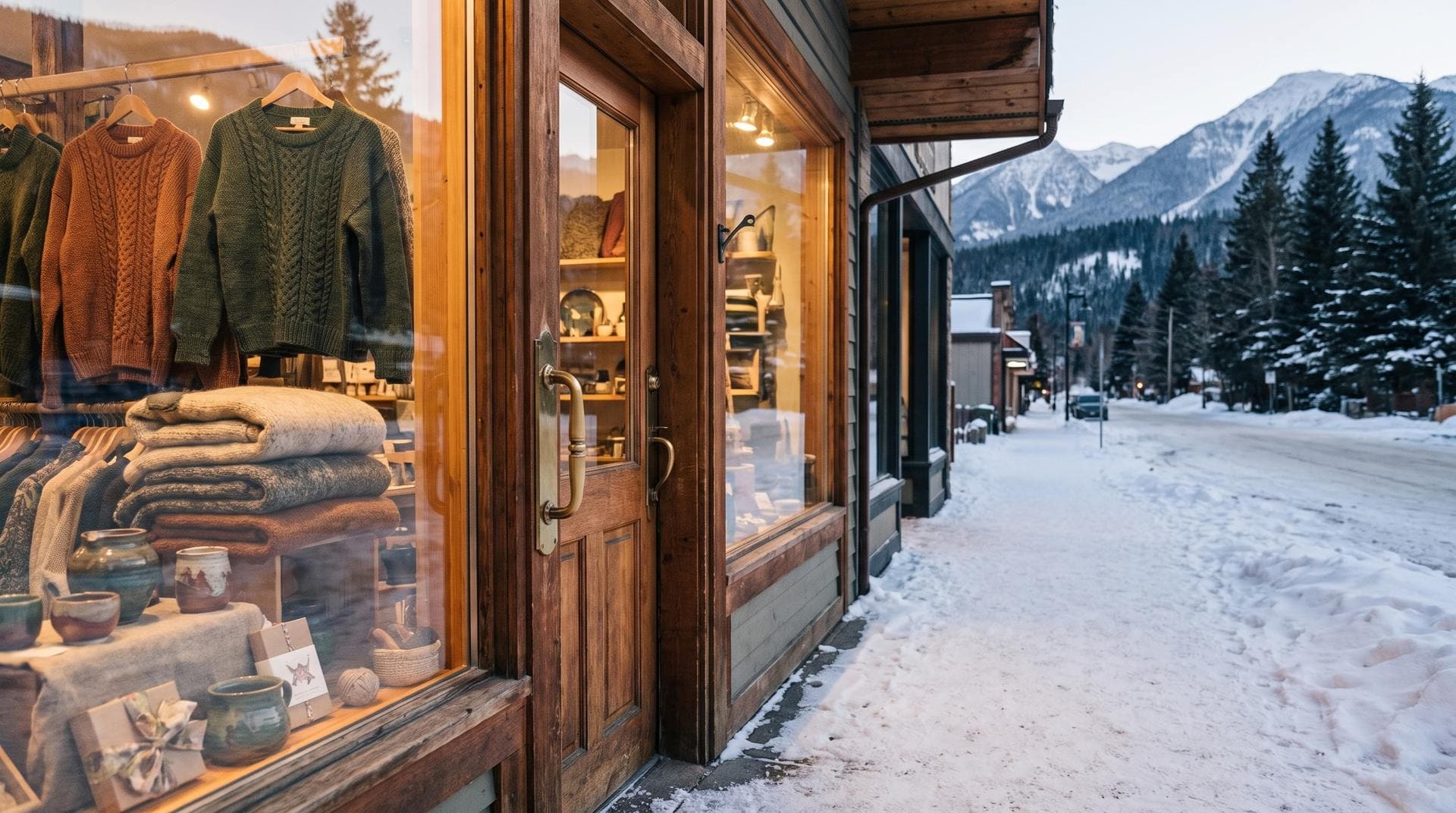
Key takeaways
- Many abandoned carts are a confidence problem rather than a price problem.
- Show shipping rates and the pickup option on the product page, before the cart, not after.
- Local pickup as a real checkout option keeps money in town that is currently going to a warehouse in Ontario.
- Your own email list is the only audience no platform can take away from you.
- A catalogue site is often the right first build. Checkout can come once online is really a channel.

On this page
What does a local shop website need to do?
Seven things carry a small retail site: current hours, what you actually carry, real photographs of the store, shipping shown before the cart, local pickup as a genuine option, plain return terms, and an email list you own. Together they answer the questions a shopper asks in the seconds before they either walk over or close the tab.
Shopify and the platform layer handle the transaction well. Hosted checkout, payment processing, inventory, shipping rates, taxes, and a theme library are all solved problems. What the platform cannot give you is a reason to buy from you rather than from a warehouse, and that reason is the site.
- Current hours and holiday hours, matched to your Google listing, on the first screen.
- What you actually carry, described by brand and category, so a search for the thing finds the shop.
- Real photographs of the store, the street, the window, and the door people are looking for.
- Shipping rates and timelines shown on the product page, before anyone builds a cart.
- Local pickup as a real checkout option, with pickup windows and the address in reach.
- Return and exchange terms written in plain words and reachable before checkout.
- A consent-based email list, because your own list is the only audience no platform can take away.

Two shoppers, one website
A shop site is read by people in two completely different situations, and a page built for one of them quietly loses the other. The good news is that most of what serves one serves both.
- The person in town tonight
- They are deciding whether to walk over before you close. They need hours, the address, whether you carry it, and whether it is worth the trip in February.
- The person buying from three towns away
- They found you through a search or a market. They need the product detail, the shipping cost, and enough about you to trust a card with a stranger.
- The visitor who leaves on Sunday
- Fernie, Nelson, and Kimberley all run on this shopper. They found something they liked, went home, and now want to order it. If the site cannot take that order, someone else got it.
- The regular who does not know you ship
- They order from a warehouse in Ontario and wait a week for a thing sitting on a shelf four blocks away. That is a signage problem, and the site is the sign.
The visitor deserves particular attention in this region. Fernie, Nelson, Kimberley, and Invermere all fill up with people who find something on a Saturday and think about it on the drive home. If your site cannot take that order on Tuesday, the thought goes nowhere. Making it able to is a Shopify store with local pickup, $5,500.
The regular who does not know you ship is ordering the same thing from Ontario. That is a signage problem, and the website is the sign.
Hours, stock, and the honest answer about inventory
Hours are the cheapest trust you can build and the easiest to let rot. A shop site and a Google listing that disagree is telling somebody you might be closed, and in a small town that costs a visit you never hear about.
Stock is harder and it needs an honest answer. A live inventory count on a catalogue site drifts the first busy Saturday, and one wrong number teaches a shopper to stop trusting the page. Where you run Shopify POS or Square, sync it properly so a sale at the counter comes off the online count. Where you do not, describe what you carry by brand and category rather than pretending to a count you cannot keep.
That distinction matters most for one-of-a-kind stock. A piece that sold on the shop floor an hour earlier should never be purchasable online, because a refund email where a parcel should have been costs more than the sale was worth.
Where the visit actually gets decided
The path from a search to a walk over is short and it is mostly made of facts. Six moments, and a shop site can lose at any of them without ever knowing it happened.
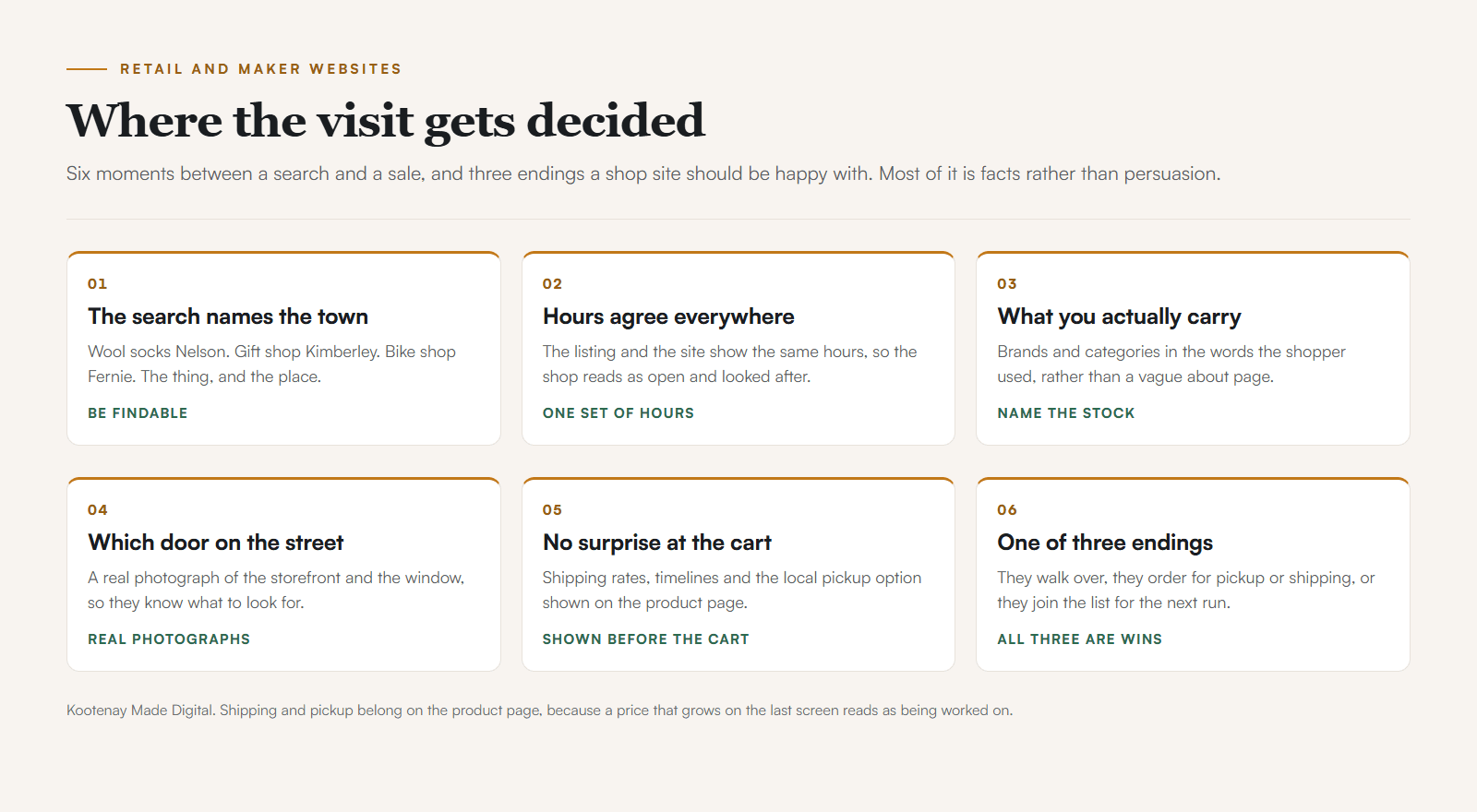
- 01A search names the thing and the town. Wool socks Nelson, gift shop Kimberley, bike shop Fernie.
- 02Your listing and your site both show the same hours, so the shop reads as open and looked after.
- 03The page says what you carry, by brand and category, in the words the shopper used.
- 04A real photograph of the storefront tells them what door to look for on the street.
- 05Shipping and pickup are visible before the cart, so nothing changes on the last screen.
- 06They walk over, or they order, or they join the list for the next run. All three are wins.
Notice the third ending. A shopper who joins the list instead of buying today is worth more than the single order you did not get, because retail compounds through drops, holidays, markets, and repeat buyers. My guide to shop content that sells without being pushy covers what to send them.
Shipping shown early, pickup treated as real
Many abandoned carts are a confidence problem. A shopper builds a cart around a price they believed, watches it grow on the last screen, and closes the tab feeling worked on.
Canada treats an unattainable advertised price as a deceptive practice, with only government-imposed taxes allowed to appear later. That is the legal floor, and the commercial reason is stronger. Rates, timelines, and any free-shipping threshold stated on the product page cost you nothing and stop the evening you currently spend answering what shipping to Calgary runs.
Local pickup deserves the same treatment. Make it a real checkout option with a pickup window and the address visible from every product page. In a region where many of your buyers live twenty minutes away, pickup is the difference between keeping the margin and paying a courier for a trip across town. My guide on hidden fees and drip pricing in Canada goes deeper on the rules.
A store, or a catalogue? An honest split
Plenty of shops are sold a full store when a catalogue would have done, and plenty of makers are sold a catalogue when they needed checkout. The answer comes from how you actually sell rather than from a package.
| What is being compared | If you build the wrong one | What you actually need |
|---|---|---|
| You mostly sell in person | A catalogue site with hours, what you carry, and photos. | Checkout is overhead you maintain for a handful of orders. |
| Online is a real channel | A catalogue plus email capture will lose sales. | A proper store, with rates, pickup, and a checkout people trust. |
| One-of-a-kind stock | Nothing syncs, so online and the till disagree by Saturday. | POS sync so a sale at the counter comes off the online count. |
| Custom or made-to-order | A cart forces you to guess at variants that do not exist yet. | A structured order path with clear starting points and a policy page. |
| Market season is the business | A site that goes quiet between markets. | Market dates, a waiting list, and a list you own before the next run. |
If you are weighing a store at all, the honest tradeoffs are in my guide on whether Shopify is worth it for a Kootenay store, and the ecommerce website design for Kootenay shops page carries the full build path either way.
A Castlegar maker, and what the build carried
Family Designs & Creations is a client build in this category, and it shows what the structure looks like when a business is built on custom work rather than on shelf stock.
Kim makes apparel, embroidery, engraving, sublimation, gifts, business merchandise, team orders, and fundraisers. That breadth is the problem the site had to solve. When every project is possible, buyers freeze, so the build gives them four obvious starting points instead of a blank order form: gifts, business merch, team apparel, and fundraisers.
The rest is deliberately small. Eight focused pages, a product menu covering what Kim actually makes, a maker story page, a custom order page, and policy pages for returns, custom orders, shipping and pickup, and privacy. Those policy pages are doing conversion work rather than legal work, because they answer the quiet questions before hesitation sets in. Real recommendations sit in the trust sections rather than in a carousel nobody scrolls to.
The positioning is the part worth stealing. The site makes the one-person studio the reason to choose her, because one person to talk to and one set of hands making the order feels safer than sending money to a faceless custom-products site. Kim also launched on the payment path that ends with her owning the site outright, which means a real Castlegar maker took a full custom build on terms sized for a one-person studio. The full write-up is in the Family Designs & Creations case study.
Where shops stand in the Kootenays
Retail is spread across a lot of small categories here, and a good number of them are invisible to a search. The single largest retail category on the register makes the point.
On The Kootenay List, the register of Kootenay businesses I built and maintain, the largest retail category is grocery stores, and 71 of the 117 listed have no website at all, as of September 3, 2026. The breakdown by town and category sits in the Kootenay business web census.
The pattern shifts hard by town. Nelson runs close to three quarters of its businesses online, so a Baker Street shop is competing on what the page says rather than on whether one exists. Kimberley sits near a third, which means a Platzl shop with a real site has the search largely to itself. Fernie and Cranbrook fall between them, and both carry the visitor traffic that makes an order-after-they-go-home path worth building. The web design in Nelson and web design in Fernie pages carry each town's numbers.
What it costs, and where to start
A catalogue and presence site starts at the Trailhead: $2,000, typically delivered in 2 to 3 weeks. It carries hours, what you stock, real photographs, an enquiry path, and email capture.
A full store with checkout, shipping rates, POS sync, and local pickup usually lands on the Storefront at $5,500, or $1,375 today and $386 a month for 12 months, which is $6,007 all in. The Own It Monthly plan spreads either one, and the Trailhead on that plan is $2,000 once, or $500 today and 12 monthly payments of $142, which is $2,204 all in and yours outright at payment 12. Kootenay businesses get the 10% neighbours discount off any build. What you pay depends on what the shop actually needs, not on a package name.
If a site already exists, the free website check-up will show you where the sale is being lost, from surprise shipping to hours that disagree with your listing. If there is no site yet, start here, and bring a photograph of your storefront from across the street.
Sources and further reading
- Competition Bureau Canada: drip pricing
Canada treats an unattainable advertised price as a deceptive practice. Only government-imposed taxes may be added later, which is why shipping belongs before the cart. Read September 2026.
- Consumer Protection BC: our laws
The provincial consumer protection framework covering disclosure for distance sales, including terms a buyer can keep. Read September 2026.
- Office of the Privacy Commissioner: PIPEDA fair information principles
What collecting names, addresses, and order history obliges you to do. Collect what a purpose needs, say why at the point of capture, and keep the policy accurate.
- WCAG 2.2 quick reference
The accessibility criteria I build to. Keyboard-navigable product pages, real alt text, readable contrast, and a checkout that works with assistive technology.
Frequently asked questions
Do I need an online store, or just a website?
It depends on whether online sales are a real channel or a side door. If most of your selling happens at the counter, a catalogue site with hours, what you carry, and photographs does the job for less money. If online is genuinely part of the revenue, build the store properly.
Can it sync with my POS and handle local pickup?
If you run Shopify POS or Square, inventory lives in one place, so a sale at the counter or a market booth comes off the online count. Local pickup shows as a real option at checkout with clear instructions, which matters here, where plenty of buyers would rather swing by than pay to ship across town.
Why does shipping have to be shown before the cart?
Because a price that grows on the last screen feels like being worked on, and Canada treats an unattainable advertised price as a deceptive practice. Rates and timelines on the product page also cut the evening you currently spend answering the same shipping question by hand.
Can this work for makers who mostly sell at markets?
That is where a lot of Kootenay makers start. The site can launch as a catalogue, a story page, a wholesale enquiry path, a market schedule, and an email capture engine, then add checkout later. The market circuit becomes the top of the funnel instead of the whole business.
What about Etsy, Amazon, and Facebook Marketplace?
They are discovery channels worth using. They also take a fee, hide your buyer list, and rank you against everyone else selling something similar. A store of your own keeps the margin, the customer email, and the ability to run a product drop on your own schedule.
How do I stop a one-of-a-kind piece selling twice?
POS sync is the answer where you run Shopify POS or Square. Without it, keep the online catalogue to items you can restock and handle unique pieces by enquiry. A refund email where a parcel should have been costs more than the sale was worth.
How much does a shop or maker website cost?
A catalogue and presence site starts at the Trailhead: $2,000, typically delivered in 2 to 3 weeks, with a 12-month payment plan available. A full store with checkout, rates, and pickup usually lands on the Storefront at $5,500, or $1,375 today and $386 a month, which is $6,007 all in. Kootenay businesses get the 10% neighbours discount off any build.
Related pages
Kootenay Made Digital
I build websites, local presence, and calm AI setups for Kootenay small businesses. Plain language, published prices, and clear work that makes you easier to find and easier to choose.