


 Castlegar, BC. Serving the Kootenays and beyond.
 9 min read
Key takeaways
- Shopify earns its fee when you carry real inventory and want sales beyond the till, such as shipping, pickup, and repeat orders.
- The true monthly cost is the plan, processing, and apps. Discipline on apps is what keeps it lean.
- Roughly 70 percent of carts are abandoned everywhere. Recovery emails are standard machinery, not an extra.
- For Kootenay retail, the tourist who went home is the online store’s best customer. Capture the email in July, sell again in November.
- Simpler is enough for static products and made-to-order work. Pay for machinery when the machinery has a job.

On this page
Is Shopify worth it for a small store?
Yes, when products are the core of the business, inventory and shipping are real jobs, and you want revenue that does not depend on the till being open. No, when you sell a static handful of items or made-to-order work where a conversation beats a cart. The real question is whether your store needs machinery.
I build on Shopify and I will still talk you out of it when it is the wrong tool. Around half the shop owners who ask me about a store actually need one this year. The other half need a better trust page, a Google profile that works, and a season of proof first. This guide is the same conversation, minus the coffee.
Shopify is not a website. It is retail machinery with a storefront attached. Buy it when the machinery has a job.
When Shopify wins for a small store
Shopify earns its keep when several of these are true. The more that apply, the less the monthly fee matters, because the machinery is doing work you are currently doing by hand or losing outright.
- Products are the core of the business, not a side table: you carry real inventory, variants, and prices that change.
- You sell beyond the till: shipping across BC and Canada, local pickup, or both.
- You need the machinery, such as inventory tracking, taxes, shipping rates, discount codes, gift cards, and refunds that do not require a spreadsheet.
- You want the revenue that runs while the shop is closed: abandoned cart recovery, email flows, and a store that sells at 11 p.m.
- Tourist customers should be able to buy from you again after they drive home.

Notice that none of those are about looking modern. They are operational, covering stock truth, shipping math, taxes, recovered carts, and repeat customers. A store that clears even a few hundred dollars a month online has already paid for the plan, and the abandoned-cart email alone often covers it. Industry-wide, roughly 70 percent of carts are abandoned, and recovery flows reliably claw back a meaningful slice of them.
When simpler is enough
Skipping Shopify is not falling behind. For some Kootenay businesses, a clean product page with a clear way to order is the honest right answer, and the store can come later with evidence behind it.
- You sell a handful of items that rarely change, and a clean product page with an order form or e-transfer covers it.
- The real business is in-person: markets, the shop floor, custom orders, and the website mainly needs to build trust and show hours.
- Inventory is one of one: custom or made-to-order work where a conversation beats a cart.
- You are testing whether anyone wants the product before investing in the machinery.
The deeper version of this decision, including what a simpler product page should still do well, is in whether you need a store platform at all. And if your products are serious enough that even Shopify themes feel tight, read when Shopify is not enough, because the ladder goes up as well as down.
The honest cost math
Five line items decide what Shopify really costs a small Canadian store. Most surprise bills come from the third one.
- The Shopify plan
- The Basic plan runs $37 CAD a month on yearly billing, checked September 2026. That covers the table stakes, with hosting, checkout, and the admin included.
- Payment processing
- Roughly 2.8 percent plus 30 cents per online card transaction on Basic. Every platform charges processing; Shopify’s is mid-pack and drops on higher plans.
- Apps
- The quiet budget killer. Reviews, bundles, subscriptions, and back-in-stock alerts often arrive as $10 to $40 monthly apps each. A disciplined build needs few or none of them.
- The build itself
- A theme you wrestle evenings for a month, or a professional build. At Kootenay Made Digital, custom Shopify stores start from $5,500, or $1,375 today and 12 monthly payments of $386, $6,007 all in on Own It Monthly, with product structure, shipping, taxes, email foundations, and launch handled.
- Your time
- The real cost of the DIY route. Sixty hours of owner evenings is not free, and a half-finished store quietly costs sales every week it stays half-finished.
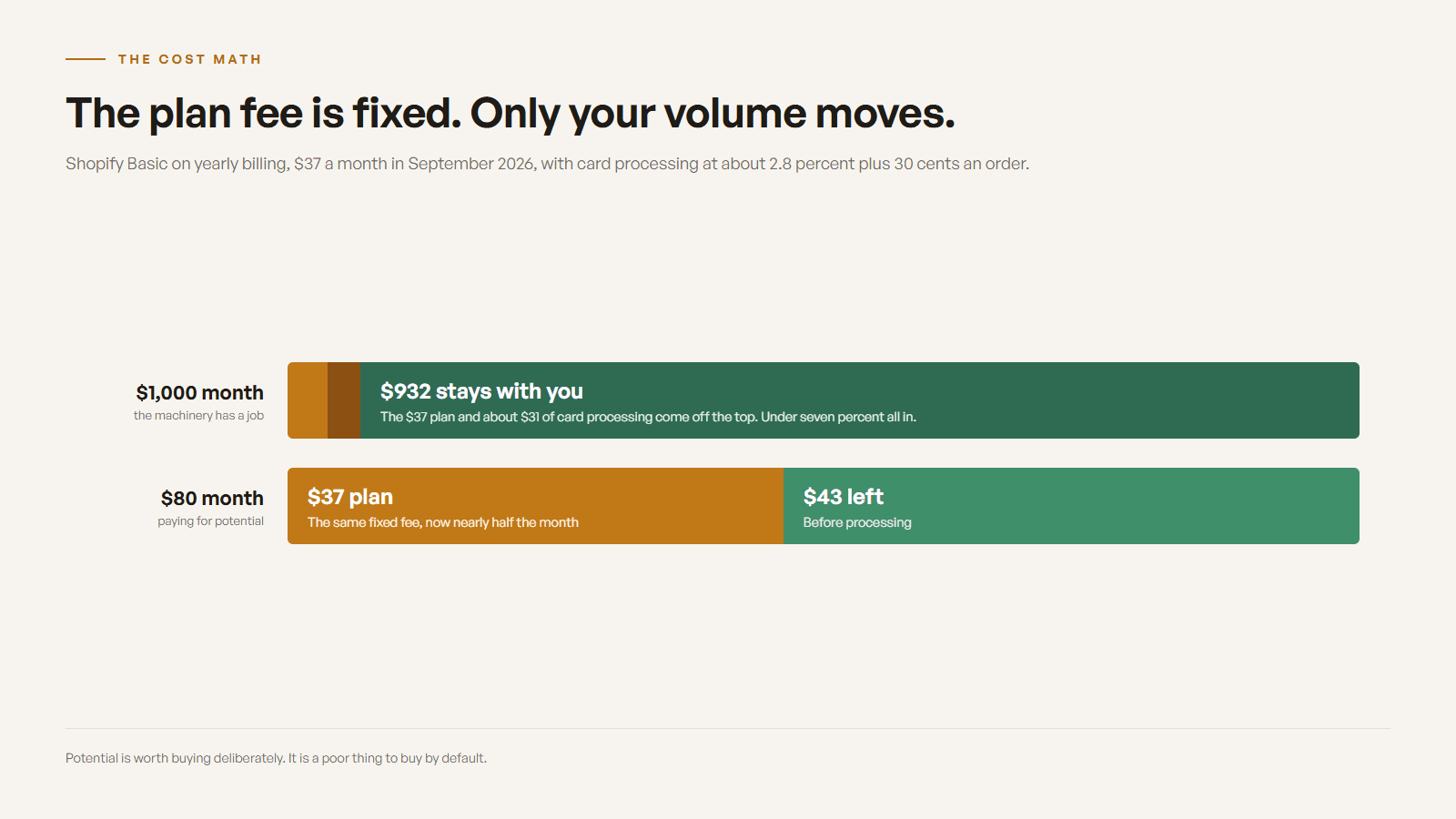
Run that math against a realistic month. A shop doing $1,000 a month online pays $37 for the plan and about $31 in processing, at September 2026 rates. That is under seven percent all-in, for checkout, hosting, inventory, and the machinery. The same shop doing $80 a month online is paying mostly for potential, and potential should be bought deliberately, not by default. The full yearly bill, with the domain, email and build added in, is in what an online store costs in Canada.
What a properly built store actually changes
The difference between DM-and-e-transfer selling and a real store is not aesthetics. It is what happens while you are asleep, busy, or closed for the season.
| What is being compared | Selling by hand | A built store |
|---|---|---|
| Checkout | E-transfer requests, DMs, and phone orders that depend on you being awake. | A real checkout with cards, wallets, taxes, and receipts, working at midnight. |
| Inventory | A notebook or memory, with the occasional oversell apology. | Stock tracked per variant, synced between the floor and the website. |
| Shipping | Guesswork at the post office and undercharged parcels. | Real rates by weight and destination, labels printed at the counter. |
| Recovered sales | A browser tab someone closed, gone forever. | Abandoned checkout emails that quietly recover roughly a tenth of lost carts. |
| The tourist who went home | A nice memory of your shop. | A customer on your email list who reorders from Calgary in November. |
The right-hand column is also why the build quality matters. A rushed theme with guessed shipping rates and no email flows delivers the left-hand column with a monthly fee attached. Product structure, shipping rules, taxes, and the welcome and abandoned-cart flows are the store. The theme is just the paint.
How to decide, in five steps
Make the call with your own numbers instead of platform marketing or platform fear.
- 01Count your products: items, variants, and how often prices or stock change. Machinery pays off with volume and change.
- 02Decide where the revenue should come from in two years: the till only, or the till plus shipping, pickup, and repeat online orders.
- 03Do the cost math above against one month of realistic online sales. A store clearing a few hundred dollars a month online already covers the plan.
- 04Check your operational tolerance. If a notebook inventory and post-office guesswork are already hurting, the machinery is overdue.
- 05If you proceed, build it properly once: product structure, shipping rules, taxes, email, and analytics from day one beat a year of patching a rushed theme.
If the math says not yet, that is a fine answer that saves you a year of fees. If it says yes, build it once and properly: see the Shopify build path for what a complete launch includes, and the retail and ecommerce websites playbook for how I build the storefront around it. Selling on Etsy today? The Etsy vs your own store math shows when the home base should become yours.
The Kootenay angle: the tourist who went home
Kootenay retail has a rhythm city stores do not. Summer visitors discover you in person, then disappear over the pass. Without an online store, that discovery is a one-time sale. With one, the July tourist becomes the November reorder, the Christmas gift shipped to Calgary, and the friend they sent your link to.
That is the real case for Shopify in a small town. It is not about competing with Amazon. It is local pickup for the neighbours, Canada-wide shipping for the visitors who went home, and an email list that remembers both. Castlegar, Nelson, Rossland, and Trail shops with good products are sitting on exactly this kind of quiet, repeatable revenue. A brewery is a clean example, taproom traffic in summer plus merch and gift boxes shipped all year, and what a brewery website should include maps that whole mix.
If that is your shop, the next step is simple: run the free check-up or tell me what you sell, and I will give you the same honest read I would give a neighbour, because around here, you probably are one.
Sources and further reading
- Shopify: pricing plans for Canada
Current Canadian plan pricing and per-transaction processing rates, the honest baseline for the monthly math.
- Baymard Institute: cart abandonment statistics
Documents the roughly 70 percent average cart abandonment rate, which is why recovery emails are not optional machinery.
- Google Merchant Center: free product listings
A proper product feed earns free placement in Google Shopping results, one of the underused advantages of a structured store.
Frequently asked questions
Is Shopify worth it for a very small store?
It is worth it when products are the core of the business and you want sales beyond the till, such as shipping, pickup, and repeat orders. It is not worth it for a handful of static items or made-to-order work where a conversation beats a cart. The dividing line is machinery. Pay for it when inventory, shipping, and checkout are real jobs.
What does Shopify actually cost per month in Canada?
Plan on $37 CAD a month for the Basic plan on yearly billing (checked September 2026), plus about 2.8 percent and 30 cents per online card transaction, plus any apps you add. A disciplined build keeps apps near zero; an undisciplined one quietly doubles the monthly cost.
Can I just sell through Facebook and e-transfer instead?
You can, and plenty of Kootenay sellers start there. It stops scaling the moment orders need taxes, shipping rates, inventory truth, or a checkout that works while you sleep. The DM-and-e-transfer model is a stage, not a destination.
Do I need a custom Shopify build or is a theme enough?
A stock theme is fine for testing. A professional build pays for itself when the store is the business. That means product structure that matches how customers shop, shipping and taxes done right, email flows wired in, and a storefront that does not look like every other theme. KMD Shopify builds start from $5,500.
How do tourists fit into a Kootenay store’s online strategy?
They are the reason online matters here. A visitor who loves your shop in July becomes a repeat customer in November only if there is a store to return to and an email list that remembers them. Local pickup plus Canada-wide shipping captures both halves.
What about Square, Wix ecommerce, or Etsy instead?
Square is strong when the till matters more than the website. Wix ecommerce inherits the platform limits covered in the Wix vs custom guide. Etsy is a marketplace with real reach, and the customers, fees and rules are theirs. Shopify is the default when the store itself is the asset you want to own.
Related pages
- Retail and ecommerce websites
- Craft beverage websites
- Kootenay ecommerce and Shopify builds
- Shopify web design in Nelson
- A Local Shop Website That Earns the Visit
Kootenay Made Digital
I build websites, local presence, and calm AI setups for Kootenay small businesses. Plain language, published prices, and clear work that makes you easier to find and easier to choose.