

 hello@kootenaymade.ca
 Castlegar, BC. Serving the Kootenays and beyond.
 10 min read
Key takeaways
- Ask whose name goes on the domain registration first. The answer tells you more than the rest of the meeting.
- Ask for a live site they built and run a speed test on it yourself while you are on the phone.
- A fair quote states what is excluded, counts custom page designs rather than URLs, and says what a change costs after launch.
- A guaranteed ranking is a red flag, because Google documents that nobody can promise one.
- There are good designers in Nelson, Trail and Cranbrook. Ask every builder the same ten questions and hire whoever answers best.

On this page
How do you choose a web designer in the Kootenays?
Ask every candidate the same ten questions, then compare the answers before you compare the prices. The questions take fifteen minutes on the phone and they sort a builder from a reseller faster than any portfolio does, because a portfolio shows the good day and the answers show the ordinary ones.
This is for an owner about to spend real money with somebody they found through a friend or a search, usually for the first time. It is not for a business happily working with a builder already, because the only thing this guide would do there is manufacture doubt about a relationship that works.
A note on who is writing. I build websites in Castlegar and I would like the job. So take the guide as an argument rather than as neutral advice, ask my competitors the same ten questions, and hire whoever answers best.
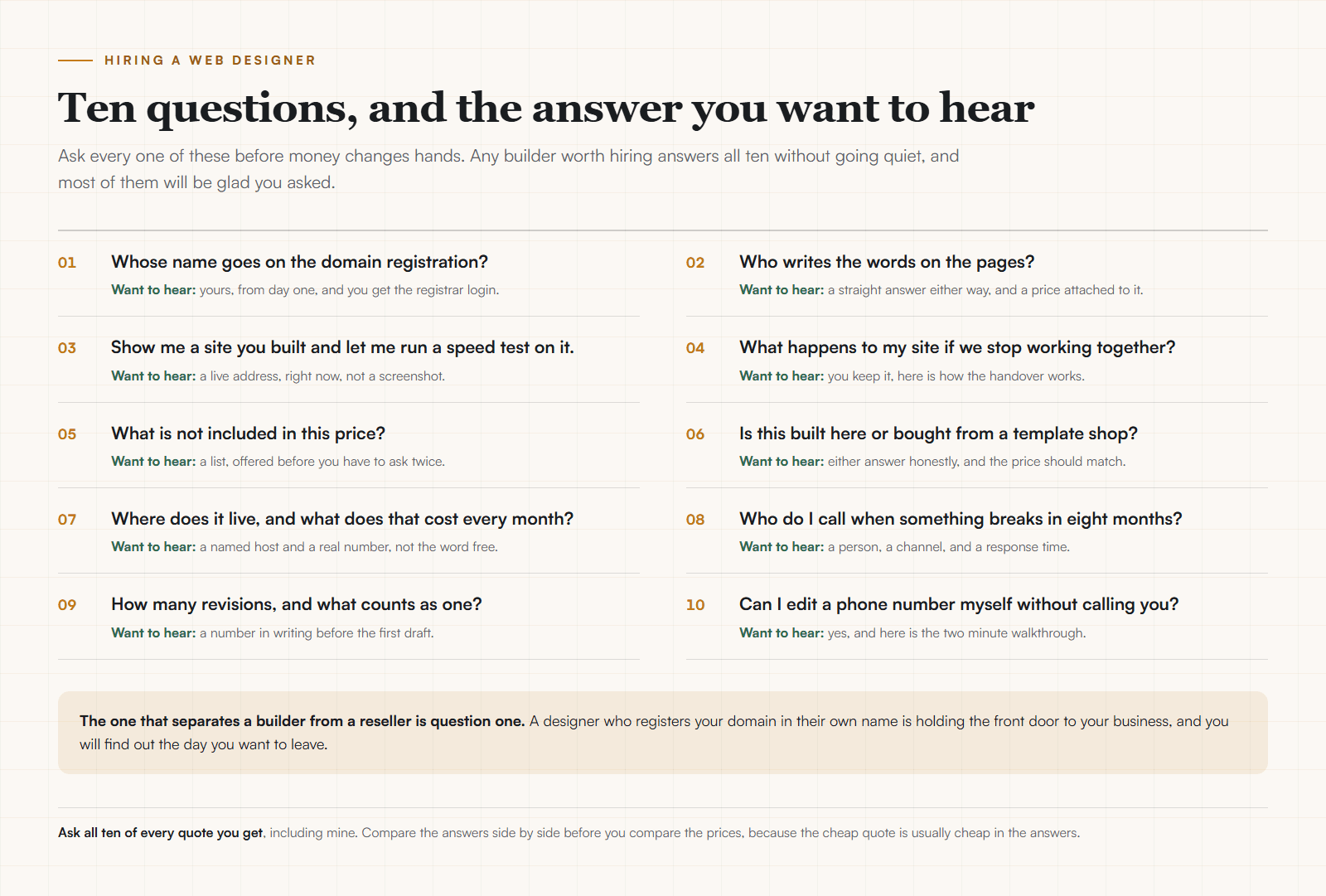
Why the first question is the one that matters
Whose name goes on the domain registration. A designer who registers your domain in their own name holds the front door to your business, and you find out on the day you want to leave. It costs them nothing to do it correctly, so the answer is a straight test of how they treat clients.
The answer you want is that the domain goes in your name, at a registrar with your email on the account, and you get the login. Anything else is worth pushing on. “We manage it for you” is not the same thing as “you own it”, and the difference only becomes visible during a departure.
The same applies to the files and the accounts. A site living in a builder’s personal hosting account is a site you cannot take with you. Ask where the code lives and whose account it is in. I go through the full ownership audit in who owns your website, and the domain mechanics in the Canadian domain guide.
Every question on that card is about what happens on an ordinary day or a bad one. Anybody can look good in a portfolio.
What does a fair quote look like?
Specific about what is included, specific about what is excluded, honest about what happens after launch, and arrived at after somebody asked what the site actually has to do. A number quoted before that conversation is a guess wearing a suit.
| What is being compared | A quote worth taking seriously | A quote worth a second look |
|---|---|---|
| The number | A range with what moves it, or a fixed price after a real conversation about scope. | A single figure quoted before anybody asked what the site has to do. |
| What is included | A written list, including what is excluded and what costs extra later. | Everything you need, unspecified. |
| Pages | Counted as custom page designs, with the number stated. | Up to eight pages, with no definition of a page. |
| Content | Who writes the words and takes the photographs, named, with a price on it. | Silence, which usually means you are writing it. |
| Timeline | A realistic window with what would move it, offered as a goal. | Live next week, guaranteed. |
| After launch | What support costs, what a change costs, and who to call. | No mention, until the first invoice for a change. |
| Ownership | The domain and the files in your name, stated in writing. | Nothing about ownership anywhere in the document. |
The pages line trips up more comparisons than anything else. A quote counting URLs and a quote counting custom page designs describe different amounts of work, and the cheap one and the expensive one are often quoting the same site. Ask each builder which they are counting and the two numbers usually converge.
Content is the other quiet one. If nobody says who writes the words and takes the photographs, the answer is you, and that is the reason most half finished websites are half finished. What to expect from a web designer covers how the process usually runs and where it stalls.
Does hiring a local designer actually matter?
Sometimes, and for specific reasons rather than as a rule. It matters for photographs of your own place, for pages that name real towns correctly, and for being able to fix something in a phone call. It matters less when your customers are national or the right specialist happens to live elsewhere.
- You want photographs of your own place taken in the right season, by somebody who knows which week the light is right.
- The site has to name real towns and real service areas, and getting those wrong reads as an outsider immediately.
- You would rather sort a problem in one phone call than in a ticket queue two time zones away.
- Your reputation here is the business, so the person building it should have some skin in the same community.
- You want to sit across a table at least once, because some conversations go better in person.

And the honest other side, because there are good reasons to hire somebody far away:
- The work is specialised enough that the right person is simply somewhere else.
- Your customers are national or international, so local knowledge adds nothing to the pages.
- The builder you want has a real portfolio of the exact thing you need, and it happens to be in another province.
- You are comfortable working over video and email, and the project is well defined.
The local landscape is real. There are people doing good work in Nelson, Trail and Cranbrook, and I am not going to pretend otherwise to win a job. Nelson runs 72 percent of its 714 listed businesses online and Cranbrook 53 percent of 1,027, on The Kootenay List compiled September 3, 2026. Those sites were built by somebody, and plenty of them are good.
What I would avoid either way is a builder with no live examples you can visit. A screenshot proves a picture was made. A URL proves a website exists, loads, and works on your phone in your kitchen, which is the whole product.
The red flags
Five, and each of them is a fact rather than a feeling. A price before a scope conversation. No written inclusions. Silence about ownership. A guaranteed ranking. And a monthly fee with no end date, where you stop paying and the site disappears.
- 01
A price before the scope conversation
Nobody can price a website before knowing what it has to do. A number offered in the first two minutes is either a template price or an opening bid.
- 02
No written list of inclusions
If the proposal does not say what is excluded, everything you assumed was included becomes a change order later. Ask for the exclusions specifically.
- 03
Silence about ownership
A proposal that never mentions who owns the domain, the files, or the content has left the most consequential question unanswered on purpose or by habit. Either way, ask.
- 04
A guaranteed ranking
Google documents that nobody can guarantee a position in its results. Anyone promising one is either uninformed or counting on you being uninformed.
- 05
A monthly fee with no end
Some monthly arrangements are honest rentals and some are ownership plans with an end date. What matters is knowing which one you signed, and what you hold on the day you stop paying.
The cheap quote deserves its own treatment, because it is not always wrong. A template with your logo dropped in is a real product at a real price when it is described as one. The problem is a template quoted as a custom build. When a website quote is too cheap goes through what usually got left out.
What should it cost?
A credible small business site starts around $2,000 and rises with what the site has to do rather than with how many pages it has. Anything much below that is usually a template, which can be a fine buy when it is honestly described.
My own numbers are published rather than quoted on request. The Trailhead is $2,000 for three custom page designs in about two to three weeks, and the tiers above it are priced by what the site does. Kootenay businesses get 10% off any build, which is the one region-exclusive thing I offer. If the timing suits better, that same $2,000 can run as $500 today and 12 monthly payments of $142, $2,204 all in, with the site yours outright at payment 12 through Own It Monthly.
I publish prices for the same reason I wrote this guide: it lets you compare before a conversation rather than after one. Ask everybody you talk to for a written number and a written list, and treat reluctance about either as information. The website cost guide covers the whole Canadian range and what moves it.
How to run the calls
Three builders, the same ten questions, one page of notes each. Ask everything before you talk about money, because the answers change how you read the numbers. Then leave it a day before deciding.
Have a live site of theirs open while you talk. Load it on your phone, watch how long it takes, and try to find the phone number with one thumb. Whatever they tell you about speed and mobile, the thing in your hand is the evidence.
2,527 of the 5,836 businesses on The Kootenay List had no website at all when it was compiled September 3, 2026. If you are one of them, the bar to clear is lower than it feels, and the first honest site does more for you than a perfect one does two years late.
One last thing. Whoever you hire, get the ownership answer in writing before the deposit leaves your account. Everything else in a website project is fixable later. That one is the piece that decides whether the work you paid for stays yours.
If you want to see how I answer each of these questions, my process page walks through a build from the first call to the handoff.
Sources and further reading
- The Kootenay Business Web Census
The Kootenay List snapshot behind the town figures quoted here, restated through the site helper rather than typed in by hand.
- Kootenay Made Digital published pricing
My own published prices and what each tier includes, published so a prospect can compare before a conversation rather than after one. Every figure quoted in this guide comes from there.
- Google Search Central, hiring an SEO
Google’s own guidance on what to ask anyone selling search work, and its documented position that no one can guarantee a ranking. Useful as an independent reference when a quote promises one.
Frequently asked questions
How do I choose a web designer in the Kootenays?
Ask the same ten questions of everyone you talk to, then compare the answers before you compare the prices. The ones that matter most are who the domain gets registered to, what happens to the site if you part ways, and whether they will show you a live site they built so you can test its speed yourself.
What questions should I ask a web designer before hiring?
Whose name goes on the domain, who writes the words, show me a live site you built, what happens if we stop working together, what is not included, where does it live and what does that cost monthly, who do I call when it breaks, how many revisions, and can I edit a phone number myself. Ten questions, and any builder worth hiring answers all of them.
How much should a small business website cost in the Kootenays?
A credible small business site starts around $2,000 and rises with what the site has to do rather than with how many pages it has. My own Trailhead tier is $2,000 for three custom page designs, typically delivered in two to three weeks. Quotes far below that usually mean a template with your logo dropped in, which is a fair product at a fair price when it is described honestly.
Should I hire a local web designer or someone remote?
Local matters when the site needs real photographs of your place, when the pages name towns and service areas you have to get right, and when you want to sort a problem in one phone call. It matters less when your customers are national or the specialist you need happens to live elsewhere. Both are defensible, and neither is automatically better.
What are the red flags in a website quote?
A price given before anybody asked what the site has to do. No written list of what is included. Silence about who owns the domain. A guaranteed ranking, which nobody can promise. And a monthly fee with no stated end, where you stop paying and the site disappears.
Who should own my website and domain?
You. The domain registered in your name, the files in an account you control, and the content yours to take with you. Ask for this in writing before you pay a deposit. A builder who hesitates on that question has told you something more useful than the rest of the meeting.
Are there good web designers in the Kootenays besides you?
Yes. There are people doing good work in Nelson, Trail and Cranbrook, and I am not going to pretend otherwise to win a job. Ask every one of them the ten questions, look at live sites each of them has built, and hire whoever answers best. If that is not me, the guide still did its job.
How long should a small business website take to build?
Two to three weeks for a straightforward site once the content exists, and four to five weeks for something larger. Those are goals rather than guarantees, and the honest bottleneck is almost always content: the photographs and the words about your own business that only you can supply.
Related pages
- Trades and contractor websites
- Professional services websites
- Retail and ecommerce websites
- Web design in Castlegar
- Web design in Nelson
Kootenay Made Digital
I build websites, local presence, and calm AI setups for Kootenay small businesses. Plain language, published prices, and clear work that makes you easier to find and easier to choose.