


 hello@kootenaymade.ca
 Castlegar, BC. Serving the Kootenays and beyond.
 10 min read
Key takeaways
- CIRA lists eighteen eligibility categories for holding a .ca, and ordinarily resident means more than 183 days in Canada in the preceding twelve months.
- The same .ca costs C$15.68 a year at NamesPro and CAD $31.00 at Webnames. Both are Canadian registrars, both checked September 2026.
- A .ca registered under an individual category gets free WHOIS privacy. A business registrant name is displayed by default.
- Register the domain in your own name, in your own account, with registrar lock and two-factor turned on.
- The domain sits above the DNS, the hosting, and the site, so losing it takes the website and the email at the same time.

On this page
Should a Canadian business use a .ca or a .com?
Take the .ca when your customers are Canadian and the business is local, because it reads as a Canadian business to a Canadian buyer and the good short names are still there. Take the .com when you sell across borders or the name is your brand everywhere. Buy both when you can, and point one at the other.
This is for an owner about to register a first domain, or about to discover that theirs is registered to somebody else. If you already hold your domain in your own name at a registrar you can log into, skip ahead to the lock and expiry section and then get on with your day.
The prices and the CIRA policy below were read on September 4, 2026. Registrars change their pricing whenever they like. CIRA changes its policy rarely, and the version in force when I checked was 1.3.
Who is allowed to hold a .ca domain?
Eighteen categories of person and organisation, set out in CIRA’s Canadian Presence Requirements. For most small businesses the answer is easy: a Canadian citizen, a permanent resident, or a corporation registered federally or in a province. The requirement is continuing rather than a one time check.
- A Canadian citizen of the age of majority in the province where they live or last lived.
- A permanent resident who is ordinarily resident in Canada, which CIRA defines as more than 183 days in the past twelve months.
- A corporation under the laws of Canada or of any province or territory.
- A partnership registered in a province or territory, where more than 66.6% of the partners qualify on their own.
- An unincorporated club or association where at least 80% of members and 80% of officers are ordinarily resident in Canada.
- The holder of a trade-mark registered in Canada, limited to a domain made of the exact word component of that mark.

The full list runs to eighteen and includes trusts, trade unions, political parties, schools, libraries, hospitals, Indian bands, Aboriginal Peoples, and governments. There is also a trade-mark route for a company with no other Canadian connection, and it is narrow: the domain can only consist of or include the exact word component of the registered mark.
Two practical notes. CIRA can ask you to prove the category you picked after registration, so choose the one that is actually true. And “ordinarily resident in Canada” means more than 183 days in the twelve months before you register, and in each twelve months after, which matters for anyone splitting the year somewhere warmer.
A .com is available to anyone on earth. A .ca has a rule behind it, and that rule is exactly why a Canadian customer trusts one.
What does a domain cost in Canada?
Between roughly fifteen and thirty-six dollars a year, and the spread is the registrar rather than the domain. At NamesPro.ca a .ca is C$15.68 a year and a .com is C$20.74. At Webnames.ca the identical .ca is CAD $31.00 and the .com is CAD $36.38. Both are Canadian registrars, both checked September 2026.
| What is being compared | NamesPro.ca | Webnames.ca |
|---|---|---|
| .ca, first year and renewal | C$15.68 a year | CAD $31.00 a year |
| .com, first year and renewal | C$20.74 a year | CAD $36.38 a year |
| Transfer a .ca in from elsewhere | Priced with registration | CAD $23.00 |
| Transfer a .com in from elsewhere | Priced with registration | CAD $30.56 |
| Tax | 5% GST added at checkout, totals processed in CAD | Shown before checkout |
The domain you get is the same either way, because both companies are CIRA certified registrars writing into the same registry. What differs is the markup, the interface, the support, and whether privacy and extras are bundled or billed. Neither price is wrong, and paying double for a registrar you can reach on the phone is a defensible choice.
Ignore the free first year offers that come attached to website builders. That domain is free for twelve months and then renews at whatever the platform charges, and worse, it lives inside a platform account you may want to leave. A separate registrar for around fifteen dollars keeps the address independent of the house.
Whose name should the domain be registered in?
Yours. The business owner’s legal name or the company’s, in an account with your email on it and your card behind it. A domain registered in a designer’s name is the front door to your business held by somebody else, and it is the single most common trap I find when I take over an existing site.
- The domain is registered in the business owner’s legal name or the company’s, never in a designer’s.
- The account it lives in belongs to the business, with the business owner’s email on file and two-factor turned on.
- Registrar lock stays on, so a transfer cannot start without someone unlocking it deliberately.
- Auto-renew stays on and the card on file stays current, because an expired domain takes the email down with the website.
- The renewal date lives in a calendar somewhere a human will see it, not only in an inbox nobody reads.
Every domain I set up goes into the client’s name from day one, with registrar lock on and two-factor enabled. That is written into how the work is priced and it is not a favour. When somebody leaves my care they take the domain, the files, and the accounts with them, because none of it was ever mine. That is what a website with the domain in your name from day one means in practice.
You can check your own situation in a minute. Search your domain in CIRA’s WHOIS. If it is a business registration the registrant name is displayed by default, so you will see whose it is. If it was registered under an individual category the details are hidden, because CIRA gives individual registrants free privacy protection automatically, and then you check by trying to log into the registrar yourself. Who owns your website walks through the rest of the audit.
Where does the domain sit in all of this?
At the top. The domain is the name, the DNS points that name at a server, the hosting is the machine holding the files, and the site is the pages themselves. Four layers, usually four different companies, and the domain is the one that takes everything else down with it.
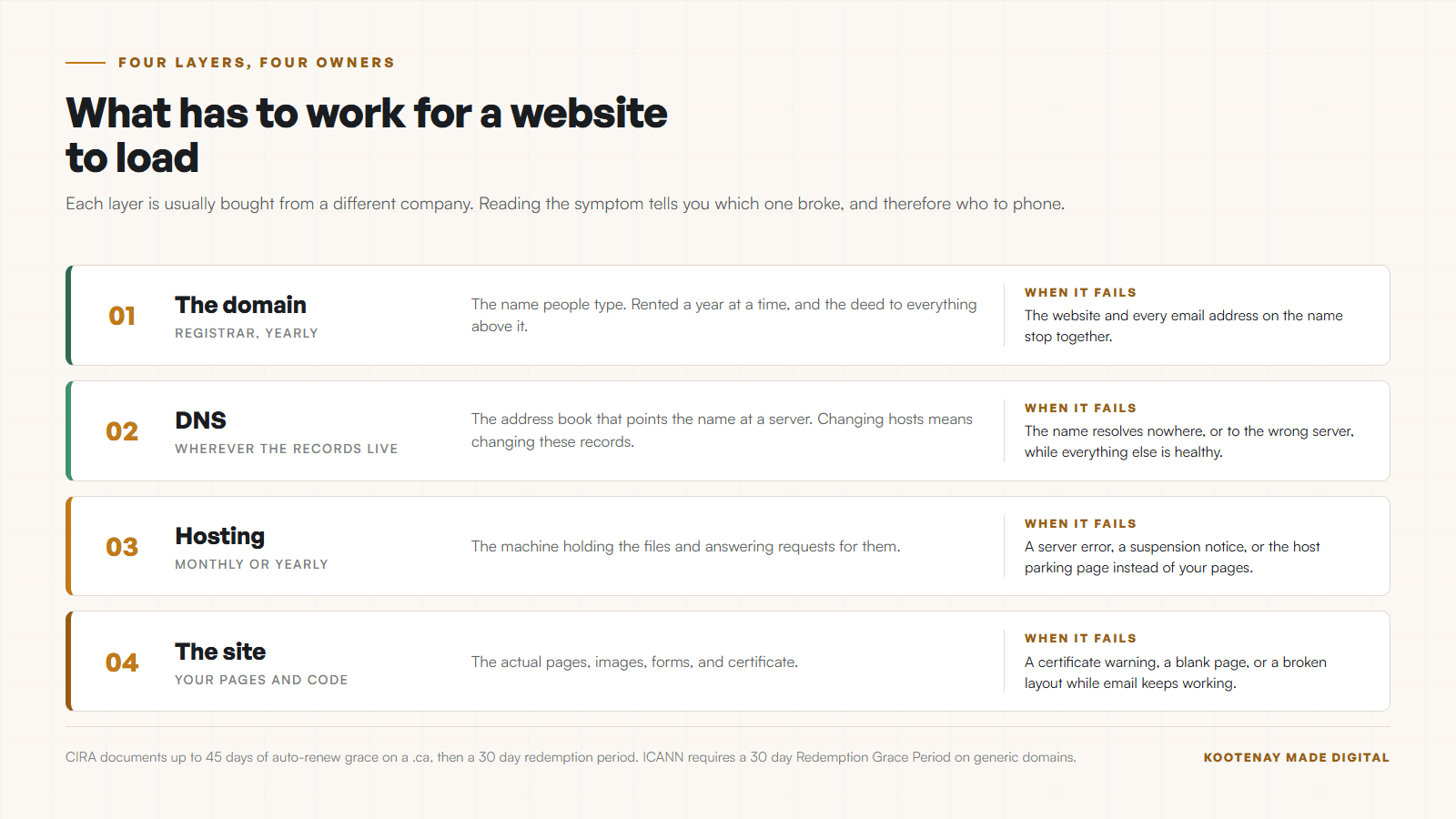
That is the practical reason to care about the registration. Hosting can be moved in an afternoon, a site can be rebuilt, and DNS records can be repointed. A domain that somebody else holds, or that lapsed and got bought by somebody watching for it, is a different kind of problem, for the website and for business email at your own domain alike. Website down or domain expired covers the recovery order when it has already happened.
Lock, transfer, and the expiry trap
Three switches decide whether your domain stays yours: registrar lock, auto-renew, and a current card. Turn all three on the day you register and the domain becomes the boring part of your business rather than an emergency.
- Registrar lock
- A flag on the domain that blocks a transfer until somebody deliberately unlocks it. Leave it on permanently and turn it off for the two days a genuine transfer takes.
- Transfer
- Moving a domain between registrars costs money and takes a few days. Webnames charges CAD $23.00 to transfer a .ca in, checked September 2026, and a transfer usually adds a year to the registration rather than wasting the time you paid for.
- Expiry
- When a domain lapses, the website and every email address on it stop at the same moment. CIRA and the generic registries both allow a grace window and then a redemption period at a much higher fee, and after that the name goes back on the market.
- Auto-renew
- On, always, with a card that has not expired. The most common domain disaster I see is a renewal notice going to an email address at a company nobody works for any more.
Buying a domain properly, in ten minutes
Pick the name, check both extensions, register at a Canadian registrar in your own name, turn on lock and auto-renew, add two-factor, and write the renewal date in a calendar. Doing all of it before anyone builds anything saves an argument later.
On the name itself: short, sayable over the phone, and free of hyphens and clever spellings. If you have to spell it out twice at the counter, it is the wrong name. Include the town if the business is local and you intend to stay local, and leave it out if you might not.
A local example of why the name matters. Castlegar has 800 businesses on The Kootenay List as of September 3, 2026, with 320 of them running no website. When one of those finally registers a name, the good short .ca versions of their trade and town are usually still free, which is rarely true of the .com.
Do this even if you are not building a website this year. A domain is around fifteen dollars, 2,527 Kootenay businesses on the List have no website at all, and a name you hold is a name nobody else can take while you decide. When you are ready, the website builder comparison covers where to point it, and website hosting in Canada explained covers the layer underneath.
Sources and further reading
- CIRA, Canadian Presence Requirements for Registrants
Policy version 1.3, read September 4, 2026. Eighteen categories, (a) through (r), covering citizens, permanent residents, corporations, trusts, partnerships, associations, trade unions, political parties, schools, libraries, hospitals, Indian bands, Aboriginal Peoples, governments, and holders of a trade-mark registered in Canada. Ordinarily resident is defined as more than 183 days in the preceding twelve months.
- CIRA WHOIS and .ca domain privacy
Read September 4, 2026. CIRA states that a domain registered under an individual category gets free privacy protection in WHOIS automatically, and that a non-individual registrant such as a corporation has its registrant name and administrative and technical contact displayed by default.
- NamesPro.ca domain pricing
Fetched September 4, 2026 from a CIRA certified Canadian registrar. .ca C$15.68 a year and .com C$20.74 a year, with registration and renewal at the same price, 5% GST added, and all transactions processed in Canadian dollars.
- Webnames.ca pricing
Fetched September 4, 2026 from a second Canadian registrar. .ca CAD $31.00 a year to register and to renew with a CAD $23.00 transfer, .com CAD $36.38 a year with a CAD $30.56 transfer.
Frequently asked questions
Should a Canadian business use .ca or .com?
Use .ca when your customers are Canadian and the business is local. It signals a Canadian business to a Canadian buyer, and shorter names are still available. Use .com when you sell across borders, when a name is your brand everywhere, or when the .com already exists and pointing it at your site avoids losing traffic to whoever holds it.
Who is allowed to register a .ca domain?
CIRA lists eighteen eligibility categories in its Canadian Presence Requirements, version 1.3. The common ones are a Canadian citizen of the age of majority, a permanent resident who is ordinarily resident in Canada, and a corporation registered under Canadian, provincial or territorial law. Holders of a trade-mark registered in Canada also qualify, limited to a domain matching the exact word component of that mark.
What does ordinarily resident in Canada mean for a .ca domain?
CIRA defines it as residing in Canada for more than 183 days in the twelve months immediately before the registration application, and in each twelve month period after that for as long as the registration lasts. It is a continuing requirement rather than a one time check at signup.
How much does a domain name cost in Canada per year?
It depends entirely on the registrar. At NamesPro.ca a .ca is C$15.68 a year and a .com is C$20.74, with 5% GST added. At Webnames.ca the same .ca is CAD $31.00 and the same .com is CAD $36.38. Both checked September 2026. The domain is identical either way, so the price difference is the registrar’s markup and their support.
Who should own my business domain name?
You, in your own legal name or your company’s, in an account you control. A domain registered in a designer’s name is the front door to your business held by somebody else, and you find out the day you want to move. Every domain I set up goes in the client’s name from day one with registrar lock and two-factor on.
How do I find out who owns a domain name?
Search the domain in CIRA’s WHOIS for a .ca. A business registrant has its name and administrative and technical contacts shown by default. An individual registrant gets free privacy protection automatically, so personal details are hidden and CIRA offers a message delivery form to reach them instead.
Should I buy both the .ca and the .com?
Buy both when the budget allows and the .com is available, then point one at the other. Two domains at Canadian registrar prices is roughly C$36 a year, which is cheap protection against somebody registering the twin of your name later. Pick one as the real address and redirect the other, rather than running two live sites.
Related pages
- Professional services websites
- Trades and contractor websites
- Retail and ecommerce websites
- Web design for Canadian businesses
- Web design across British Columbia
Kootenay Made Digital
I build websites, local presence, and calm AI setups for Kootenay small businesses. Plain language, published prices, and clear work that makes you easier to find and easier to choose.