


 hello@kootenaymade.ca
 Castlegar, BC. Serving the Kootenays and beyond.
Cedar & Stone Lodge
A small-lodge site that shows the full price and takes the booking itself.
32
Pages and routes
5
Rooms with their own page
4
Steps to a booking request
15
Journal guides for trip planners
Guests book through the platforms because the platforms answer their questions.
Every platform booking costs a cut.
A guest who books a small lodge through a commission platform pays the lodge less than one who books direct, for the same night in the same room.
And it costs the businessAcross a season, those cuts add up to money a five-room lodge feels.
Guests will not book on a price they cannot see.
When the rate hides the taxes or the cancellation terms, guests go to a platform that shows the total and the rules.
And it costs the businessThe lodge loses the booking to a site it pays, or answers the same price question by email again.
Small details decide the stay.
Stairs, check-in times and what is included matter to a guest who is arriving late or bringing a parent with bad knees.
And it costs the businessEvery detail the site leaves out becomes a message the hosts answer by hand, often during breakfast.
Built to make booking direct the easy choice.
The full price, before anything is sent.
The booking request shows the rate and each BC tax line by line, so the total is never a surprise.
A request that goes to the hosts.
Four steps, then the request reaches the people who run the lodge, not a third party.
Every room answers its own questions.
Stairs, check-in, cancellation and what is included sit on each room page, drawn from one policies file.
A reason to stay, not only a room.
Breakfast, the hot pools, Kootenay National Park and fifteen guides make the trip, on facts that trace to their sources.
The thinking behind the build
Cedar & Stone Lodge is a fictional five-room bed and breakfast 3 km from the Radium hot pools, rebuilt in September 2026. A small lodge lives or dies on direct bookings, because every night sold through a commission platform costs it a cut. So the site answers everything a guest checks before booking: the room, the full price with tax, the stairs, the check-in window, the cancellation terms and what there is to do in the valley.
A small lodge pays a platform commission on every booking that does not come to it directly. Guests go to the platforms because the platforms answer their questions: the full price, the cancellation terms, what the room is like. The rebuild set out to answer all of those on the lodge's own site, so booking direct becomes the easier choice rather than the loyal one.
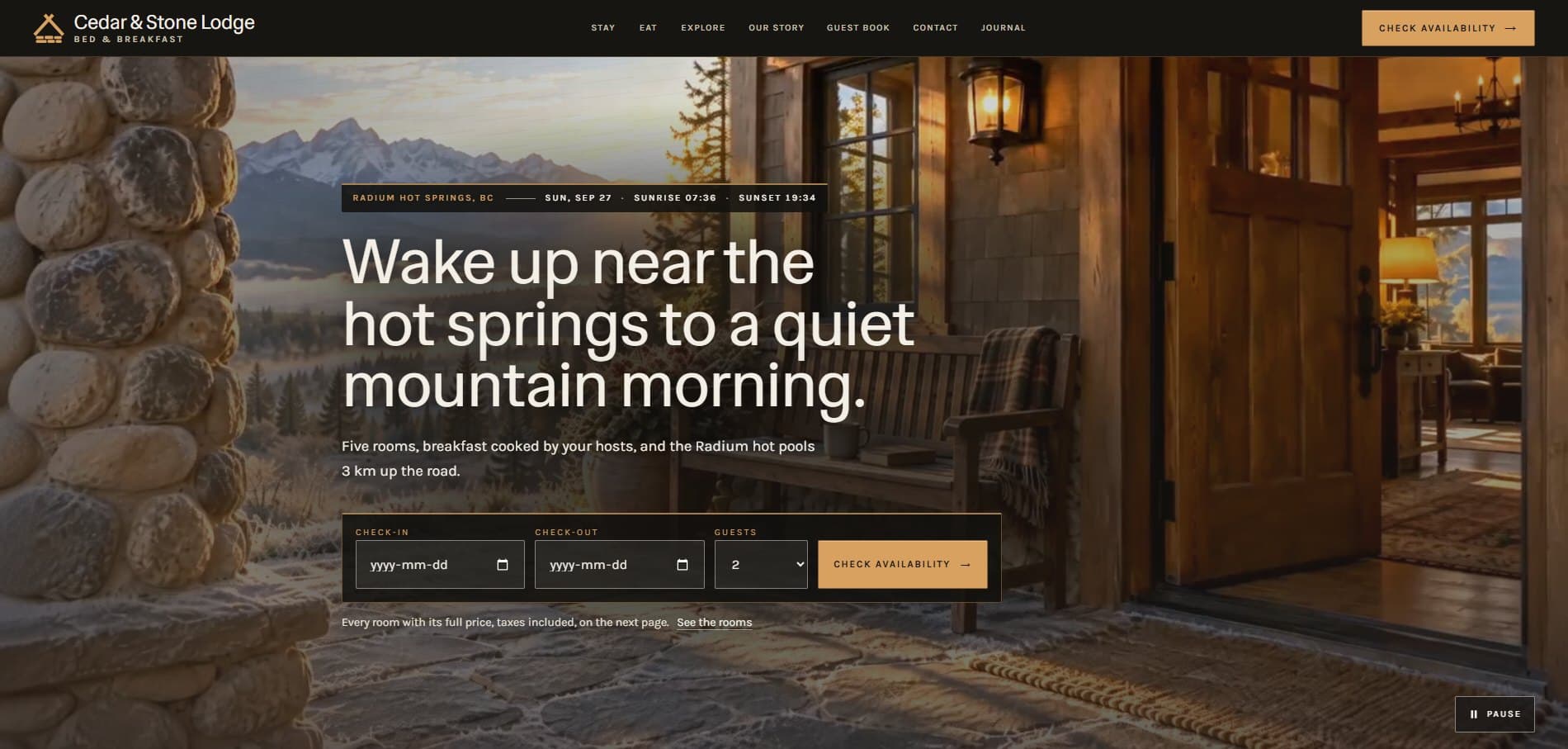
The booking request is the centre of it. A guest chooses dates, a room and how many are coming, and sees the price for the stay with the GST, PST and municipal and regional district tax set out line by line. It takes four steps, and the request goes to the hosts rather than to a third party. The homepage says up front that every room's full price, taxes included, is on the next page.
Each room answers the questions a guest would otherwise email about. The five room pages give the bed, the view and the starting rate, and a Good to know block covers how many stairs there are, the check-in window and the cancellation terms. The Moonlit Ridge Suite, for example, says it is one flight of 14 steps with a handrail. The questions page draws from the same policies file, so no answer contradicts another.
The site sells the stay as well as the room. The hero opens on the lodge with today's date, sunrise and sunset, and a day at the lodge runs down the homepage from arrival to breakfast to a morning at the hot pools. Every fact about Radium, from the pools to Kootenay National Park, traces to Parks Canada or the provincial government, and fifteen journal guides meet travellers while they plan.
The rebuild was checked the way a guest would use it. An automated accessibility scan reads zero violations on all 32 pages at phone and desktop widths, and text on the textured bands was pixel-checked for contrast. The phone menu now opens in about a tenth of a second. The contact map loads only when someone asks for it, and a privacy page says what the site collects.
For a real lodge, inn or cabin rental, the same build runs on its own rooms, rates and house rules, with the booking request wired to the reservation system it already uses. The Good to know blocks become the questions its hosts answer by email every week.
What a guest knows before they send a request.
They know the total
The rate and every tax are on the page before the request is sent.
They know the room fits
Stairs, check-in and cancellation are answered on the room page, not in an email thread.
They know who they are dealing with
The request goes to the hosts, and the site tells a guest what the lodge collects and why.
Everything that shipped.
I rebuilt the lodge site from its imagery up. It has five room pages, each with a Good to know block for stairs, check-in and cancellation, and a four-step booking request with the taxes itemised. There is a breakfast page, an Explore guide to the valley built on Parks Canada and provincial facts, a questions page drawn from one set of house policies, and fifteen journal guides. Everything carries a new hero film, a consistent image set, a new logo and type, plus accessibility and privacy pages.
Highlights
- A four-step booking request that shows the room, the nightly rate and each BC tax before it is sent
- Five room pages, each with its bed, view, starting rate and a Good to know block
- Stairs, check-in times and free cancellation terms stated on every room page
- Today's date, sunrise and sunset in the hero, so the page reads like a morning at the lodge
- Explore built on Parks Canada and provincial sources: the hot pools, Kootenay National Park and the valley
- A questions page drawn from one policies file, so every answer matches the room pages
- Fifteen journal guides for the searches travellers make before a Radium trip
- A map on the contact page that loads only when a guest asks for it

Pages and surfaces
- Home
- Stay, with a page for each of 5 rooms
- Eat (breakfast and private dinners)
- Explore the valley
- Our story
- Book direct
- Guest book
- Journal with 15 guides
- Questions
- Contact
- Accessibility
- Privacy
Real code. Real routes. Production ready.
- House policies live in one file, so the room pages, the questions page and the booking request always agree
- The booking request works out BC accommodation taxes line by line before anything is sent
- Sunrise and sunset in the hero are calculated for Radium each day, with nothing typed in
- Zero automated accessibility violations on all 32 pages, at phone and desktop widths
- The phone menu is ready at load, so the first tap opens it in about a tenth of a second
- The contact map and other heavy pieces load only when a guest asks for them
Stack
How it was built
Cedar & Stone Lodge is a fictional concept, and the site says so. The lodge, the hosts Mara, Theo and Charli, the rooms, rates and guest book entries are invented, and the guest book labels its entries as illustrative. The facts about Radium and Kootenay National Park are real and sourced. For a real lodge, the same site runs on your real rooms, your real rates and your own reservation system. Counts read from the live site on September 28, 2026.
Let guests book the lodge, not the platform.
The same booking request, room pages and valley guides can be built around your rooms and your house rules. Start with the free check-up and I will show you where your site sends guests to a platform. No website yet? Tell me about the lodge and I will show you where to begin.
No website yet? Start your first one here
Built as The Engine, $6,500. Own It Monthly can spread the build over 12 payments, yours outright at the end.
In this industry yourself? Read the lodge and B&B website design playbook.
More work
07 / 23