


 hello@kootenaymade.ca
 Castlegar, BC. Serving the Kootenays and beyond.
 8 min read
Key takeaways
- Google removes reviews for policy breaches, and allows negative experiences described respectfully.
- Review count and score sit inside prominence, one of three local ranking factors Google names.
- Write about eighty words, to the next reader, and stop after one reply.
- Offering anything in exchange for removing a negative review breaks Google policy.
- Volume is the real defence. One bad review among forty barely registers.

On this page
What does a bad review actually do?
Less to your ranking than you fear and more to your next customer than you would like. Google counts reviews inside prominence, one of three local factors it names, so a single review moves an average rather than a position. The person reading it tomorrow is the real audience. This guide is for an owner staring at a fresh one star; if you have no reviews yet, the sibling guide on asking for them is the better start.
- What Google says it uses
- Google names relevance, distance and prominence as the main local ranking factors, and lists review count and score inside prominence. One review moves a number that is built from all of them.
- What Google says you cannot do
- Google states there is no way to request or pay for a better local ranking. That includes buying your way out of a bad review.
- What replying does
- Google says replying shows customers you value their feedback. It is written as a customer relationship benefit, so treat a reply as something you do for the next reader rather than for the algorithm.
- What it does to humans
- This is the real cost. The next person compares your reply to the complaint and decides what kind of business you are. That decision happens in about fifteen seconds.
Small towns change the math in both directions. As of September 3, 2026, The Kootenay List counts 318 businesses in Kimberley, and only 113 of them have a website. In a market that size a review is read by people who know both names, which makes a graceful reply worth more than it would be in a city and a sharp one cost more.
You are not writing to the reviewer. You are writing to the person reading in March.
What does a good reply look like?
Five parts, in order, in about eighty words. Open with the person, name the specific complaint, correct one fact if a fact is wrong, own your half, and offer a direct way to reach you. Then stop.
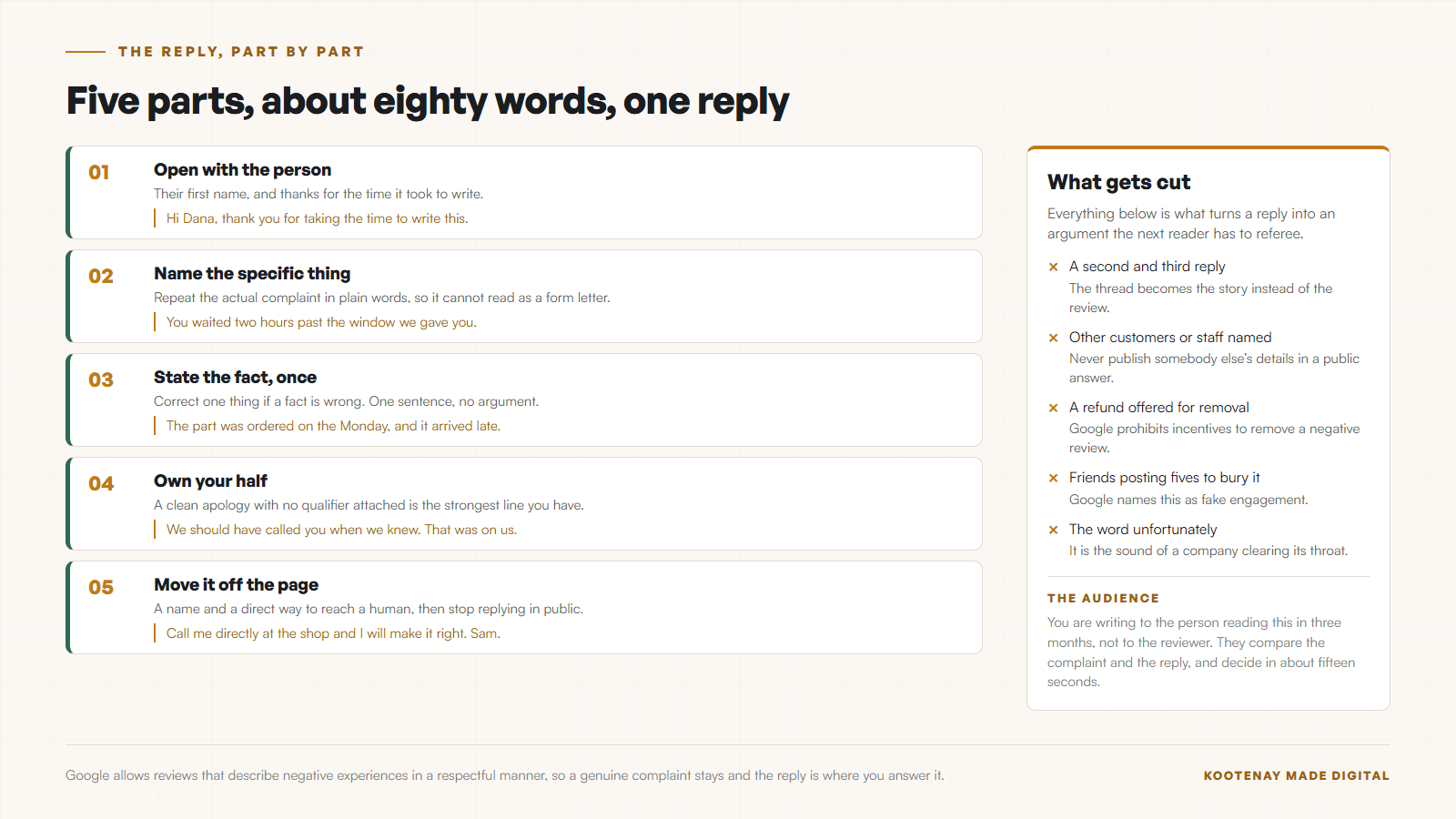
- 01
Open with the person, not the platform
Use their first name if you have it. Thank them for the time it took to write. Two sentences at most, and no corporate preamble.
- 02
Name the specific thing
Repeat the actual complaint in plain words. The late arrival, the wrong part, the wait. A reply that could apply to any review reads as a form letter, and readers know one when they see one.
- 03
State the fact, once
If a fact is wrong, correct it calmly and briefly. One sentence. You are writing for the reader in three months, and that reader stops reading the moment it becomes an argument.
- 04
Own your half
Whatever was genuinely yours, say so without qualifiers. A clean apology is the strongest paragraph in a public reply and it costs nothing.
- 05
Move it off the page
Give a direct way to reach a human: a name, a phone number, an email. Invite the conversation somewhere it can actually be resolved, then stop replying in public.
The part owners skip is the fourth. A clean apology, with no qualifier attached, does more for the next reader than any explanation. The sentence that begins with sorry and then adds however has apologised for nothing, and every reader can feel the hinge.
How do I actually write it?
Six steps, and the first one is the only one that is hard. Waiting a night costs you nothing and saves you the reply you would have regretted. Everything after that is craft.
- 01Wait a night. Nothing good has ever been written into a review box within ten minutes of reading one.
- 02Check the facts internally first. Find the job, the invoice, the booking. Know what actually happened before you type.
- 03Draft it at about eighty words. Long replies read as defensive no matter how reasonable the words are.
- 04Read it out loud as if the customer is standing at your counter. If you would not say it to their face in front of other customers, cut it.
- 05Take out every instance of the word "unfortunately", and every sentence that opens with the company rather than the person.
- 06Have somebody who was not involved read it before you post. They will find the line that sounds sharp to a stranger.
Read the finished reply as a stranger would, next to the complaint. That pairing is what a customer actually sees. It is the same fifteen-second judgment I write about in whether your website is trusted enough to call, and the reply is one more surface being judged.
What will Google actually remove?
Policy breaches, and nothing else. Google publishes the categories, and the important line for owners is the other direction: content describing a negative experience in a respectful manner is allowed to stay. Flagging a fair review because it stings wastes your afternoon.
| What is being compared | What Google says | What to do |
|---|---|---|
| A review from somebody who was never a customer | Google prohibits content not based on a real experience. | Flag it, and say in the reply that you have no record of the visit. |
| A paid or incentivised review | Google prohibits reviews paid for, directly or in kind. | Flag it as fake engagement. |
| Reviews posted from several accounts by one person | Google names this specifically under fake engagement. | Flag each one, and note the pattern. |
| A competitor or an ex-employee | Google names reviews from people with a professional or personal relationship to the business, naming industry competitors and former employment directly. | Flag it and state the relationship. |
| Harassment, threats, or slurs | Google prohibits content containing a specific threat of harm or dehumanizing language. | Flag it immediately. This one usually moves fastest. |
| A genuine bad experience, stated respectfully | Google explicitly allows content describing negative experiences in a respectful manner. | It stays. Reply to it well. |
To flag one, open the review on your Business Profile, choose the report option, and pick the policy it breaks. Be specific and unemotional in the description, name the policy in Google words, and give whatever evidence you have: no booking record, an employment end date, a matching pattern across accounts. Then wait. Nothing is gained by flagging the same review six times.
What should I never do?
Five mistakes cause almost all the damage, and three of them break Google policy outright. The other two just make you look worse than the original review did.
- Do not argue in a second and third reply. The thread becomes the story instead of the review.
- Do not name other customers, staff, or medical, legal, or financial details in a public answer.
- Do not offer a refund in exchange for taking the review down. Google prohibits incentives for removing a negative review.
- Do not ask friends to post fives to bury it. Google names content posted at the request of one person as fake engagement.
- Do not go silent for a month and then reply. A reply that arrives late reads worse than none.

The refund one catches good people with good intentions. Fixing the problem is right and you should do it. Tying the fix to the review is the part Google prohibits, because it turns your reviews into something you bought.
How do I make the next one matter less?
Volume. A single one star among six reviews is a headline; among forty it is a footnote. Getting into the habit of asking is the only defence that works before you need it, and it is entirely within Google rules when you ask everybody rather than only the happy ones.
There is a regional reason to start today. As of September 3, 2026, The Kootenay List counts 1,027 businesses in Cranbrook and 483 of them with no website at all. For a business in that group, the Google profile and its reviews are the entire online impression, which makes the review count the whole shop window.
The mechanics are their own guide, on how to get more Google reviews without begging or buying. It covers the moment to ask, the exact sentence, and the link. The broader case for why reviews earn calls at all is in reviews, local search, and the phone ringing.
One more thing worth doing today. Read your profile the way a customer does, then read the site it sends them to. If the reviews say you are careful and the website says otherwise, the review is doing work the site is undoing. My guides on the Google Business Profile for a Kootenay business and why a business is not showing up on Google Maps cover the listing side of that in detail. If you would rather hand that work off, my page on local SEO and reviews for Kootenay businesses covers what I build.
Volume is the only defence you can build before you need it.
Sources and further reading
- Google: remove or report a review
Checked September 5, 2026. Lists the policy categories Google removes reviews under, and states that content describing negative experiences in a respectful manner is allowed.
- Google Maps: prohibited and restricted content
Checked September 5, 2026. Defines fake engagement, prohibits incentives in exchange for posting or removing a negative review, and names reviews from people with a professional or personal relationship to the business, including competitors and former employees.
- Google Business Profile: improve your local ranking
Checked September 5, 2026. Names relevance, distance and prominence, counts review number and score inside prominence, and states there is no way to request or pay for a better local ranking.
Frequently asked questions
Does one bad review hurt my Google ranking?
Less than most owners fear. Google names relevance, distance and prominence as the main local factors, and review count and score sit inside prominence alongside links and how known the business is. One review nudges an average. The bigger cost is the next reader deciding what kind of business you are.
Can I get a bad Google review removed?
Only if it breaks a policy. Google removes reviews that are not based on a real experience, that were paid for directly or in kind, that come from a competitor or former employee, or that contain threats or dehumanizing language. Google explicitly allows content that describes a negative experience in a respectful manner, so a genuine complaint stays.
How long should my reply be?
About eighty words. Name the person, name the specific problem, correct one fact if a fact is wrong, own whatever was yours, and give a direct way to reach you. Longer replies read as defensive regardless of how reasonable the sentences are.
Should I offer a refund to get the review taken down?
Fix the problem if it deserves fixing, and never tie the fix to the review. Google prohibits offering incentives such as payment, discounts, or free goods in exchange for posting, changing, or removing a negative review. Make it right because it is right, and let the customer decide what to do with their review.
What if the review is about something that never happened?
Flag it, then reply once, calmly, saying you have no record of the visit and inviting them to contact you directly so you can look into it. That reply is written for the next reader, not for the reviewer. Then stop. A second reply turns a false review into a public argument.
Related pages
- Restaurant and cafe websites
- Wellness and clinic websites
- Trades and contractor websites
- Web design in Kimberley
- Web design in Cranbrook
Kootenay Made Digital
I build websites, local presence, and calm AI setups for Kootenay small businesses. Plain language, published prices, and clear work that makes you easier to find and easier to choose.