


 Castlegar, BC. Serving the Kootenays and beyond.
City of Silvermere
A civic website organized around residents, not the org chart.
177
Pages and routes
129
Page modules
100%
Task-first IA
0
Templates used
Most city sites are built around departments. Residents do not think in departments.
Every misdirected call started on the website.
When a resident cannot find how to pay a bill, report an issue, or reach the right department, they call. Each of those calls is staff time spent answering something the site should have handled on its own.
And it costs the businessThe calls do not arrive evenly. They spike in the week property taxes are due, land on whoever is at the counter, and each transfer pulls someone off a permit file that then waits.
Transparency that is buried is not transparency.
Agendas, budgets, and bylaws hidden three clicks deep make a council look like it has something to hide, even when it does not. Residents trust what they can find.
And it costs the businessBuried records generate work: information requests for documents already published, emails asking when the agenda goes up, and a clerk re-sending the same budget file that has been on the site all along.
An org-chart website serves the org, not the public.
Residents do not know which department owns their problem, and they should not have to. A site organized by internal structure quietly pushes the work back onto the front counter.
And it costs the businessReports land in the wrong queue: a bylaw complaint routed to public works, the same streetlight arriving as several separate tickets, and a crew dispatched from an address nobody was prompted to confirm.
Built around the tasks residents actually arrive with.
A top-task homepage, not a welcome message.
Pay, report, taxes, permits, council, and emergency paths lead, because that is what residents actually came for.
Category-aware intake that routes itself.
A resident arrives with a specific issue and lands on a form already aligned to it, which cuts misrouted reports, duplicate calls, and staff follow-up.
Transparency as a normal layer.
Meetings, budgets, bylaws, and records are findable and current, so public trust is built passively instead of demanded.
The human side, handled.
Support, safety, and crisis resources make the city legible exactly when life is complicated, which is when people need it most.
The thinking behind the build
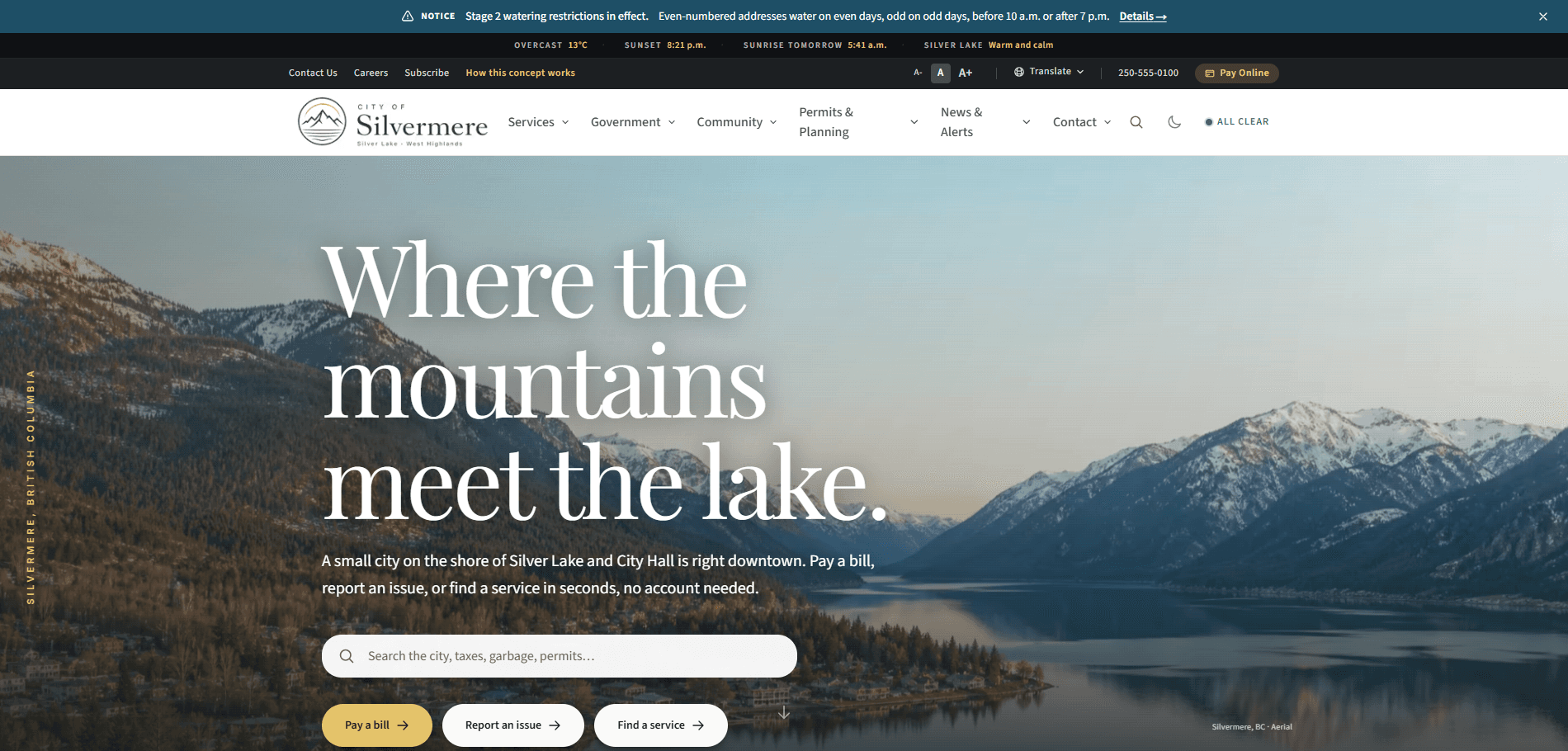
City of Silvermere is a fictional municipal website concept for a mountain-lake community. The goal was to show what a resident-first civic platform can feel like when services, deadlines, forms, support, council information, planning applications, public notices, and everyday tasks are organized around real public needs instead of department silos. For a municipality, the value is not decoration. The value is fewer confused calls, fewer dead-end searches, clearer compliance paths, stronger public trust, and a website that behaves like dependable civic infrastructure.
Municipal websites fail when they are organized around internal structure instead of resident urgency. Someone with a barking dog issue, a tax question, a building permit, a crisis resource need, a road concern, or a council agenda does not care which department owns the page. They care about getting to the right next step without decoding city hall.
Silvermere solves that by making top tasks obvious and repeating them through the site architecture. Pay a bill, report an issue, property taxes, utility rates, pet licences, building permits, business licences, council agendas, emergency paths, and support resources are treated as civic wayfinding, which is exactly what residents expect from a modern municipality.
The request flow is the clearest demonstration. The supplied animal concerns URL shows how a resident can arrive with a specific issue and land on a form already aligned to the category. That small detail matters because it reduces abandonment, misrouted reports, duplicate phone calls, incomplete submissions, and staff follow-up. Good UX is operational efficiency wearing a polite jacket.
For council and administration, the concept shows a public-trust layer: meeting pages, agendas, budgets, bylaws, reports, FOI, policies, elections, strategic planning, master plans, news, alerts, and document access. Municipalities need residents to believe information is findable and current. The structure makes transparency feel like a normal part of the service experience, not a PDF drawer hidden three clicks deep.
For planning and development teams, the site demonstrates how permits, inspections, housing strategy, downtown work, capital projects, climate planning, business licensing, tenders, investment, and small-business support can live in one coherent system. Builders, business owners, newcomers, and residents can self-serve the first layer of understanding before contacting staff.
For front-counter and communications staff, the value is routing. A department directory, staff profiles, contact paths, feedback, subscriptions, common questions, documents, forms, careers, volunteer opportunities, and support hubs reduce the number of conversations that begin with 'I could not find this on the website.'
The concept also handles the human side of local government. Support resources, Indigenous acknowledgement framing, accessibility pages, emergency and crisis pathways, public safety information, recreation pages, transit, heritage, attractions, seniors, veterans, youth, newcomers, cemetery information, pet life-event support, and warming centres all make the city feel legible when life is complicated.
The resilience layer is built for the province this concept lives in. Emergency Mode flips the whole site into evacuation posture with one control, rendered on the server so it works on every page even when JavaScript fails, and the emergency page itself stays available offline once visited. Wildfire season is precisely when networks degrade and residents reach for their phones, so the site is engineered for its worst day, not its best one.
The concept also answers the question every municipal evaluator asks: who maintains the content? A working decoupled Drupal 10 prototype shows the authoring side: department authors draft, approvers review, publishing can be scheduled, French translation is built in, and every field carries help text so real staff can be trained in an afternoon. The website stays fast and static; the CMS feeds it through a read-only API, and if the CMS is ever offline the site does not care.
Trust is treated as a measurable surface. A public site-health page shows per-template performance and accessibility scores from real scans, published on the site itself so anyone can check the claims, and an about-this-concept tour walks through nine deliberate design patterns with a try-it link on each. A municipal website that grades itself in public is making a promise about how it will be maintained.
The fictional setting gave the build freedom to be complete without exposing a real municipality to invented claims. Silvermere is visibly labelled as a concept, with invented people, services, addresses, documents, and contact details. That keeps the showcase honest while still proving the depth of the build.
What a resident feels when the answer is one click away.
Fewer dead ends
Top tasks repeat through the architecture, so residents reach the next step without decoding city hall first.
A city that looks organized
Findable records and current information make the municipality feel dependable, which is half of public trust.
Help when life is hard
Crisis, housing, newcomer, and senior resources are one path away, not buried in a PDF drawer three clicks deep.
Everything that shipped.
I built a full Next.js municipal concept with a civic brand system, fictional Silvermere setting, top-task homepage, service architecture, government and council routes, planning and permit pages, payment and report paths, request intake flows, support resources, staff directory, document surfaces, news and alert routes, accessibility/legal pages, generated civic imagery, fictional staff portraits, iconography, and clear concept disclaimers throughout. On top of that base sit the resilience and operations layers: a one-switch Emergency Mode that flips the entire site into evacuation posture and works even with JavaScript disabled, an offline-capable emergency page, a severity-aware alert system, answer-first search with curated top-task answers, a garbage-day lookup with per-zone calendar downloads, a shared events system feeding the calendar and subscribable feeds, a public site-health dashboard, and a working decoupled Drupal 10 authoring prototype that shows how city staff would own the content with drafts, approvals, scheduling, and French translation, without touching code.
Highlights
- Emergency Mode: one control flips the entire site into evacuation posture, server-rendered on every page, working even without JavaScript, with decoration suppressed so information leads
- Offline-capable emergency page: a narrow-scope service worker keeps evacuation information available after the network drops
- Severity-aware site-wide alert system: three visual treatments, resident-dismissible notices, and non-dismissible emergency alerts
- Answer-first search: curated top-task answer cards with task-language synonyms, a designed zero-result path, and the same answers in the command palette
- Garbage and recycling day lookup: five zones, week-parity schedules, BC statutory-holiday shifts, and a downloadable 12-month calendar per zone
- Public site-health dashboard: per-template performance and accessibility scores from real scans, published on the site itself for anyone to check
- Decoupled Drupal 10 authoring prototype: drafts, review queues, approvals, scheduling, department roles, French translation, and a trained-in help layer on every field, feeding the site over a read-only API
- Top-task civic homepage that prioritizes pay, report, taxes, licences, permits, council agendas, support, and emergency pathways
- 177-route sitemap covering municipal service, government, planning, community, news, contact, document, request, payment, and support surfaces
- Category-aware request intake path, including the animal concerns form linked from bylaw and report-an-issue contexts
- Resident support architecture for mental health, housing, family violence, food support, newcomers, youth, seniors, veterans, warming centres, and pet life events
- Council transparency surfaces for meetings, agendas, minutes, budgets, bylaws, elections, policies, FOI, reports, strategic plans, and master plans
- Planning and development architecture for building permits, inspections, housing strategy, downtown work, capital projects, climate planning, tenders, business licences, investment, and small-business support
- Operational routing for departments, staff directory, contact options, careers, volunteer opportunities, feedback, newsletter subscriptions, documents, forms, and common questions
- Emergency and public-safety pathways for fire, RCMP, preparedness, alerts, bear-smart guidance, warming centres, crisis support, and crisis phone numbers
- Community and placemaking pages for attractions, recreation, transit, heritage, Lakelight arts programming, new residents, seniors, veterans, youth, library, cemetery, and local business life
- Fictional municipal identity with Silver Lake, Silvercrest Mountains, civic crest, staff portraits, image system, and visible concept disclaimers
Pages and surfaces
- Home
- Services hub
- Government hub
- Planning and permits hub
- Community hub
- Pay a bill path
- Report an issue path
- Animal concerns request form
- Property taxes and utility rates pages
- Pet licence and bylaw pages
- Building permit and business licence pages
- Council meetings, agendas, budgets, bylaws, policies, and reports
- Staff directory and department contact routes
- Documents and forms library
- News, alerts, media, newsletter, and subscription routes
- Support hub with mental health, housing, newcomer, youth, family violence, warming centre, seniors, veterans, and pet life-event resources
- Recreation, transit, attractions, heritage, and Lakelight cultural pages
- Events calendar with a shared events system and downloadable calendar feeds
- Garbage and recycling day lookup with per-zone schedules and calendar downloads
- Offline-capable emergency page and site-wide Emergency Mode
- Public site-health dashboard with per-template performance and accessibility scores
- About-this-concept pattern tour explaining nine deliberate design decisions
- Privacy, accessibility, credits, sitemap, feedback, careers, and volunteer routes
Real code. Real routes. Production ready.
- Next.js 16 municipal concept deployed on Vercel
- 177 public sitemap URLs verified from the live sitemap
- Decoupled Drupal 10 authoring option over read-only JSON:API: with the CMS connected, alerts and news flow from it; without it, the static site is byte-for-byte unchanged
- Server-rendered Emergency Mode and alert stack that function with JavaScript disabled, plus a service worker keeping the emergency page available offline
- Build-time site-health pipeline: real per-template scans rendered to a public dashboard, with accessibility at 100 across every template in both form factors on the published dataset
- Theme system with computed AA contrast ratios across an ink token set, light and dark, with the toggle at every viewport width
- Category-aware request path linked to report-an-issue and bylaw service contexts
- Large civic information architecture spanning services, government, planning, community, contact, news, documents, request, pay, safety, and support
- Resident-service taxonomy built around tasks, departments, life events, public records, permits, payments, reports, alerts, and support needs
- Custom civic image system with brand assets, attraction imagery, icons, diagrams, staff portraits, and newsletter/contact visuals
- Visible fictional-concept disclaimer and invented civic details to avoid confusion with a real municipality
Stack
How it was built
Silvermere is a fictional municipality, and the site says so throughout. Invented people, services, addresses, and records, with visible concept disclaimers. It is a complete working pattern, not a real city. For a real municipality, the same system wires to your real services, your real council, and your real records.
Your residents deserve a city hall that answers.
Silvermere is the proof. The same resident-first architecture, request intake, and transparency layer can be built around your services, your council, and your community. Start with the free check-up and I will show you where residents are getting lost and where staff are paying for it.
No website yet? Start your first one here
Built as The Empire, from $10,000. Builds this size bill by milestone, paid as agreed stages go live.
In this industry yourself? Read the municipal website design playbook.
More work
10 / 20