


 hello@kootenaymade.ca
 Castlegar, BC. Serving the Kootenays and beyond.
The Kootenay List
The region's business layer, rebuilt as a public record book that stays fresh.
5,836
Businesses on record
83
Kootenay and Boundary towns
6,633
Sitemap URLs
100
Accessibility, mobile and desktop
The region's business information was dead, stale, or paywalled.
Directories die of staleness
The incumbents did not lose to a better competitor. They lost to their own last-updated dates. A listing layer nobody maintains becomes a liability the first time someone drives to a closed shop.
And it costs the businessThe cost lands on me every week: 5,836 records only stay true if someone re-checks them by hand, and one person driving to a closed shop undoes a year of that in an afternoon.
The complete roster was paywalled
Chamber directories list members, which means they list who paid. A resident looking for every option does not care who paid, and a list that starts from membership can never be complete.
And it costs the businessCompleteness has no invoice attached. A business that never paid anyone still has to be found in a public source, filed, and dated, and the towns with a dozen names take the same care as the cities.
Google Maps cannot do judgment
Maps knows coordinates. It does not know that a category needs a region-wide page with town filters, that a closed business should leave the list instead of haunting it, or that checked with a date beats verified with a shrug.
And it costs the businessJudgment does not automate. Deciding that a category earns a region-wide page, or that a closed business leaves the list instead of haunting it, is my hand on every one of those calls.
Free only works if it is structural
A free directory with a paid tier eventually ranks its payers. The List has no paid placement in its data model at all, so the promise cannot quietly break later.
And it costs the businessFree forever means I gave up the obvious revenue on purpose, so the running cost has to stay near nothing. That is why the whole region compiles to static files instead of sitting on a database with a bill attached.
Honesty as the product, freshness as the brand.
Build the data like a product
Harvest, filter, deduplicate, hand-check, and only then render: 5,836 real businesses from thousands of raw rows, with consent lanes in the schema and private data structurally excluded from the build.
Make freshness visible
Every record carries the date it was last checked and the public source it came from. The site says checked, not verified, because one is a fact and the other is a favour.
Design a civic register, not a startup
Bone, manila, and kraft paper, ruled entries, pressed stamps, and a living wall of real names. It looks like a public institution because that is the trust level the job requires.
Static so free stays free
No database, flat compiled JSON, custom search. A product with near-zero running costs is the only kind that can promise free forever and mean it.
The thinking behind the build
The Kootenay List is not a concept and not a client job: it is a live product I built, launched, and maintain. The region's business information layer was either dead, stale, or behind a chamber paywall, so residents asked Facebook and hoped. The List answers with the only open, complete, region-wide business register in the Kootenays: free to search, free to be listed, with freshness you can actually see. It is also the most honest kind of proof my studio can offer, because anyone can visit it, today, and check my work.
Every small region has the same dead layer: a chamber directory behind a membership fee, a listings site that died in 2019 and still ranks, and a search engine full of ghosts. When a resident of Trail needs a plumber or a parent in Nelson needs a kids store, the honest answer has been to ask Facebook and hope. That layer is what The Kootenay List replaces.
The data is the product, so the data got built like a product. Thousands of harvested rows were filtered, deduplicated, and hand-checked down to 5,836 businesses that actually exist, across 83 towns and 112 categories. No Google-scraped data anywhere in the build. The consent lanes live in the schema itself: person-shaped listings render only what the business self-published, private contact data never enters the compiled dataset, and an automated gauntlet proves zero email leaks across the build output.
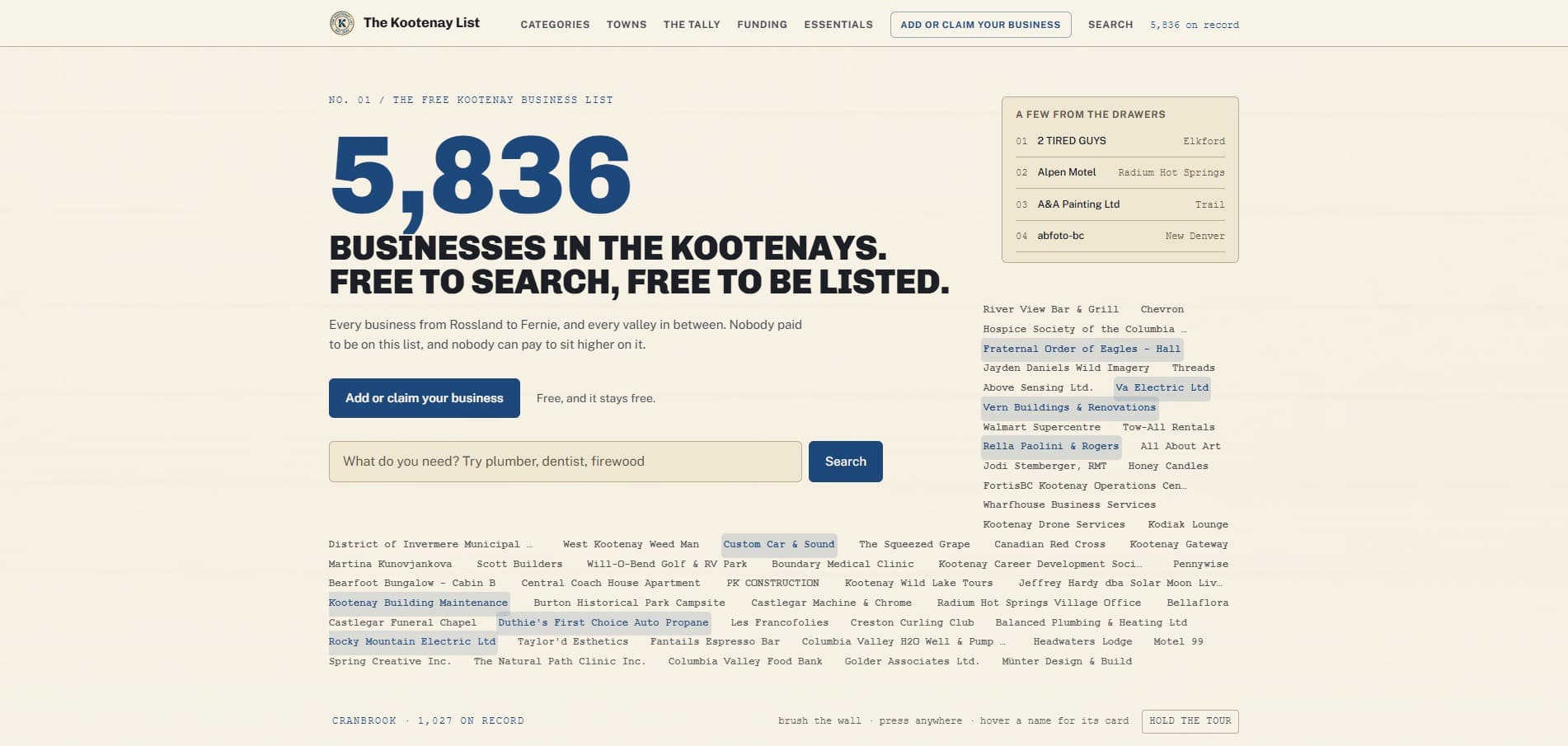
The design refuses the startup-directory look from the first pixel. The concept is the region's living business register: a public record book, so the palette is bone, manila, and kraft paper with record ink and a stamp blue, the type is a civic pairing with a mono voice for the data, and the signature is the living page: a wall of real business names that responds to touch and to typing, every name lifting its own ruled index card. It reads like a public institution because that is the job it is applying for.
Freshness is visible everywhere, and worded carefully. Every record carries the date of its last check, and the site says checked instead of verified on principle: verified is a claim, checked is a fact with a date on it. The header carries the living tally. And when a business closes, its entry comes off the list the moment it stops being true, because the fastest way to lose a region's trust is to send one person to a locked door.
The engineering is deliberately boring in the best way: static output, no database, flat JSON compiled from the master dataset, and a custom search index that makes 5,836 records feel instant. That is why desktop Lighthouse reads 99 performance, 100 accessibility, 100 best practices, 100 SEO with a 0.9 second largest paint, and why the whole thing costs almost nothing to run, which is what free forever requires structurally.
The register keeps growing the way a public institution should: deliberately. The Kootenay Boundary joined as a full territory, bringing Grand Forks, Christina Lake, Greenwood, Midway and their neighbours onto the same ruled paper and taking the List from 77 towns to 83. Around the records grew a resource layer: a funding map of the grants and support programs a Kootenay business can actually reach, built to outlive its own links, business licence guides for every town that publishes one, and an essentials layer for the everyday needs a resident searches first.
The List is also the studio's proof of maintenance, which is the thing a website client actually worries about. Anyone can open any record and see when it was last checked. A prospect deciding whether I will still care about their site in a year can look at five thousand entries that answer the question with dates.
The launch is a beginning, not a finish line. The claim flow starts the long game of owners maintaining their own records, the statistics page starts the citation loop, and the region-wide category pages start compounding in search. A register earns its authority the same way it earned its data: one checked entry at a time.
What a resident, and a business owner, feels on the List.
For residents: it answers the real question
Every kids store between Trail and Nelson is one page, not twelve searches. Region-wide categories with town filters are the architecture, not a feature.
For business owners: being listed costs nothing
Free to be listed, free to claim, a dofollow link if you have a website, and a quiet honest state if you do not. Nobody can outrank you by paying.
For the region: the list stays true
When something closes or changes, the list changes with it. A register that stays true is infrastructure, not a website.
Everything that shipped.
I built a static Next.js platform that renders 5,836 businesses across 83 towns and 112 categories into 6,633 sitemap URLs, with no database behind it: the whole region compiles from a hand-maintained dataset into flat JSON. The front is a civic record book: a living wall of business names you can sweep with a keystroke, ruled entries on bone and manila paper, and a pressed stamp on every record showing the day it was last checked. Under it sit region-wide search over a custom index, cross-town category pages, a consent-clean claim flow, an owner filing lane with its own FILED BY THE OWNER stamp, a funding map of grants and support programs for Kootenay businesses, business licence guides per town, and a statistics page nobody else in the region can publish, because nobody else has the data.
Highlights
- The living page: thousands of real business names as a wall you can brush, press, and sweep with type-to-search, each name lifting its index card
- A pressed freshness stamp on every record: the date the entry was last checked, plus the public source it came from
- Region-first architecture: every category page is region-wide with town filters, so one page answers what would otherwise take twelve searches
- The doorway-page bar: a category-town page only exists where three or more listings earn it, so no thin pages exist anywhere on 6,633 URLs
- The Tally: live region statistics (5,836 businesses, 83 towns, 112 categories) as a public page, citation bait no competitor can copy
- The funding map: every grant and support program a Kootenay business can actually reach, organized to outlive its own links
- Business licence guides for every town that publishes one, so starting a business begins on the List too
- A claim flow and an add-your-business flow, both consent-first and CASL-clean, with owner-filed entries stamped as such
- Free forever, structurally: no paid placement exists in the data model, so the ranking cannot be bought
- Dofollow website links on every listing that has a site: the gift a small business actually feels
- Entries that stop being accurate come off the list immediately: accuracy beats volume, every time
- A print stylesheet, an alphabet thumb index, a your-town memory chip, and a pull-a-card surprise page, because a record book should be a pleasure to use

Pages and surfaces
- Home (the living page)
- Region-wide search
- Categories hub + 112 category pages
- Cross-town category and town pages
- Town hubs
- 5,836 business record pages
- The Tally (region statistics)
- The funding map (grants and support programs for Kootenay businesses)
- Business licence guides by town
- Essentials (the everyday-needs layer)
- What's Missing (the gaps page)
- Surprise (pull a card from the drawers)
- Sources and data credits
- Claim flow
- Add-your-business flow
- For businesses
- Privacy and terms
Real code. Real routes. Production ready.
- 5,836 businesses, 83 towns, 112 categories, 6,633 sitemap URLs, all statically rendered: no database in production
- Custom search over a compiled index: no external search service, and the worst keystroke cost was engineered from 1,960ms down to 64ms
- Desktop Lighthouse 99 performance / 100 accessibility / 100 best practices / 100 SEO, LCP 0.9s, CLS 0.007; accessibility 100 on mobile as well
- The doorway-page bar enforced in the build: category-town pages generate only above three listings, so thin pages cannot exist
- Consent enforced at compile time: self-published fields only for person-shaped rows, private emails structurally excluded, zero leaks proven across the build output
- A typography and readability hardening pass took 631 sub-12px text nodes to zero across the route surface
- Zero horizontal overflow at 390px verified across twelve representative routes
- OpenStreetMap-derived location data credited and redistributable under ODbL on a public sources page
Stack
How it was built
The Kootenay List is a real, live product that I own and operate. Every number here is measured against the live build: 5,836 businesses, 83 towns, 112 categories, 6,633 sitemap URLs. The data comes from public sources named on every record, and location data is credited under ODbL. Private contact information never enters the build. No business paid to be listed or ranked. Mobile performance still trails desktop and is being worked, while accessibility holds at 100 on both.
This is what I build when the client is my own region.
The Kootenay List is the standard: complete data, visible freshness, and trust as the architecture. If your project lives or dies on people believing your information, a directory, a catalogue, a data-heavy platform, start with the free check-up and I will show you exactly where it is leaking trust.
No website yet? Start your first one here
This one is owned KMD infrastructure, not a client package. The same craft is for hire: see the services.
More work
19 / 20