


 hello@kootenaymade.ca
 Castlegar, BC. Serving the Kootenays and beyond.
Marrick Museum & Archives
A small museum's front counter, open on every phone.
24
Pages
12
Objects, each with a story
5
Galleries on the visit route
8.8
Jury score, home page
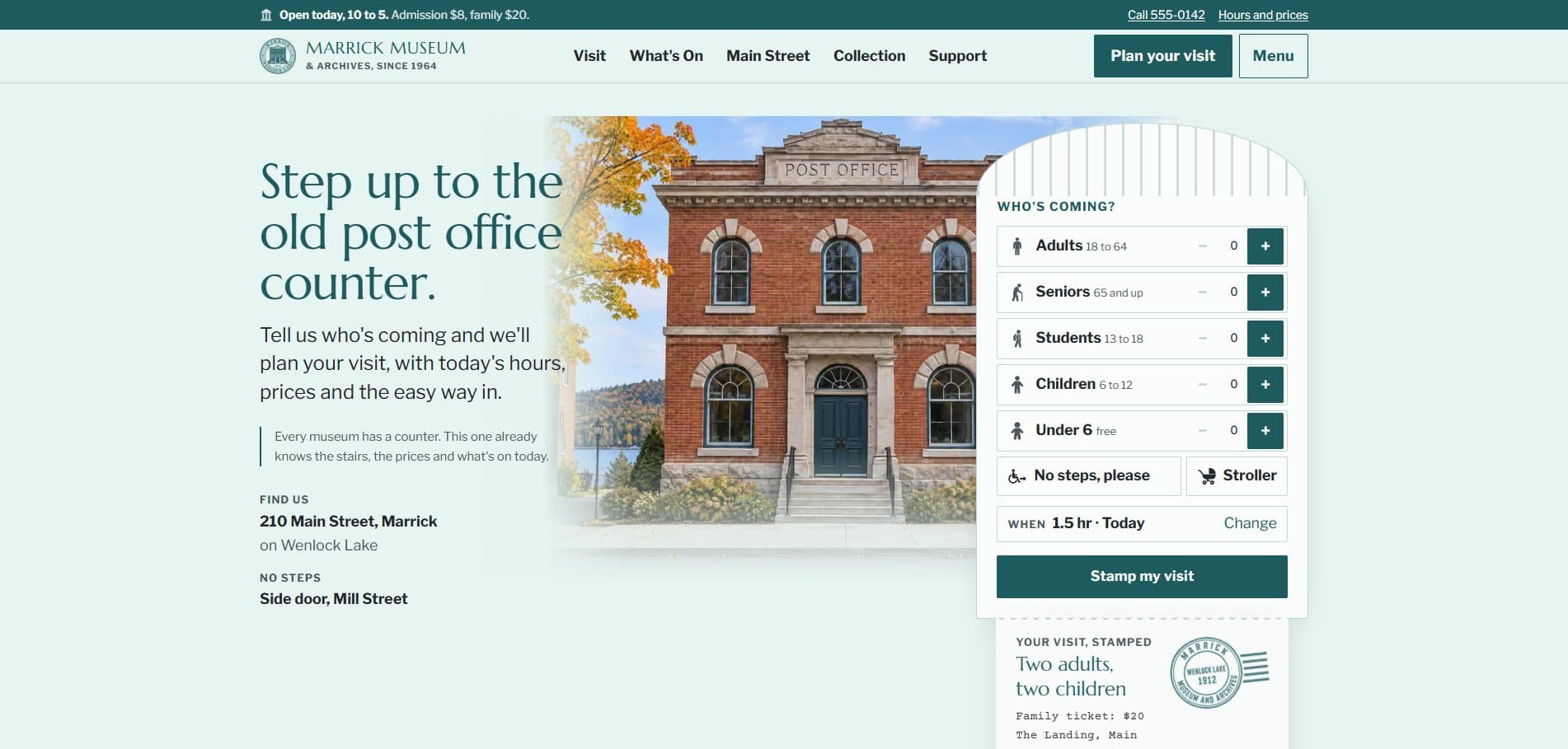
A museum visit is planned before anyone leaves home.
The hours are hard to find.
On many small museum sites the hours sit behind a menu, and the season's changes never reach the page.
And it costs the businessA family drives out on summer hours in October and finds the door locked.
Nobody knows what the visit will cost the group.
Prices are listed per person, and a family has to do the math and guess what counts as a child.
The access question goes unanswered.
Whether Grandma can manage the stairs decides the trip, and most sites say nothing about steps, lifts or seating.
And it costs the businessThe visitors who needed that answer most stay home.
Built to answer the trip in one move.
Open today, first.
Today's hours and admission lead every page, from one calendar.
Say who is coming.
The Wicket turns the group into a price, a route and today's events.
An honest access guide.
Steps, the lift, washrooms and seating, with a photograph of each.
Come see the originals.
Every archive search result ends with an invitation to visit.
The thinking behind the build
Marrick Museum & Archives is a fictional museum in the invented town of Marrick, on the invented Wenlock Lake. In the story it is run by a historical society founded in 1964, from a 1912 post office on Main Street, with two paid staff and about 40 volunteers. It is the kind of museum most Kootenay towns have, and it was built to show what that museum's website should do. Its first job is getting more people through the door.
Small museums told the same story in the research behind this build. About half the people on a museum's website are planning a visit, and they come with four questions: is it open, what will it cost us, will the kids be bored, and can Grandma manage the stairs. So Marrick answers all four in the first screen, before anyone scrolls.
The idea came from the building. The museum sits in its town's old post office, and the counter window, the wicket, is where you step up and get served. The site works the same way. Step up, say who is coming, and the counter hands back your visit, stamped. Prices, routes and access facts all come from one canon file, so the slip never says one thing while the visit page says another.
The look is a stamp. The ground is gummed-paper white, everything is engraved in one deep stamp teal, the object cards have perforated edges, and dates sit in round postmarks. The headings are set in carved Roman capitals like those over a 1912 post office door, the reading face is a Franklin Gothic like the town paper's, and catalogue numbers and postmarks are typewritten. Donations are chosen as postage stamps, and a membership is franked with what a year of it keeps going.
The second half is for the archive. A family search by surname or street returns the catalogued photos, clippings and records, and every result ends with an invitation to come and see the originals. Who's in this photo? lets a visitor suggest a name for a face and say how they know. Staff confirm it in the back office, which also changes today's hours and adds events without anyone touching code.
Everything in Marrick is invented: the town, the lake, the society, the staff, the objects and every photograph. The images are generated, the archive photos included, and the site is labelled as a concept build on every page. Nothing names a real place or nation. The demo data in the family search and the naming queue is sample data, and nothing a visitor types is published.
The jury certified it SHIP at a weighted 8.8 on the home page, with home scored 9 for design and 9 for creativity, after three rounds of fixes. The readiness battery passed with no failures, and its red control caught all 27 planted faults. For a real museum, the public site with The Wicket is the Engine build. The back office, the family search, photo naming and online memberships are the larger build, quoted on scope.
What a visitor can count on.
One source of truth
The slip, the visit page and the calendar all read the same canon file.
Staff can change it
Hours, events and confirmed names change in the back office, with no code.
Invented and labelled
The town, the people and every photo are invented, and every page says it is a concept.
Everything that shipped.
I built Marrick around the counter window of its old post office, called the wicket. The home page opens with today's hours and admission, then the counter. Say who is coming, how long you have and whether anyone needs to avoid steps, and the site stamps a visit slip with the price for your group, the route through the five galleries and today's events. Around it sit a visit page with a printable visitor card, a calendar of events, Main Street then and now, 12 collection objects with their own pages, three school programs, an honest access guide to the building, and support pages. The archives hold a family search by surname or street, and a demo back office lets staff change today's hours, add an event and confirm a name someone suggested for a face in an old photo.
Highlights
- Open today, with the hours and admission, in the first line of every page
- The Wicket: say who is coming and get a stamped visit slip with the group's price, route and today's events
- A visit page with hours for the next two weeks, the price list and a printable visitor card
- Main Street told at four corners, each shown then and now
- Twelve collection objects in five rooms, each with its own page and story
- Is my family here? Search the archives by surname or street
- Who's in this photo? Visitors suggest a name with how they know, and staff confirm it
- Donations chosen as postage stamps and memberships franked with what a year of them keeps going
- A demo back office: change today's hours, add an event, confirm a suggested name

Pages and surfaces
- Home (The Wicket)
- Visit: hours, prices, the full planner and a printable visitor card
- What's On
- Main Street: four corners, then and now
- Collection: 12 objects in 5 rooms, each with its own page
- Schools: three programs by age
- Archives, with Is my family here?
- Access
- Support: membership and donations
- About
- Back office (demo login)
- Accessibility
- Privacy
Real code. Real routes. Production ready.
- Next.js 15, React 19 and Tailwind CSS 4
- One canon file feeds the hours, prices, galleries, events and access facts that every page and The Wicket read
- The visit slip rolls to the next open day after last admission, checked by time-of-day tests
- With JavaScript off, the counter still shows both seasons' hours and the price list
- No face recognition: staff draw the face boxes, and a per-photo switch closes public naming
- Built toward WCAG 2.2 AA, with no overlap or sideways scrolling at 320 px and 130% text
Stack
How it was built
Marrick Museum & Archives is a fictional museum built as a concept to show the standard for community museum websites, and every page of the site says so. Marrick, Wenlock Lake, the historical society, the staff, the objects and every photograph are invented. The images are generated, and the family search and naming queue run on sample data. Facts read from the live concept on October 5, 2026.
Your museum deserves more people through the door.
Marrick shows the standard. The same counter can be built for your building, your hours and your collection. If you already have a site, start with the free check-up. If you have no website yet, tell me about your museum and I will show you where to begin.
No website yet? Start your first one here
Built as The Empire, from $10,000. Builds this size bill by milestone, paid as agreed stages go live.
In this industry yourself? Read the museum and heritage website design playbook.
More work
20 / 23