

 hello@kootenaymade.ca
 Castlegar, BC. Serving the Kootenays and beyond.
 9 min read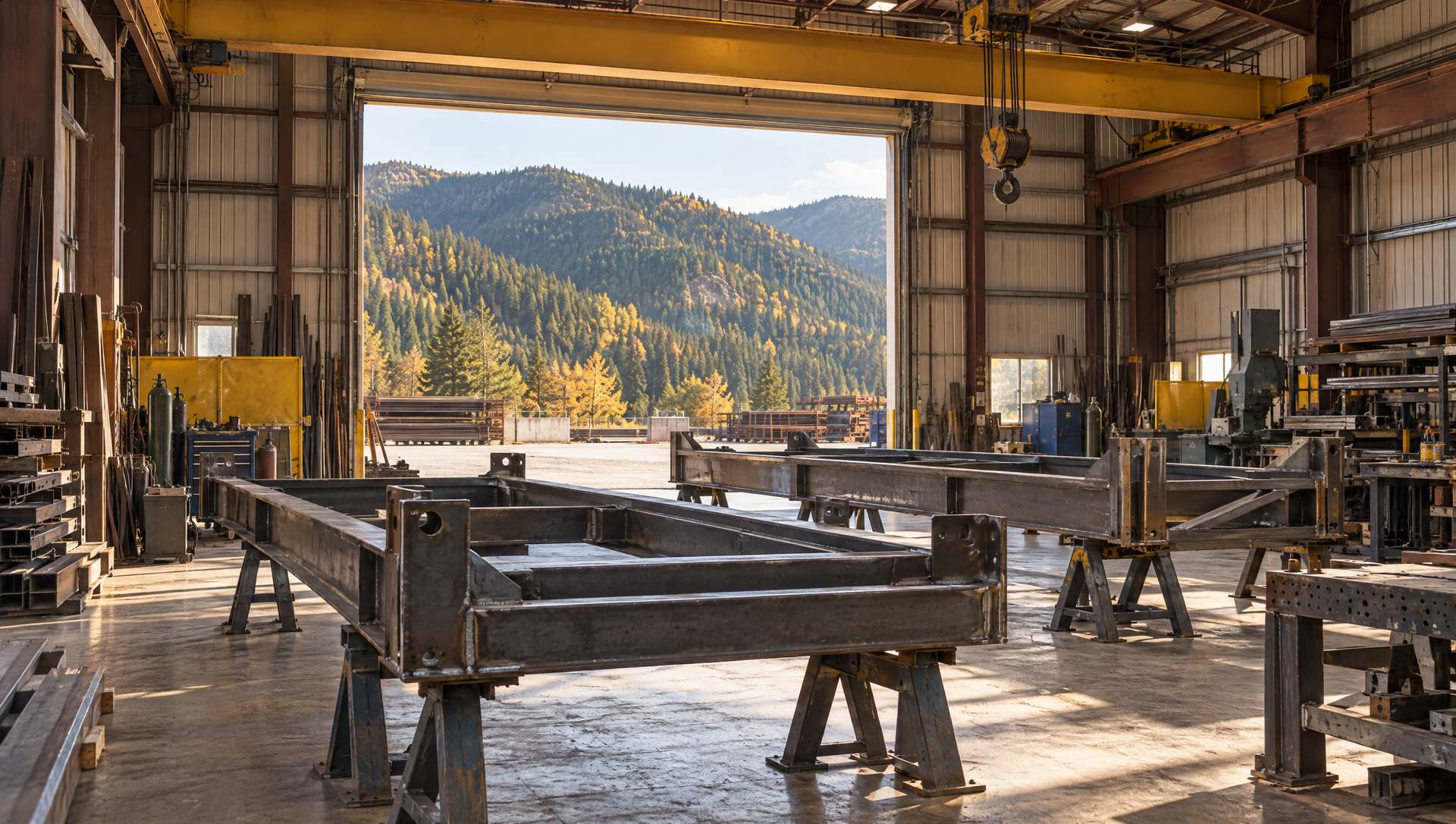
Key takeaways
- The shortlist is built on a screen, alone, against a deadline. Anything your site cannot answer is a reason to move on.
- Publish the capability list by process, material, tolerance, and size. A buyer searches those exact words, so the list does your SEO too.
- Certifications belong on the page with the issuing body and the current date, because they get checked rather than admired.
- A published lead-time range wins the enquiry from the shop that makes people phone in to find out.
- An RFQ form that collects a quotable request on the first pass cuts two rounds of email off every job.

On this page
What does an industrial or B2B website have to do?
It has to let a stranger qualify you at eleven at night without sending an email. That means a capability list a buyer can read and forward, spec sheets as pages, certifications with dates, a lead-time range, an RFQ form that captures a quotable request, and photographs of the plant that carry the argument.
Directories, marketplace listings, and approved-vendor portals carry your name, your category, and your phone number beside every competitor. They are worth being in. None of them holds a drawing, a tolerance, a certification date, or a reason to pick you.
- A capability list by process, material, tolerance, and size, written the way a buyer searches for it.
- Spec sheets published as real pages rather than downloads, so search and buyers can both read them.
- Certifications named with the issuing body and the current date, kept editable so nothing quietly ages.
- A lead-time range by job type, stated honestly, with a note that it moves with the shop load.
- An RFQ form asking for quantity, material, tolerance, revision, delivery date, and the drawing file.
- Photography of the real plant, the fleet, and the yard, captioned with what each machine does.
- A page for every service area you actually cover, written rather than templated with town names.

The shortlist gets built without you in the room
Purchasing managers shortlist suppliers on a screen, usually alone, usually against a deadline. Anything your site cannot answer becomes a reason to move to the next name on the list.
That is the part owners underestimate. A lost quote at least tells you it existed. A shortlist you never made is silent, and it happens every week to shops that are good at the work and invisible on a screen.
The buyer rarely has the final say either. They have to hand your capability to an engineer, a site super, or a controller. Give them a page they can forward and you have put your case into a room you were never invited to.
A listing proves you exist. A capability page proves you can do the work, in the room where the decision happens.
The capability page a buyer forwards
Every industrial supplier has a capability list. It usually lives in a PDF someone made for a trade show years ago, or in the owner's head. Turned into real pages, it answers the search a buyer types and survives being pasted into an email.
- One page per process
- Machining, welding, fabrication, hauling, rebuild, whatever you actually run. A buyer searching a process should land on the page that proves you run it.
- Sizes and tolerances
- The envelope you work inside and the tolerance you hold. This is the number that decides whether they keep reading or move down the list.
- Materials
- What you cut, weld, machine, or handle, named the way the buyer names it on a drawing.
- Volumes
- One-offs, short runs, production. Saying which you are comfortable with saves both sides a wasted quote.
- Industries already served
- Forestry, mining, municipal, agriculture, transport. Naming them lets a buyer recognize their own problem in your work.
- The equipment behind it
- The machine list with capacities, photographed. An engineer reading a spec page either believes you or does not.
There is no guesswork in the search side of this, which is unusual. Industrial searches are specific: a process, a material, and a place. Your capability list is your keyword list, already written, already true. One page per real capability is the whole structure, and my guide to service pages that bring better leads covers how those pages get built.
The RFQ that arrives quotable
A contact form that asks for a message costs you two rounds of email on every enquiry. The buyer pastes a description, forgets the drawing, and waits a day for you to ask what is missing. Six fields fix it.
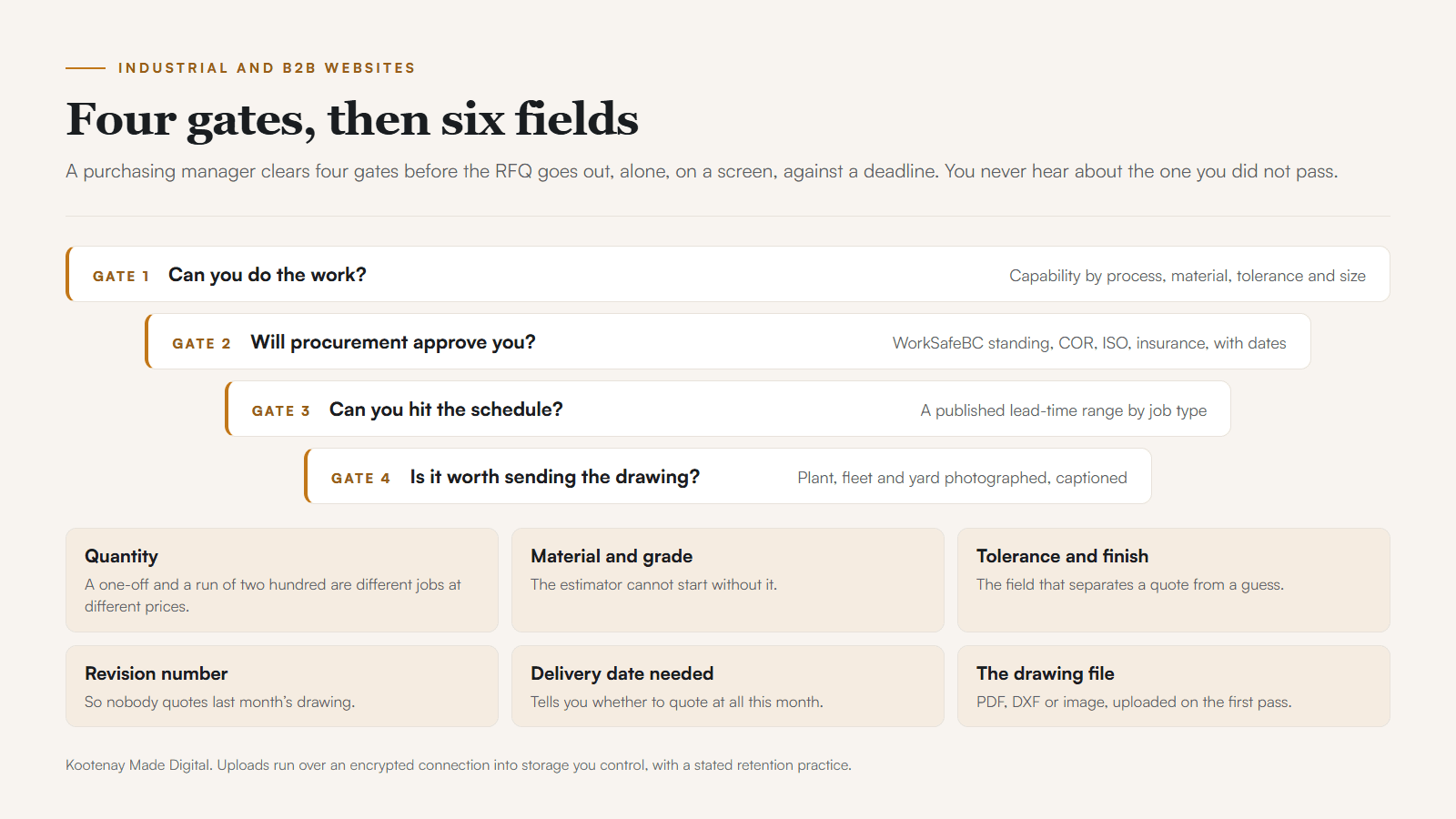
- 01Quantity, because a one-off and a run of two hundred are different jobs at different prices.
- 02Material and grade, because the estimator cannot start without it.
- 03Tolerance and finish, which is the field that separates a quote from a guess.
- 04Revision number, so nobody quotes last month’s drawing.
- 05Delivery date needed, which tells you whether to quote at all this month.
- 06The drawing itself, uploaded as a PDF, DXF, or image over an encrypted connection.
An RFQ often arrives with a drawing the customer treats as proprietary. Uploads run over an encrypted connection into storage you control, with a stated retention practice, so a buyer sending a print knows where it lands and who can open it. If the quote itself needs software behind it, that becomes a custom RFQ and quoting tool.
Certifications and the week of vendor onboarding
Certifications get checked rather than admired. WorkSafeBC clearance, COR certification, ISO registration, and insurance limits are boxes on a vendor form, and a missing date stalls approval for a week.
Buyers can search any BC firm's clearance status through WorkSafeBC and print the letter themselves before issuing a purchase order. That means the fact is already public. Publishing your standing with the date it was current simply moves the check to your page and shortens the process.
The same holds for a Certificate of Recognition, which is a voluntary employer certification issued by WorkSafeBC through a certifying partner. Name the issuing body, the scope, and the expiry. Publish only what you actually hold, and let the page say so when something lapses rather than quietly aging into a false claim.
Publish a lead-time range and win the enquiry
Industrial buying runs on schedules. Price matters, and a date that holds matters more. A buyer building a schedule cannot commit to a date nobody has given them.
So state a typical range by job type, and say out loud that it moves with the shop load. Nobody reads a range as a promise, and the estimator who publishes one stops spending afternoons on calls it would have answered. The supplier who makes people phone in to find out loses the enquiry to the one who wrote it down.
Two buyers, one website
Procurement and the site super are looking for different things, and a site built for one of them loses the other. The fix is structure rather than length.
| What is being compared | Procurement | The site super |
|---|---|---|
| Wants | Terms, compliance, a paper trail, an approved vendor number. | Access, tonnage, turnaround, and who answers at seven in the morning. |
| Checks first | Certifications, insurance limits, WorkSafeBC standing. | The equipment list, the yard photos, the service area. |
| Blocked by | A missing certificate date, so onboarding stalls for a week. | A page that cannot say whether you handle the load. |
| Reads | The certifications page and the terms. | The capability pages and the photographs. |
| Converts on | A vendor package they can file without emailing you. | A phone number and an RFQ form that takes a drawing. |
Give each a clear path from the homepage. Compliance and terms in one direction, capability and equipment in the other, and a phone number that dials with one tap on both. A yard super standing beside a truck on two bars of signal should have your capability page in a second or two, which is a performance requirement rather than a nicety.
Where suppliers stand in the Kootenays
This is a region built on mills, mines, highway freight, and the shops that keep all three running. It is also a region where a great many of those shops cannot be qualified from a screen.
On The Kootenay List, the register of Kootenay businesses I built and maintain, 52 of the 95 manufacturing businesses listed have no website at all, as of September 3, 2026. The breakdown by town sits in the Kootenay business web census.
The Castlegar and Trail corridor carries much of that industrial base, and Trail sits near the bottom of the region for how many of its businesses have a site of any kind. Cranbrook carries the largest business count in the Kootenays and feeds the Elk Valley operations up Highway 3. A buyer in Calgary or Kamloops sourcing a fabricator has no way to tell any of that from the highway, which is the entire argument for publishing the capability list.
The industrial and B2B website design page carries the full build path, and the web design in Castlegar page carries that town's numbers.
What it costs, and where to start
A focused presence site starts at the Trailhead: $2,000, typically delivered in 2 to 3 weeks. That suits a single-process shop that needs the capability list, the certifications, and an RFQ path.
Most industrial suppliers work several towns and several trades at once, and they land on the Engine at $6,500, or $1,625 today and $457 a month for 12 months, which is $7,109 all in, typically delivered in 4 to 5 weeks. It carries the spec-sheet library, the certification wall, and a page for every service area you cover. Dealer logins, parts portals, and customer accounts push the build into Empire territory, from $10,000, scoped per project. Kootenay businesses get the 10% neighbours discount off any build. What you pay depends on what the shop actually needs, not on a package name.
Somewhere this week a purchasing manager is deciding which three suppliers get the RFQ. If you already have a site, the free website check-up will tell you what a buyer cannot confirm about you today. If there is no site yet, start here, and bring the capability list you already carry in your head.
Sources and further reading
- WorkSafeBC: get a clearance letter
Buyers can search any BC firm’s clearance status and print a letter before issuing a purchase order. Publishing your standing with the date it was current saves a week of email. Read September 2026.
- BC Construction Safety Alliance: COR program
The Certificate of Recognition is a voluntary employer certification issued by WorkSafeBC through a certifying partner. Naming the issuing body and the scope is what makes the claim checkable. Read September 2026.
- Government of Canada: Canada’s Anti-Spam Legislation
CASL applies to business-to-business email as well. Consent gets captured and logged, the company is identified as sender, and every send carries a working unsubscribe.
- Google Search Central: creating helpful content
Google frames strong pages around usefulness and real experience. A capability page written in a buyer’s vocabulary is the version both an engineer and a search engine understand.
Frequently asked questions
Nobody buys industrial parts off a website. Why do I need one?
The purchase happens on a purchase order. The shortlist happens online. A purchasing manager with three suppliers to find checks every one of you before the RFQ goes out, and you never hear about the one you did not get sent. The site is the qualifier.
Can the RFQ form handle drawings and large files?
Yes. The form takes PDF, DXF, and image uploads over an encrypted connection, and the request arrives in your inbox with the quantity, material, tolerance, and delivery date attached. Your estimator opens one email rather than chasing three.
Do I have to publish my prices?
No, and most fabricators should not. Published rates suit shop-rate work. For quoted work the honest version is a lead-time range, a minimum order if you have one, and a fast RFQ path. Buyers expect to know whether it is worth sending the drawing.
We serve half the province. How does that get handled?
With a page per service area, written properly rather than town names swapped into a template. Each covers what you deliver there, the freight reality, and the work you have already done in that region. That is the Trailhead’s Full Coverage version at $3,200, and the Engine includes it.
Can it connect to our ERP or quoting software?
The site feeds the systems you already run rather than replacing them. RFQs can route to email, to a shared inbox, or into your quoting tool where an integration exists. I scope that in the first conversation, because the answer depends on what the software exposes.
Our buyers are engineers. Will this look like marketing fluff?
It should not, and that is a writing decision. The pages get built on numbers, materials, tolerances, capacities, and dates, in the vocabulary your customers use. An engineer reads a spec page and either believes you or does not. Adjectives lose that argument every time.
How do you handle certifications that expire?
Every certification is published with its issuing body and current date, and you update it yourself from a phone. A stale certification page is worse than none, because a compliance officer reads an expired date as a company that stopped paying attention.
How much does an industrial or B2B website cost?
A focused presence site starts at the Trailhead: $2,000, or $500 today and 12 monthly payments of $142 on Own It Monthly, which is $2,204 all in. Most industrial suppliers land on the Engine at $6,500, or $1,625 today and $457 a month, which is $7,109 all in, typically delivered in 4 to 5 weeks. Dealer logins and customer portals move the build into Empire territory, from $10,000, scoped per project. Kootenay businesses get the 10% neighbours discount off any build.
Related pages
Kootenay Made Digital
I build websites, local presence, and calm AI setups for Kootenay small businesses. Plain language, published prices, and clear work that makes you easier to find and easier to choose.