

 hello@kootenaymade.ca
 Castlegar, BC. Serving the Kootenays and beyond.
 13 min read
Key takeaways
- The Employer Training Grant pays 80 percent of training costs up to $10,000 per employee and $300,000 per employer a year, and it was open when I checked.
- The WorkBC wage subsidy changed on August 31, 2026 to a flat 50 percent up to $12.50 an hour for up to 800 hours.
- Four Innovate BC programs read closed on September 5, 2026, including the Innovator Skills Initiative and Ignite.
- The Agri-Business Planning Program opens September 15 and closes October 20, 2026, first come first served.
- Destination BC co-op marketing money goes to consortiums and sector associations, and its guidelines say a private business cannot receive it directly.

On this page
Which BC small business programs are actually open right now?
On September 5, 2026 the open list was short and specific: the Employer Training Grant, the WorkBC wage subsidy, Community and Employer Partnerships, the Community Workforce Response Grant until October 23, the Agri-Business Planning Program from September 15, several CleanBC vehicle and charging rebates, and the BC Arts Council intakes. Almost everything else people search for has closed.
This guide is for a BC owner who has been told there is provincial money and wants to know which programs exist before spending an evening on forms. It is written from each program page, read the same day, with the closed ones quoted in the province’s own words so you can stop chasing them.
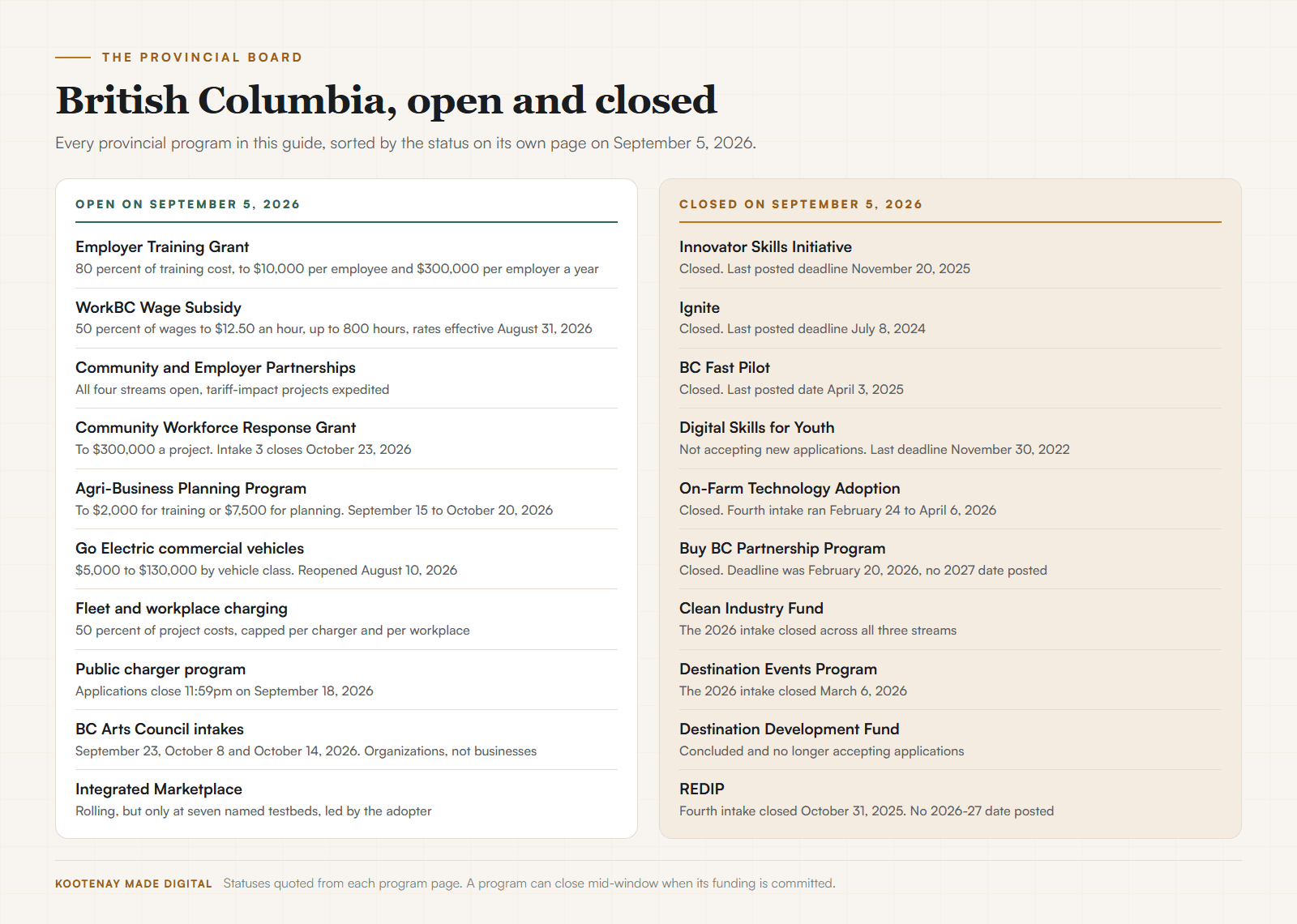
These read closed on the day I checked, in the words on their own pages:
- Innovator Skills Initiative, Innovate BC: "This program is currently closed." Its last posted deadline was November 20, 2025.
- Ignite, Innovate BC: "This program is currently closed." Last posted deadline July 8, 2024.
- BC Fast Pilot: "This program is currently closed." Last posted expression-of-interest date April 3, 2025.
- Digital Skills for Youth: "This program is not accepting new applications." Last posted deadline November 30, 2022.
- On-Farm Technology Adoption Program: "This program is currently closed." The fourth intake ran February 24 to April 6, 2026.
- Buy BC Partnership Program: the deadline was February 20, 2026 at 16:00 PST, and no 2027 intake date is posted.
- Clean Industry Fund: "The 2026 Clean Industry Fund Intake is now closed."
- Destination Events Program: "The 2026 Destination Events Program intake closed on March 6, 2026."
- Destination Development Fund: "has concluded and is no longer accepting applications."
- REDIP: the fourth intake closed October 31, 2025 and no 2026-27 intake date is posted.

A closed program described as open costs an owner weeks. That is why every line here carries the date I read it.
Training and hiring: the province’s biggest lever
This is where most provincial money for an ordinary business sits. Four programs, two of which you apply to yourself and two of which reach you through an organization. The Employer Training Grant is the one worth learning properly.
- 01
BC Employer Training Grant
Eighty percent of training cost up to $10,000 per employee, to a maximum of $300,000 per employer per year, with the employer paying the other twenty percent. Open for the 2026/27 fiscal year for training starting on or after April 1, 2026, with no closing date published. Applications are ranked by six priority factors, two of them new this year.
- 02
WorkBC Wage Subsidy
Fifty percent of a new hire’s wages to a maximum of $12.50 an hour for up to 800 hours, effective August 31, 2026. The job seeker has to come through a WorkBC service provider. An employer can hold five active agreements per business number at once and up to ten subsidised clients a fiscal year.
- 03
Community and Employer Partnerships
Four streams funding training and work experience for unemployed British Columbians. All four were open when I checked, and projects responding to tariff impacts are prioritised and expedited. The province asks you to email the team before applying.
- 04
Community Workforce Response Grant
One hundred percent of training costs to $300,000 a project, including $11,000 per participant. Intake 3 closes October 23, 2026 at 4:30pm Pacific. The applicants are non-profits, associations, governments and union halls, so an ordinary private business applies through one of them.
Two details decide most Employer Training Grant applications. You have to apply on your own behalf with a Business BCeID, because a third party cannot apply for you, and the applications are ranked against six priority factors. Two of those factors were added for 2026/27: training delivered through a BC public post-secondary institution, and trades training at apprenticeship level 3 or 4. The province states that applications meeting fewer factors may be returned unassessed when funding is tight.
The wage subsidy changed shape on August 31, 2026. The old tiered 24-week schedule with weekly caps became a flat 50 percent up to $12.50 an hour for up to 800 hours. Agreements approved before that date keep the old rates, so an employer partway through a placement is on different terms than one starting today.
Innovate BC: what is closed and what is rolling
Four Innovate BC programs carried a closed banner on September 5, 2026: the Innovator Skills Initiative, Ignite, BC Fast Pilot and Digital Skills for Youth. One thing is still moving, though only a narrow set of projects qualify.
Integrated Marketplace runs a rolling intake for cost-shared projects where an organization at one of seven approved testbeds deploys a BC innovator’s commercially ready technology. The testbeds are named: three ports and an airport, health, forestry and emergency management, mining and critical minerals, and marine and coastal. The lead applicant is the organization adopting the technology, not the company that built it. Its page says the intake stays open until at least March 2026, which has passed, so confirm the status before you plan around it.
The Innovator Skills Initiative is worth a line on its own, because it paid up to $10,000 per candidate toward a first tech-sector salary. Its page said “This program is currently closed” when I checked, with a last posted deadline of November 20, 2025. Innovate BC also names a Venture Acceleration Program, ScaleUp and Accelerate IP on its home page, and none of those has a program page on its own site, so I could not confirm their amounts or intake status.
Agriculture and food: a real window, and it is short
The Agri-Business Planning Program opens September 15, 2026 and closes October 20, 2026 at 4:30pm Pacific, or earlier if the funding is fully allocated. It is first come, first served. For a working farm or food processor it is the clearest provincial money on this page.
- Stream 1
- Specialized business training and courses for owners and managers. Up to 70 percent of eligible costs, reimbursed to a maximum of $2,000 and a minimum of $500.
- Stream 2
- Business planning and coaching from a qualified consultant, covering strategy, cash flow, human resources, succession, risk and disaster recovery. Reimbursed to a maximum of $7,500 for an individual business.
- Who qualifies
- BC primary producers, or food and beverage processors with at least 51 percent of the final product’s direct cost incurred in BC. You need a GST and business number, BC tax filing, and gross revenue over $50,000 in the previous year. Aquaculture, seafood and not-for-profits are excluded.
- What closed
- The On-Farm Technology Adoption Program, whose fourth intake ran February 24 to April 6, 2026, and the Buy BC Partnership Program, whose deadline was February 20, 2026. Neither has posted a new intake.
Both programs sit under the Sustainable Canadian Agricultural Partnership, a $3.5 billion five-year agreement between the federal, provincial and territorial governments that runs to March 31, 2028. The framework is not something you apply to. It is the thing that funds the programs you do apply to, and the next framework for 2028 to 2033 is being negotiated now.
There is also an Agritech Concierge, which is navigation help rather than money: connections to programs, to governments and to industry partners, for any farmer, food entrepreneur or agritech business. It is listed as an ongoing service with no deadline.
CleanBC: vehicles and charging
These are rebates on things you buy, and they are the largest dollar figures on this page. Commercial zero-emission vehicle rebates reopened on August 10, 2026 and run in funding-limited windows, with more funds scheduled for December 10, 2026 and April 12, 2027.
The commercial vehicle rebate scales with vehicle class: $5,000 for Class 2B, $30,000 for Class 3, $60,000 for Class 4 and 5, $90,000 for Class 6 and 7, and $130,000 for Class 8. Indigenous organizations, local governments and non-profits get a 20 percent top-up. A business can claim rebates on up to five vehicles a year, the vehicle has to operate in BC for at least 48 months, and pickup trucks are not eligible.
Charging has three doors. Fleet charging pays back 50 percent of project costs, or 75 percent for Indigenous communities and public sector organizations, with per-charger caps up to $100,000 and fleet assessments funded separately. Workplace charging pays 50 percent of eligible costs, capped at $14,000 per workplace and $56,000 across four locations, and the site needs at least five employees on it. The public charger program was open with a hard deadline of 11:59pm on September 18, 2026.
Tourism: the co-op model, and two programs that ended
Destination BC’s co-operative marketing program is real money and it is not available to a single business. Its guidelines state that private businesses cannot apply and receive funding directly, and encourages them to work through a community consortium or a sector association.
A consortium of three or more communities, or a province-wide sector association, can request $30,000 to $250,000 at up to 50 percent matching, stepping down to 40 percent in years four to six. Eligible activities include photography and video creation, content marketing, paid advertising, market research and travel media relations. The most recent posted guidelines were for 2026/27, with a deadline of October 31 that has passed, and no 2027/28 guidelines had appeared when I checked.
Two tourism programs are finished. The Destination Events Program, which paid up to 10 percent of an event budget to a maximum of $150,000, closed its 2026 intake on March 6, 2026. The Destination Development Fund has concluded and its page is kept only so existing recipients can reach the reporting requirements. If you run a tourism business in the Kootenays, the regional door is described in my Kootenay grants and funding guide.
Arts and culture: mostly for organizations
The BC Arts Council had several intakes open on September 5, 2026, and nearly all of them are written for non-profit organizations and collectives. A commercial cultural business rarely fits the eligibility lines on those pages.
Operating Assistance across all its streams closes October 8, 2026, and the Accelerate program shares that date. Project Assistance for community arts organizations accepts applications until October 14, 2026, with a maximum grant of $25,000 and typical grants between $5,000 and $20,000. Arts Circulation and Touring closes September 23, 2026, with maximums of $25,000 and $15,000 depending on category. Operating Assistance for community arts organizations requires at least three previous BC Arts Council grants since April 1, 2022, which is a real barrier to a first-time applicant.
Rural development money, and who can actually take it
The Rural Economic Diversification and Infrastructure Program is the largest rural pot in the province and a for-profit business cannot lead an application to it. Its fourth intake closed October 31, 2025 and no 2026-27 intake had been posted when I checked.
REDIP funds four categories: capacity at $50,000 a year for up to three years, development at $100,000, small implementation projects at $400,000, and large ones at $1 million. Lead applicants are rural municipalities and regional districts, all Indigenous governments and economic development corporations, and rural not-for-profits. For-profit organizations and businesses are named as ineligible lead applicants, and a business can join only as one of a maximum of two project partners.
That partner slot is worth knowing about. If your regional district or chamber is planning a project that would help your sector, being named as a project partner is the realistic route into money like this. When you do find one worth applying for, I work as a BC grant writer for small businesses and write applications for $500, or from $1,500 for the long ones with budgets and letters of support.
Where do you get a human to talk to?
BC Business Advisory Services, run by the province’s Business Development Branch, gives free one-on-one consultations on starting, managing and growing a business, and on navigating government programs. Call 1-855-698-2157 or email Business.Advisors@gov.bc.ca. Calls are not answered live and advisors return messages in order, Monday to Friday, 8am to 5pm.
A note on Small Business BC, because people ask. On September 5, 2026 every request to smallbusinessbc.ca returned a redirect to an unlock page, and the page served there was an unrelated application titled “The Taxi Company - Book a Taxi Online”. The province’s own business support organizations page, last updated September 1, 2026, does not list Small Business BC among its named organizations. I am reporting what I observed and nothing further. Use the advisory line above, or your regional Community Futures office.
What closes in the next ninety days?
Six dated provincial deadlines fell between September 5 and early December 2026. Two of them are open to an ordinary business applying on its own behalf.
- September 18, 2026: the CleanBC Go Electric Public Charger Program closes at 11:59pm.
- September 23, 2026: BC Arts Council Arts Circulation and Touring closes.
- October 8, 2026: BC Arts Council Operating Assistance and the Accelerate program close.
- October 14, 2026: BC Arts Council Project Assistance closes, with new-applicant registration pausing October 7.
- October 20, 2026: the Agri-Business Planning Program closes at 4:30pm Pacific, or earlier if funding runs out.
- October 23, 2026: the Community Workforce Response Grant closes Intake 3 at 4:30pm Pacific.
How I keep this page honest
Every line here was read on September 5, 2026 and I will re-read the pages quarterly. Closed programs stay listed as closed for a year, because owners keep searching for them and a page that says so is more useful than one that quietly drops them.
Where a program page and its own listing disagree, I report the disagreement rather than picking a winner. Where an amount is not published, I say so. Federal programs are a separate layer with a separate set of doors, and I cover them in my guide to federal small business grants and programs. For funding a website specifically, the BC website funding guide covers that narrower question, and the website cost guide explains what a fundable scope looks like on paper.
Sources and further reading
- WorkBC: BC Employer Training Grant
Read September 5, 2026. Source for the 80 percent cost share, the $10,000 per employee and $300,000 per employer caps, the Business BCeID requirement, the six priority factors and the 60-day decision.
- WorkBC: Wage Subsidy
Read September 5, 2026. The Wage Subsidy Handbook dated August 2026 states the rates effective August 31, 2026: 50 percent of wages to a maximum of $12.50 an hour for up to 800 hours, replacing the old tiered 24-week schedule.
- WorkBC: Community Workforce Response Grant
Read September 5, 2026. Source for the $300,000 project cap, the $11,000 per participant figure, the eligible applicant list, and the Intake 3 close of October 23, 2026 at 4:30pm PT.
- Innovate BC programs
Read September 5, 2026. The Innovator Skills Initiative, Ignite, BC Fast Pilot and Digital Skills for Youth pages each carry a closed banner in the words quoted here. Integrated Marketplace describes a rolling intake with a stale date.
- BC Agri-Business Planning Program
Read September 5, 2026, page last updated September 1, 2026. Source for the two streams and their reimbursement caps of $2,000 and $7,500, the revenue floor, and the intake opening September 15 and closing October 20, 2026.
- CleanBC Go Electric
Read September 5, 2026. Source for the commercial vehicle rebate table by class, the August 10, 2026 reopening and the funding-release dates, the fleet and workplace charging rebates, and the public charger deadline of September 18, 2026.
- Destination BC: Co-operative Marketing Partnerships Program
Read September 5, 2026. Source for the matching model, the $30,000 to $250,000 request band, and the guideline sentence stating that private businesses cannot apply and receive funding directly.
- BC Arts Council programs
Read September 5, 2026. Source for the October 8, 2026 Operating Assistance and Accelerate deadlines, the October 14 Project Assistance deadline, and the September 23 circulation and touring deadline.
- Rural Economic Diversification and Infrastructure Program
Read September 5, 2026, page last updated November 5, 2025. Source for the four categories and their caps, the closed fourth intake, and the exclusion of for-profit organizations as lead applicants.
- Help for small businesses and entrepreneurs, Province of BC
Read September 5, 2026. Source for BC Business Advisory Services: free one-on-one consultations, 1-855-698-2157 and Business.Advisors@gov.bc.ca, with messages returned Monday to Friday.
Frequently asked questions
Is there a BC grant to start a small business in 2026?
No provincial program is written to fund starting a business. What BC funds is training, hiring, clean vehicles, agriculture planning, tourism marketing through consortiums, and arts organizations. The closest thing to startup support is free advisory through BC Business Advisory Services and the Community Futures network. That was the position on September 5, 2026.
What is the BC Employer Training Grant and who can use it?
It reimburses 80 percent of eligible training costs up to $10,000 per employee, with a maximum of $300,000 per employer a year, and the employer covers the other 20 percent. It was open for the 2026/27 fiscal year when I checked, for training beginning on or after April 1, 2026. You apply yourself with a Business BCeID, because a third party cannot apply on your behalf, and decisions come inside 60 days.
How much is the WorkBC wage subsidy worth in 2026?
The handbook dated August 2026 sets the rate at 50 percent of the employee’s wages, to a maximum of $12.50 an hour, for up to 800 hours, effective August 31, 2026. The employer pays the other half on the first $25 an hour, everything above $25, all overtime and all mandatory employment costs. Agreements approved before August 31, 2026 keep the older rates.
What happened to Launch Online and the Innovator Skills Initiative?
Both are gone. Launch Online was a 2021 pandemic-recovery program and has not reopened. The Innovator Skills Initiative page read "This program is currently closed" on September 5, 2026, with a last posted deadline of November 20, 2025. Ignite, BC Fast Pilot and Digital Skills for Youth carried the same closed banner that day.
Are there BC grants for farms and food processors?
Yes, and the calendar matters. The Agri-Business Planning Program opens September 15, 2026 and closes October 20, 2026 or sooner if the funding runs out, reimbursing up to $2,000 for training or up to $7,500 for business planning with a consultant. It needs gross revenue over $50,000 in the previous year. The On-Farm Technology Adoption Program and the Buy BC Partnership Program were both closed when I checked.
Can a single tourism business get Destination BC marketing money?
Not directly. The co-op marketing guidelines state that private businesses cannot apply and receive funding directly from the program, and are encouraged to work with a community consortium or a sector association. Consortiums of three or more communities can request $30,000 to $250,000 at up to 50 percent matching. The Destination Events Program closed on March 6, 2026 and the Destination Development Fund has concluded.
Where do I talk to a person about BC programs?
BC Business Advisory Services offers free one-on-one consultations on starting, managing and growing a business, and on navigating government funding. Call 1-855-698-2157 or email Business.Advisors@gov.bc.ca. Calls are not answered live, and advisors return messages in order, Monday to Friday between 8am and 5pm.
Related pages
- Farm and agriculture websites
- Tourism and resort websites
- Trades and contractor websites
- Web design across British Columbia
- Web design in Castlegar
Kootenay Made Digital
I build websites, local presence, and calm AI setups for Kootenay small businesses. Plain language, published prices, and clear work that makes you easier to find and easier to choose.