


 hello@kootenaymade.ca
 Castlegar, BC. Serving the Kootenays and beyond.
 11 min read
Key takeaways
- CDAP is gone. Its official pages redirect or return errors, and BDC dates the closure of the main grant stream to February 19, 2024.
- CanExport SMEs closed at 12:00pm Eastern on August 31, 2026, in the program page’s own words.
- NRC IRAP is still the main federal technology door, and no official page publishes an amount or a cost-share percentage.
- SR&ED’s enhanced expenditure limit rises to $6 million under Budget 2025, and CRA’s own glossary page is behind the legislation.
- PacifiCan’s Business Scale-up and Productivity and Tourism Growth programs both read closed on September 5, 2026.

On this page
Which federal grants are still open in 2026?
Fewer than the search results promise. The two most searched federal grants are closed: CDAP has no live official page left, and CanExport SMEs states that its intake ended at 12:00pm Eastern on August 31, 2026. What remains is advisory, a tax credit, repayable products delivered by banks, one regional program with no fixed deadline, and targeted programs for specific groups.
This guide is for a Canadian owner who has read that Ottawa hands out grants and wants to know which ones exist. It is written from each official page, read on September 5, 2026, with the closed programs quoted in the government’s own words. Federal applications are usually the long kind, and having a grant writer for Canadian small businesses write one starts at $1,500.
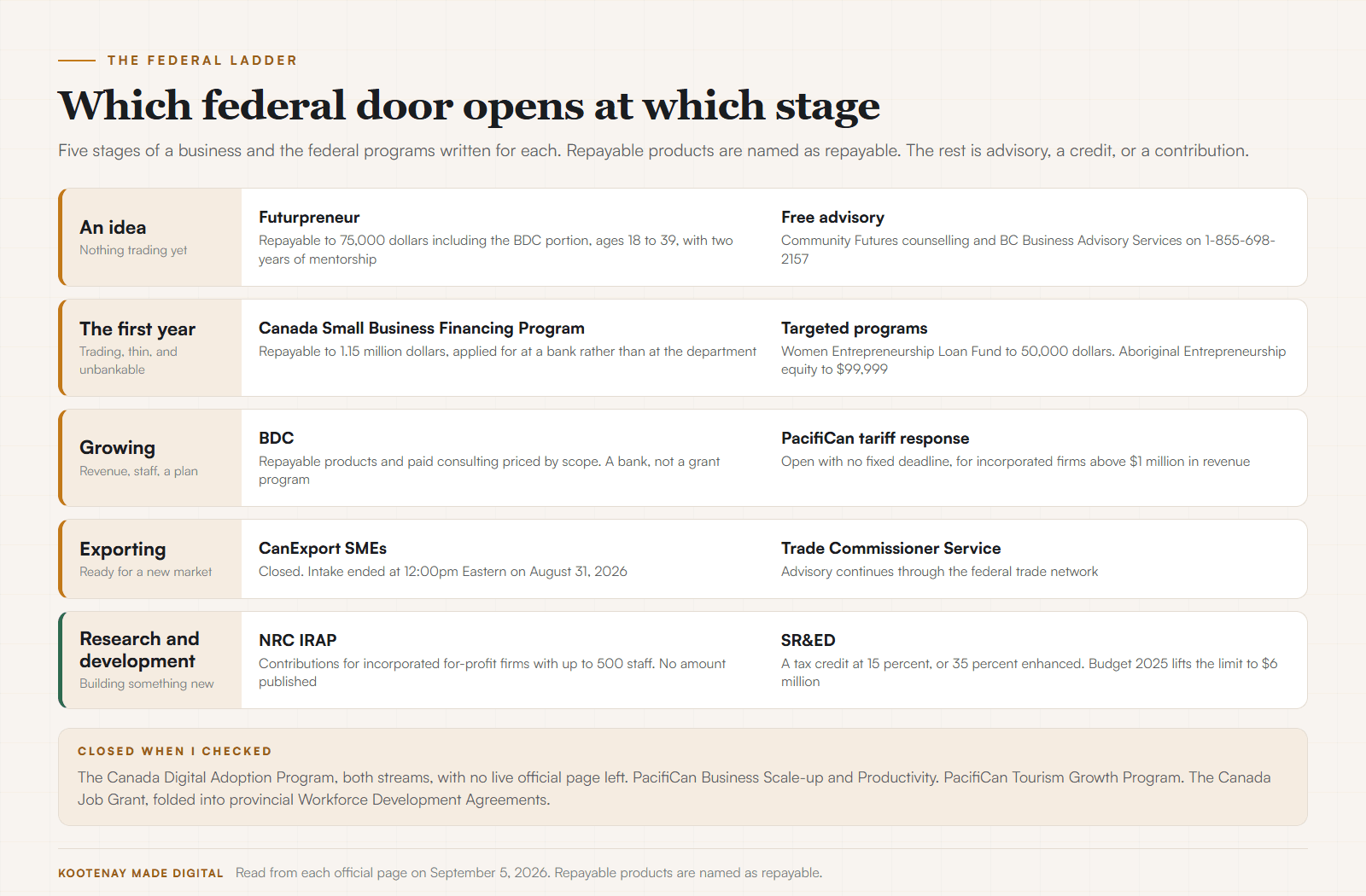
These were open on the day I checked:
- NRC IRAP: advisory from an industrial technology advisor, plus contributions for incorporated for-profit firms with up to 500 staff. No amount is published on its page.
- The Canada Small Business Financing Program: open and continuous, delivered by banks and credit unions rather than by the department.
- SR&ED: a tax credit claimed on the corporate return, at a basic rate of 15 percent and an enhanced rate of 35 percent for eligible companies.
- PacifiCan Regional Tariff Response Initiative: accepting applications with no fixed closing date, for incorporated businesses with at least a million dollars in annual revenue.
- PacifiCan Regional Innovation Ecosystems: open to not-for-profits until October 30, 2026 at noon Pacific.
- The Women Entrepreneurship Loan Fund and the Aboriginal Entrepreneurship Program: both accepting applications through their delivery organizations.

Federal applications are usually the long kind. The grant application process, step by step covers each piece before you start one.
CDAP paid for small business websites for two years. Budgeting around it now is budgeting around a page that no longer exists.
NRC IRAP: the main technology door
The National Research Council’s Industrial Research Assistance Program funds research and development of innovative, technology-driven products and services. Its page publishes no amount and no cost-share percentage, which is unusual and worth knowing before you plan a budget around it.
The eligibility test is three lines. The business has to be incorporated, for-profit and operating in Canada, employ up to 500 full-time equivalents, and be developing and commercialising an innovative technology-driven product or service. The page is equally clear about what it will not fund: day-to-day operating costs, non-technical or purely commercial activities, work done outside Canada, and research with limited potential for commercialisation.
Two things sit beside the funding. Advisory services from an Industrial Technology Advisor cover technical and business advice, referrals, literature and patent searches, and connections to universities, colleges and provincial programs. A separate stream cost-shares part of the salary of a young graduate aged 15 to 30 on a placement of six to twelve months at a minimum of 30 hours a week. Neither page states an intake window, and the entry point for all of it is a phone call to 1-877-994-4727.
BDC: what it is and what it is not
The Business Development Bank of Canada is a bank, not a grant program. It publishes product ceilings for a range of repayable products, and its consulting arm is a paid engagement priced by scope. Nothing on either page is money that stays.
The published ceilings on its financing index start at 350,000 dollars for a small business product and 150,000 dollars for start-up support. Its inclusive entrepreneurship and Indigenous entrepreneur products also reach 350,000 dollars, a growth product reaches 2 million dollars, and forestry support reaches 25 million dollars. Product-specific criteria are not on the index page, so each one has to be read on its own.
BDC Advisory Services covers strategy, finance, operations, marketing, technology, international expansion, sustainability and leadership. The page states that pricing varies with the scope and complexity of the engagement and that engagements typically span several months. It is a consultancy that a business hires. Worth saying, because it appears in a lot of lists of “government support” as though it were free.
Futurpreneur: the one written for people under 40
Futurpreneur Canada describes a flexible, equity-free product of up to 75,000 dollars including the portion that comes from BDC, paired with up to two years of one-to-one hand-matched mentorship. It is continuous, with no intake window.
The eligibility is age-gated and stage-gated. You have to be 18 to 39 at submission, with the full application in before your fortieth birthday, a Canadian citizen or permanent resident living in Canada. The business has to be pre-startup or startup: about to launch with first sales expected within months, or under a year of significant sales revenue.
The published cost of repaying it: Futurpreneur states its own rate as CIBC prime plus 3 percent, capped at 9 percent, and the BDC portion at BDC’s floating base rate plus 1.65 percent, with both interest-only in the first year. Whether those payments fit your numbers is a conversation for your accountant, and the mentorship comes with it.
The Canada Small Business Financing Program
This one confuses people because it has a government name and a bank counter. Innovation, Science and Economic Development Canada guarantees it, and you apply at a bank or credit union rather than to the department. It was open and continuous when I checked, with no deadline.
The published maximum is 1.15 million dollars per borrower, which includes a maximum of 1 million dollars in term amounts and 150,000 dollars in lines of credit. Eligible uses named on the page include working capital, intellectual property, renovations and equipment. Most start-ups and existing for-profit, not-for-profit and charitable small businesses in Canada with gross revenues of ten million dollars or less are eligible. Farming businesses are directed to a separate program under the Canadian Agricultural Loans Act.
SR&ED: the biggest federal number, and it is a tax credit
SR&ED is a tax credit rather than an application. For a business doing real technical work it is often the largest federal support available. CRA states a basic rate of 15 percent and an enhanced rate of 35 percent for some corporations, with the enhanced credit refundable for eligible Canadian-controlled private corporations.
The 2026 change is worth reading properly. The Budget 2025 tax measures annex raises the enhanced credit expenditure limit to $6 million, up from the previously announced $4.5 million, and moves the taxable capital phase-out thresholds from $10 million and $50 million to $15 million and $75 million. It also extends the enhanced credit to eligible Canadian public corporations and restores capital expenditure eligibility. All of it applies to taxation years beginning on or after December 16, 2024.
One caution. CRA’s own glossary page still showed the superseded three million dollar limit and the older refundability formula when I checked on September 5, 2026, so the department’s reference pages are behind the legislation. Read the Budget annex, and talk to an accountant who files these, because the claim is made on the corporate return within the SR&ED reporting deadline.
PacifiCan: the federal money that lands in BC
Pacific Economic Development Canada runs the regional programs for British Columbia, and its funding index publishes an open or closed flag for every one. On September 5, 2026 two of the programs BC businesses ask about most were closed.
- Regional Tariff Response Initiative
- Open, with no fixed deadline and at least 20 business days of notice promised before intake closes. For incorporated businesses hit by tariffs, with a minimum annual revenue of $1 million, offering up to $1 million non-repayable plus repayable contributions per project.
- Regional Innovation Ecosystems
- Open to not-for-profits until October 30, 2026 at noon Pacific, an extension from the original September 11 date. Contributions normally do not exceed $3 million, with 50 percent matching. A business benefits as a client of a funded organization.
- Community Economic Development and Diversification
- Open on an ongoing basis, for not-for-profit entities including local, regional and Indigenous economic development organizations. Amount varies, with no range published.
- Business Scale-up and Productivity
- Closed. The page reads “Not currently accepting applications.” It offered $200,000 to $5 million per project in repayable contributions to incorporated high-growth businesses.
- Tourism Growth Program
- Closed. “Applications for the Tourism Growth Program are no longer being accepted.” It offered up to $250,000 per applicant, repayable for businesses and non-repayable for not-for-profits.
The pattern across PacifiCan is worth naming: the largest open pools go to not-for-profits, and a business reaches them as a client of a funded organization. That mirrors what happens regionally, which I go through in my Kootenay grants and funding guide.
Women and Indigenous entrepreneurs: the targeted doors
Two federal programs are written for specific groups and both were accepting applications when I checked. Neither is applied for at the department. Each is delivered by partner organizations that set their own criteria.
The Women Entrepreneurship Loan Fund offers up to 50,000 dollars to women entrepreneurs, with a stated focus on start-ups, underrepresented groups and sole proprietorships. Four delivery organizations were named on the page: the Women’s Enterprise Organizations of Canada, the National Aboriginal Capital Corporations Association, Nventure and Evol. You apply to the organization serving your province.
The Aboriginal Entrepreneurship Program’s access to capital stream offers a non-repayable equity contribution of up to $99,999 for an individual Indigenous entrepreneur, or up to $250,000 for an eligible Indigenous community business, paired with business support services. Its page states there is no deadline to apply. Applications go to the local Indigenous Financial Institution, and for the Kootenays the NACCA directory points to All Nations Trust Company in Kamloops, whose published service area names the Ktunaxa nations, the Shuswap and Lower Kootenay bands and six Metis societies serving the region.
Whatever happened to the Canada Job Grant?
It stopped being federal. The Workforce Development Agreements consolidated and replaced the Canada Job Fund Agreements, which included the Canada Job Grant, along with the Labour Market Agreements for Persons with Disabilities and the Targeted Initiative for Older Workers.
The federal page describes transfers of $722 million a year plus an additional $900 million over six years to the provinces and territories, and sets no intake of its own. Employers never apply to it. In British Columbia the money reaches you as the BC Employer Training Grant, which pays 80 percent of training costs up to $10,000 per employee. I cover it, and the rest of the provincial layer, in my guide to the BC small business grants open now.
How I keep this page honest
Every line was read from an official page on September 5, 2026, and I will re-read them quarterly. Closed programs stay listed here as closed for a year, because owners keep searching for CDAP and deserve to land somewhere that says what happened.
Two limits worth stating. Where an official page publishes no amount, this guide says so, which is why IRAP has no dollar figure here even though other sites quote one. And where a department’s own pages disagree, as CRA’s glossary does with the Budget annex, I report the disagreement rather than picking the friendlier number. For the narrower question of paying for a website, the BC website funding guide covers it, and the website cost guide explains what a fundable scope looks like on paper.
Sources and further reading
- NRC IRAP: financial support for technology innovation
Read September 5, 2026. Source for the eligibility test of incorporated, for-profit, operating in Canada with up to 500 full-time equivalents, and for the explicit exclusions of day-to-day operating costs and work done outside Canada. No dollar figure or cost-share percentage appears on the page.
- BDC financing
Read September 5, 2026. Source for the published product ceilings and for the note that BDC advisory work is a paid consulting engagement priced by scope rather than a grant.
- Futurpreneur Core Startup Program
Read September 5, 2026. Source for the ceiling including the BDC portion, the age window of 18 to 39, the stated rates, and the two years of hand-matched mentorship.
- Canada Small Business Financing Program
Read September 5, 2026, page modified June 25, 2026. Source for the maximum, the split between term amounts and lines of credit, and the eligibility line covering most start-ups and existing small businesses with gross revenues of ten million dollars or less.
- CRA: SR&ED tax incentive overview
Read September 5, 2026, page modified April 1, 2026. Source for the 15 percent basic rate and the 35 percent enhanced rate. Note that CRA’s own glossary page still carries the superseded three million dollar limit.
- Budget 2025 tax measures annex
Read September 5, 2026. Source for the enhanced SR&ED expenditure limit rising to $6 million, the taxable capital thresholds moving to $15 million and $75 million, and the in-force date of taxation years beginning on or after December 16, 2024.
- PacifiCan funding index
Read September 5, 2026. Source for the open and closed status of every PacifiCan program in British Columbia, including the closed Business Scale-up and Productivity and Tourism Growth programs.
- CanExport SMEs
Read September 5, 2026. The page states that the application intake period ended at 12:00 p.m. ET on August 31, 2026 and that applications are not being accepted at this time.
- Women Entrepreneurship Loan Fund
Read September 5, 2026. Source for the ceiling, the focus on start-ups and sole proprietorships, and the four named delivery organizations that applicants apply to instead of the department.
- NACCA directory of Indigenous Financial Institutions
Read September 5, 2026. Source for the two BC-headquartered institutions, which identifies All Nations Trust Company as the one whose published service area includes the Kootenays.
Frequently asked questions
Is CDAP still available in 2026?
No. The Canada Digital Adoption Program is closed and its official pages are gone: every ISED URL for it now redirects to a language splash page or returns a 404. A federal Question Period note from ISED states the Boost Your Business Technology grant is fully subscribed and not accepting new applications, and BDC, its co-delivery partner, states the stream stopped accepting applications and dates that to February 19, 2024. Checked September 5, 2026.
What federal grants can a small business still get in 2026?
Fewer than the search results suggest. On September 5, 2026 the open federal doors were NRC IRAP for technology development and SR&ED as a tax credit. Add the Canada Small Business Financing Program through banks, PacifiCan’s tariff response initiative for larger incorporated firms, and the targeted programs for women and Indigenous entrepreneurs. CanExport SMEs closed on August 31, 2026.
How much does NRC IRAP actually give a business?
The official page does not say. It describes customized advice, connections, and in some cases funding, and it names what is never funded: day-to-day operating costs, purely commercial activities, work done outside Canada, and research with limited commercialisation potential. Widely repeated third-party figures do not appear on any NRC page, so I will not repeat them. Access is through an Industrial Technology Advisor at 1-877-994-4727.
Is Futurpreneur worth looking at?
If you are between 18 and 39 and starting, it is one of the few federal-adjacent doors written for you. Futurpreneur describes a flexible, equity-free product of up to 75,000 dollars including the BDC portion, paired with up to two years of hand-matched mentorship. The full application has to be in before your fortieth birthday, and the business has to be pre-launch or under a year of significant sales. Whether the repayments fit is a question for your accountant.
What changed with SR&ED in 2026?
The Budget 2025 tax measures annex raises the enhanced credit expenditure limit to $6 million, from the previously announced $4.5 million, at a fully refundable 35 percent rate, and moves the taxable capital phase-out thresholds to $15 million and $75 million. It applies to taxation years beginning on or after December 16, 2024. CRA’s own glossary page still showed the older three million dollar figure when I checked, so read the Budget annex rather than the glossary.
What happened to the Canada Job Grant?
It was folded into the Workforce Development Agreements, which consolidated and replaced the Canada Job Fund Agreements, the Labour Market Agreements for Persons with Disabilities and the Targeted Initiative for Older Workers. The money now flows to the provinces, so an employer never applies federally. In British Columbia the delivery vehicle is the BC Employer Training Grant, covered in my provincial guide.
Related pages
- Industrial and B2B websites
- Professional services websites
- Web design for Canadian businesses
- Web design across British Columbia
Kootenay Made Digital
I build websites, local presence, and calm AI setups for Kootenay small businesses. Plain language, published prices, and clear work that makes you easier to find and easier to choose.