


 hello@kootenaymade.ca
 Castlegar, BC. Serving the Kootenays and beyond.
The Kootenay Slate
What is on tonight across the Kootenays, on one wall, in time order.
64
Calendars read
413
Events in the next 30 days
34
Towns with something on
2,217
Pages in the sitemap
Finding out what is on took eleven browser tabs.
Every town and venue posts in its own place
Every town has a calendar, every venue has a Facebook page, and every tourism board stops at its own town line. A simple Friday question takes twenty minutes.
And it costs the businessFor a hall or a venue, an event only reaches the people who already check that one page.
Listings skip who it is for and the price
A parent wants to know first whether a seven-year-old can come, and many listings never say or leave the price blank.
And it costs the businessEvery missing detail turns into a message or a phone call to the organiser, the same question asked again for each event.
A guessed detail sends people to the wrong door
A site that fills a blank with a guess will sooner or later send someone an hour down the highway to an event that was never for them.
And it costs the businessOne bad trip teaches a reader to stop trusting the whole calendar, and every organiser on it loses that reader.
One regional wall in time order that leaves the blanks blank.
Tonight at the top of the wall
The wall runs in start-time order and nothing else, with pages for tonight, tomorrow, the weekend, the week and the month, for the region and each busy town.
Two facts on every poster
Each poster states who the event is for and what it costs when the source says so. When the source is silent, the field stays blank.
Every calendar scored out of 100
A program reads 64 calendars most mornings and scores each one on how complete and current its listings are. A calendar under 60 comes off.
A poster photo becomes a listing
Anyone can snap a flyer on a pole. Claude reads it and fills in the form, and I approve every event before it goes up.
The thinking behind the build
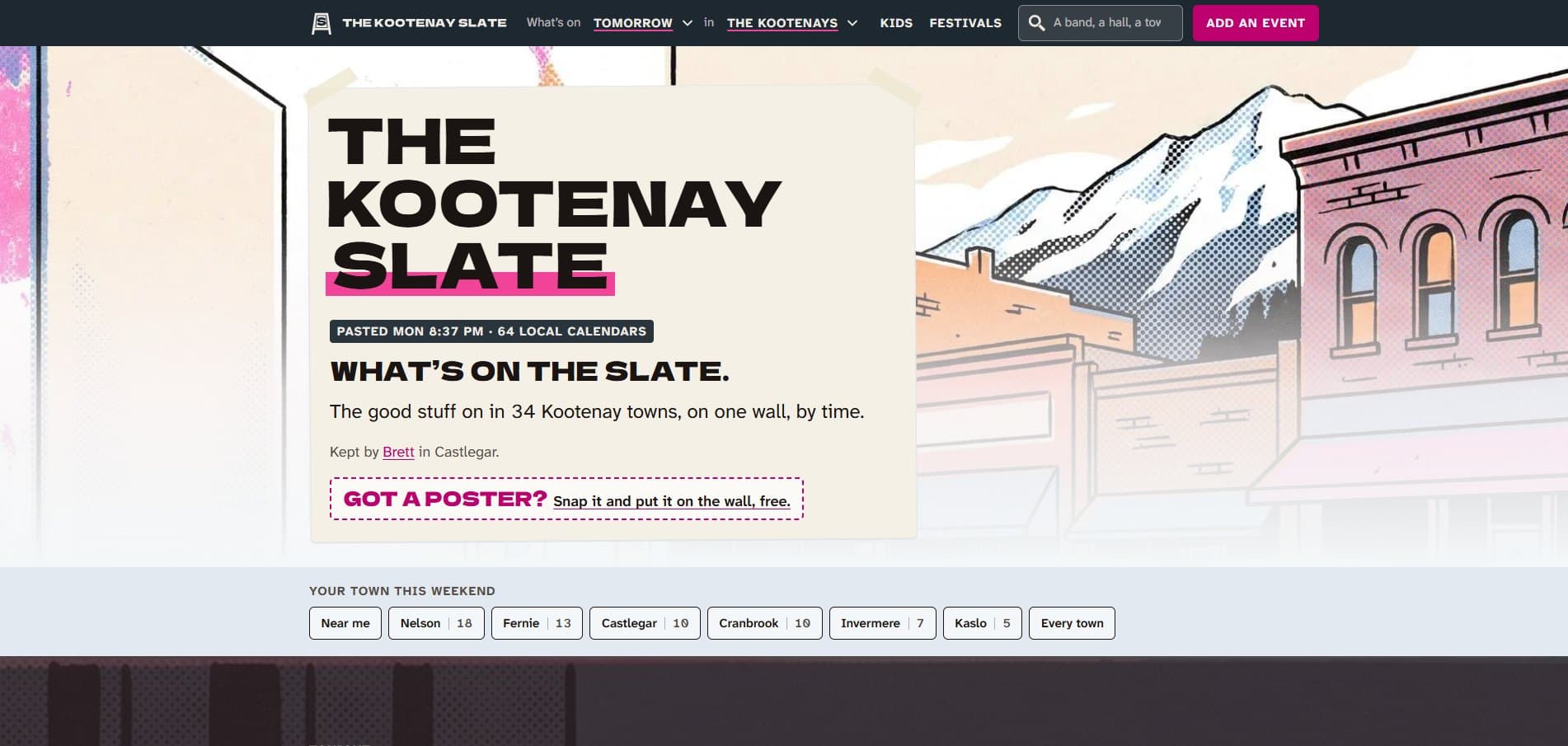
The Kootenay Slate is my own product, the second one I run after The Kootenay List. It went live in September 2026 to tell people what is on tonight near them. It reads 64 public calendars most mornings, sorts every event by start time, and puts each one on a poster that says who it is for and what it costs. For a venue or organiser, it is a free place to be seen. For anyone judging my work, it is a live data system they can check today.
Finding out what is on in the Kootenays took eleven browser tabs. Towns keep calendars, venues post on Facebook, and tourism boards stop at their own town lines. Research mapped 63 local event pages across both Kootenays before any design began, and none of them covered the whole region.
An event is only true for a night, so the rules came before the design. A poster holds the title, the time, the place, who it is for and what it costs, and it links back to its source for the full description. If the source did not say who an event is for or what it costs, that field stays blank. The word Free appears only when the source said free. The wall runs in start-time order, and nothing else moves a poster up or down.
The site is drawn as a risograph print of the Kootenays in four inks, with 28 towns illustrated from their real landmarks. Every picture is a drawing, so no image can be mistaken for a real venue or a real crowd. The front page reads like a poster wall, with a stamp showing when it was last pasted and how many calendars fed it.
Coverage is the hard part. A program reads 64 public calendars most mornings, from town halls and libraries to arts councils and live music listings, and it skips any page a site's robots file asks it to leave alone. Each calendar is scored out of 100 on how complete, current and early its listings are. Size does not count, so a small hall can outscore a tourism office, and a calendar that scores under 60 comes off the wall. In late September I re-tested all 1,035 sites the first research had listed, reading their pages this time, searched 31 towns again, and eight new boards came on, among them Tourism Fernie, which the first pass had dropped with 63 events on its own pages.
The people who keep those calendars are volunteers and small offices, so the Slate presents them the way a gig poster presents its acts. The boards page is printed as a gig bill, headliners first, in the order of each board's score, and each board's pass shows its billing. Every board has a page of its own with its next dates set as a tour poster and a card that shows what earns its score, and event and town pages name the board behind them. Each board can also take home a seal that says it is read by the Slate. The seal carries no score, so it never goes stale on someone else's site.
Plenty of events never reach a calendar and only exist on a poster. So anyone can photograph a flyer, and Claude reads it and fills in the add form in a few seconds. In testing on 64 flyers, including rough phone photos, it never invented a date, a time or a price, and every miss came flagged as unsure. I read every submission before it goes up, and the photo is deleted once I decide.
The Slate runs on the same habits as The Kootenay List. Every poster names its source and links back to it with an ordinary link, and anyone can ask for their event to come off. Every event also has a calendar file a venue can use on its own site. If your business depends on people knowing what is on and when, like a venue, a festival or a class schedule, this is the system I would build for you.
What a resident, a parent and a venue find on the Slate.
Residents see tonight first
What is on tonight, tomorrow and this weekend sits at the top of the wall, for their own town or the whole region.
Parents get a family wall
Every event marked all ages or family sits on its own wall, and the phone shortcut opens straight to it.
Venues get the visit back
Every poster links to the venue's own page and names the board it came from, the words stay theirs, and anything comes off the wall when they ask.
Everything that shipped.
I built the Slate on Next.js. An early-morning job reads the calendars six at a time, merges duplicate listings and compiles the wall, and nothing publishes if its checks fail. The site holds 2,217 pages in its sitemap, including 1,780 event pages, 183 venue pages, walls from tonight to the month, 18 town walls, valley and corridor pages, a kids wall and a festivals page. Every calendar also has a page of its own on the boards bill. Events sent in by hand and through the flyer scanner go to a small database and wait for my approval, which reaches me by email.
Highlights
- Walls for tonight, tomorrow, this weekend, this week and the month, for the region and 18 towns
- Who it is for and what it costs on every poster, left blank when the source is silent
- A flyer scanner that turns a photo of a poster into a filled-in form in seconds
- A boards page printed as a gig bill, with every calendar billed in the order of its score and its billing on its pass
- A page for every board with its next dates set as a tour poster, and a seal the board can put on its own site
- A calendar file for every event, and a pin that plans a night out to send to friends
- A kids wall for all-ages and family events, and an after-9 wall for late shows
- A Wrong? Tell me link on every event page, opening a form already filled in

Pages and surfaces
- Home (the wall)
- Tonight, tomorrow, this weekend, this week and the next 30 days
- 30 day pages and the month pages
- 1,780 event pages
- 183 venue pages
- 110 series pages for repeating events
- 18 town walls with their own time pages
- 9 valley pages and 4 corridor pages
- Kids, after 9 pm, live music, the arts, markets and festivals
- Every town on the map
- The boards, printed as a gig bill, and a page for every board
- Add an event and scan a flyer
- How it works
- About, accessibility, privacy and terms
Real code. Real routes. Production ready.
- The wall compiles from the calendars most mornings, and nothing publishes if the checks fail
- The calendar reader skips any page a site's robots file disallows, and it reads six boards at once but only one request at a time per server
- Each board's seal is built once as an SVG at build time and carries no score, so a copy on the board's own site never goes stale
- Event schema on every event page, so search engines can show the event's date and place
- A standard calendar file for every event, ready for a phone or a venue's own site
- The flyer scanner sends the photo to Claude, keeps it only until I decide, then deletes it
- Installable web app with maskable icons and shortcuts to tonight, the weekend and the family wall
Stack
How it was built
The Kootenay Slate is my own live product. I built it and run it from Castlegar, BC, under Kootenay Made Digital, beside The Kootenay List. The illustrations are drawn risograph-style plates of the region, never photographs of real venues. Event counts change daily. Counts read from the live site on September 29, 2026.
Your schedule deserves one clear wall.
If people need to know what you have on and when, like classes, shows, tours or a season of events, the Slate is the standard I would build yours to. If you already have a site, start with the free check-up. If you have no website yet, tell me what you run and I will show you where to begin.
No website yet? Start your first one here
This one is owned KMD infrastructure, not a client package. The same craft is for hire: see the services.
More work
23 / 23