


 hello@kootenaymade.ca
 Castlegar, BC. Serving the Kootenays and beyond.
On a lake, the water decides the day.
Marina websites that answer the lake before anyone has to call.
Before anyone drives out to your dock, they want to know three things: is it calm, is the store open, and what does it cost. Most marina websites answer none of them, so the answers come from your phone, one call at a time. I build marina and waterfront rental websites from Castlegar, BC, that put today's conditions, your hours, and every rate on the front page, from Kootenay Lake to the Arrow Lakes.

What a boater checks before leaving the house
I treat the website as the part of the marina that answers before anyone calls. The lake report, the rates, the hours, and the safety page do the work your staff do at the counter, so the calls that do come in are about booking, not about the wind. Where you already use a booking or moorage tool, I connect to it rather than replace it, so a marina or boat rental website and the reservation system read as one business.
- 01
The water is checked before anything else
A paddler, an angler and a family with a rental all ask the same first question: what is the lake doing today. If your site cannot answer it, they check a weather app that knows nothing about your bay, or they phone you. Answer it on the front page and the rest of the site gets read.
- 02
A trip to the dock is a commitment
Many marinas sit at the end of a lake road, some way from town. Nobody makes that drive on a maybe. They want the hours, the price, and the conditions settled before the truck leaves the driveway.
- 03
Price is part of the plan, not a surprise at the till
Families and visitors budget a day on the water against everything else they could do. A complete, current rate sheet on the site lets them choose you on purpose, instead of choosing whichever operator showed a number first.
- 04
Safety is decided at home
Once a boat is out past the last cell signal, nobody can look anything up. The people who read your safety page before they leave are the ones who come back with the boat and the stories you want.
- 05
The season changes the whole offer
Rentals stop, hours shorten, dry storage and winterizing start, and a winter derby might begin. A site that has to be remembered each spring and fall is wrong for weeks every year, and visitors believe what it says.
See Scotties Marina, on the Lower Arrow Lake near Castlegar.
Client build
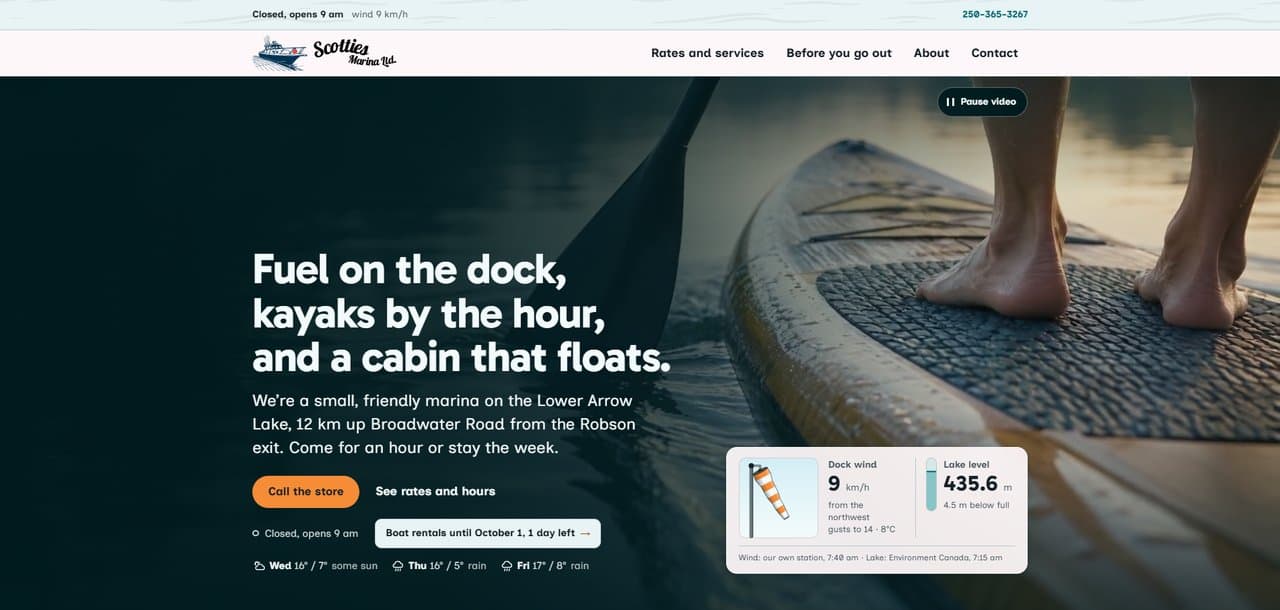
Scotties Marina sells fuel on the dock, rents kayaks, paddleboards and two boats, rents a floating cabin, and runs campsites and moorage. I built its site from scratch. The front page carries the wind from the marina's own weather station and the lake level from Environment Canada's gauge at Fauquier, and one rates file feeds 23 prices and a printable rate sheet.
- Live for a real client since September 2026
- Wind from the marina's own station
- Lake level from the public gauge
- 23 prices on one printable rate sheet
- A safety page with a printable float plan
- Winter hours that switch on their own date
Scotties Marina is a real client, live since September 2026. It is a small marina built on the Trailhead, so it shows the lake report and the rate sheet at their simplest; a larger marina gets more pages around the same core.
What I build for marinas and rental docks
- 01
The lake report
Today's wind at your dock, the lake level from the nearest public gauge, and whether you are open, each with its source and the time it was read. It is the reason most people open a marina website at all, so it goes at the top.
- 02
Every rate in one place
Fuel, moorage, launch fees, rentals, cabins, campsites, dry storage, and winterizing, all from one rates file. The rate board, the services page, and a printable rate sheet read from the same source, so a price changes once and matches everywhere.
- 03
Rentals and moorage requests that arrive complete
Rental and moorage forms that ask for what you need the first time: dates, party size, boat length, and the kind of moorage. Where you already take bookings through a rental or marina tool, I link straight into it instead.
- 04
A site that keeps its own calendar
Summer and winter hours, rental seasons, and notices that switch on their own dates. The winter version of the site can lead with dry storage, winterizing, and ice fishing without anyone logging in.
- 05
Before you go out
A plain safety page for your stretch of water: emergency steps, the public numbers, the hazards of a reservoir that rises and falls, and a float plan to print and leave with family. It is written for the renter who has never been on your lake.
The standard that comes with every build I ship.
- A front page led by the lake report: wind, lake level, and open or closed
- One rates file behind the rate board, the services page, and a printable rate sheet
- Rental, cabin, and moorage request forms, or a link into your booking tool
- Summer and winter hours and notices that switch on their own dates
- A before-you-go-out safety page with a printable float plan
- A photo gallery of your real dock, boats, and customers' catches, with consent
- Privacy notice and accessible forms

Every unanswered question comes back as a phone call at the fuel dock
Nobody complains when a marina website is thin. They just call, or they drive out and find the store closed. The right column moves those answers onto the page.
Conditions are only known at the dock
Costs them
A paddler with a day off has to guess whether the lake is calm enough, or phone and hope someone picks up.
Costs you
The same question answered between fuel customers, all morning, every morning the wind is up.
FixWind and lake level on the front page, with a source and a time on every reading.
The rates live on a sheet taped to the store window
Costs them
A family comparing a boat rental against a day at the beach cannot see the price until they are standing at your counter.
Costs you
Rate questions by phone and message, and a printed sheet that drifts out of step with what the website says.
FixOne rates file behind every price on the site and a printable rate sheet, so a price changes in one place.
Hours change with the season and the website does not
Costs them
Someone drives up a long lake road in October on summer hours and finds a locked store.
Costs you
An annoyed first visit, and a review you did not earn.
FixHours, rental season and notices that switch on their own dates, from one calendar.
Moorage enquiries arrive with none of the details
Costs them
A boat owner asks about a slip and waits for a reply that starts with more questions.
Costs you
Three messages to learn the boat's length, the dates, and whether they want summer or year-round moorage.
FixA moorage request form that asks for boat length, dates, and the kind of moorage up front, and lands in your inbox.
Safety information only lives at the counter
Costs them
A renter heads out past the last cell signal without knowing what to do if the engine quits.
Costs you
Safety briefings repeated at the dock for every renter, with no written version to hand them.
FixA before-you-go-out page with emergency steps, public numbers, and a float plan they can print and leave with family.
The lake report puts today's water on the front page
Every marina answers the same questions all season. Is it windy, where is the water, are you open. On a BC reservoir the water question matters more than anywhere, because the level can move by metres over a season, and the shoreline, the launch, and the angle of the gangway all move with it.
I put those answers where people look first. The wind can come from a weather station on your own dock. The lake level comes from the public gauge nearest you, where one exists. Your open or closed status comes from your own calendar, so nobody has to remember to change it. Every reading shows its source and the time it was taken, and when a station goes quiet, the site says so instead of guessing.
- Wind, gusts and temperature from your own dock station, refreshed every minute
- Today's lake level from the public gauge, with how far it sits below full and which way it is moving
- Open or closed, the season's notices, and the hours, worked out from one calendar
- A source and a time on every reading, and no number at all when a station is quiet
Renters, moorage records, and the rules on the water
A site in this category is judged on more than looks. These are the obligations and reassurances I build in by default, so the business stays credible and protected.

Proof of competency for renters
Anyone operating a power-driven pleasure craft in Canada needs proof of competency, most often the Pleasure Craft Operator Card, the PCOC. For renters, Transport Canada accepts a completed rental boat safety checklist as proof of competency for the length of the rental. I put the rule and what renters should bring on the rentals page, so the conversation at the dock is a confirmation rather than a surprise.
Lifejackets and safety equipment
Canada's Small Vessel Regulations require a lifejacket or PFD of an appropriate size for every person on board, paddlecraft included. Your site can say which sizes you stock and what comes with each rental, so a family knows before they arrive whether to bring a child's lifejacket.
Customer records under BC's privacy law
Moorage contracts, rental waivers, and contact forms collect personal information, and in British Columbia private businesses handle it under the Personal Information Protection Act. I write a plain privacy notice, limit each form to what you actually need, and keep records in your inbox or your booking tool rather than on the public site.
Waivers belong to your lawyer
I can build an online waiver step or link to the one your booking tool provides. The words of the waiver, and whether it holds up, are a question for a BC lawyer, and I say so rather than write one.
Deposits, cards, and CASL
Rental deposits and moorage payments go through PCI DSS compliant processors, so card numbers never touch your site. Newsletters about the season opening or a derby are commercial electronic messages under Canada's Anti-Spam Legislation, so I set up consent at signup, clear sender details, and a working unsubscribe.
Honest labels on conditions data
Real-time lake levels from the Water Survey of Canada are published as provisional, and a dock weather station is a single point on a big lake. I show the source and time with every reading and never present a number as official. The site builds to WCAG 2.2 AA throughout, so the lake report works with a screen reader as well as at a glance.
Want this standard on your site?
One conversation, no pitch deck. Tell me where the business is stuck and I will tell you what I would build.
What a build like this costs.
A focused presence site starts with the Trailhead: $2,000, or $500 today and $142 a month on Own It Monthly ($2,204 total). Plenty of businesses in this industry need exactly that and nothing more.
Bigger jobs usually land at $6,500, or $1,625 today and $457 a month on Own It Monthly ($7,109 total)
The Engine · typical timeline 4 to 5 weeks
A marina with rentals, moorage, a cabin or campsites, and a season needs rate pages, request forms, a seasonal calendar and the lake report, which is what the Engine covers. A small dock with one or two services can start on the Trailhead.
The honest answer depends on what you actually need, not on a package name. Start with the free check-up or the contact form, and I will book a proper 45-minute consultation with you, no pressure either way.
Comparing options right now? What a website should cost breaks down how to read any quote, and who actually owns your website covers what you keep if you ever leave, on any platform, including mine.
Your booking and marina software does the plumbing. KMD wins the decision.
These tools are built to take a booking from someone who has already decided. They do not tell a boater what the water is doing today, what your whole price list looks like, or why your dock beats the public launch down the road.
Marina management tools such as Dockwa handle slip reservations and moorage billing, and rental booking tools such as FareHarbor and Peek handle time slots, deposits, and waivers. They run the reservation. The decision to come to your dock at all is made earlier, on your website, often on a phone, and often while someone is deciding whether the lake is calm enough.
What the category tool covers
- Slip and moorage reservations and billing
- Rental time slots, deposits, and availability
- Online waivers and check-in
- Booking confirmations and reminders
- Payments through their own processors
Where the upgrade actually pays off.
- 01
Put today's wind and lake level on the front page instead of making people phone for them
- 02
Keep every rate in one file so the website, the rate board, and the printed sheet never disagree
- 03
Let the site switch its own hours and seasonal notices instead of relying on someone to remember
- 04
Ask for boat length and dates in the moorage form, not in the third reply
- 05
Give renters a safety page they read at home, before they are out of cell range
Where I would start.
- Custom websitesThe Engine is where most builds for this kind of business land, and every tier is priced on the page.
- Local SEOPeople search for fuel, moorage and rentals by the name of the lake, and local SEO puts the marina in those map results with current hours.
- Ongoing supportRates change between seasons and the lake report leans on outside data feeds, and a support plan keeps both working.
Questions marina owners ask me
How much does a marina website cost in BC?+
Most marinas with rentals, moorage, and a cabin or campsites land in the Engine at $6,500, or $1,625 today and $457 a month on Own It Monthly ($7,109 total), typically delivered in 4 to 5 weeks. A small dock with one or two services can start on the Trailhead at $2,000, or $500 today and $142 a month for 12 months ($2,204 total). It depends on what you actually need, not on a package name.
Can my website show the wind and the lake level live?+
Yes. The wind can come from a weather station on your own dock, and the lake level from the nearest public gauge, where the Water Survey of Canada or BC Hydro publishes one. Scotties Marina on the Lower Arrow Lake runs both on its front page. Each reading shows its source and the time it was taken, and the site says so when a station goes quiet.
Do I have to replace my booking or moorage software?+
Usually not. Tools like Dockwa, FareHarbor, or Peek are good at taking a reservation. I keep the one you use and build the website that makes people want to book, then link the two so the handoff feels like one business.
Can people book a boat or a kayak rental online?+
Yes, two ways. The simpler one is a request form that asks for the date, the rental, and the party size, and lands in your inbox. If you want live availability and deposits, I connect the site to a rental booking tool that handles both.
What do renters need to operate a rental boat?+
Anyone operating a power-driven pleasure craft in Canada needs proof of competency. Renters can use a completed rental boat safety checklist, which Transport Canada accepts for the length of the rental, or show their own PCOC. I put that on the rentals page so nobody learns it at the dock.
Can the site handle moorage waitlists and dry storage enquiries?+
Yes. A moorage and storage request form asks for boat length, dates, and the kind of moorage or storage up front, so you can answer or add someone to your waitlist without three rounds of messages. Winterizing and dry storage get their own section for the fall.
Is this only for marinas?+
No. It fits boat, kayak, and paddleboard rentals, houseboat rentals, yacht and boat clubs, fuel docks, and lakeside cabins or campgrounds with a dock. Anywhere the business depends on the water and the season, the same lake report and rate sheet do the same job.
Will I own the website?+
Yes. The code lives in your own GitHub account, the site runs on hosting in your name or mine, your choice, and the domain is registered to you. Scotties Marina's code, hosting, and domain all sit in the marina's own accounts.
Will the site work for everyone?+
I build to WCAG 2.2 AA: readable contrast in bright sun, labelled forms, keyboard access, and a lake report that a screen reader can speak as well as a sighted visitor can scan. Scotties Marina's eight pages passed an automated axe check with no critical or serious problems.

Who builds this
I am Brett, the person behind Kootenay Made Digital. I plan, design, and build every site myself from Castlegar, BC, so the person you email is the person doing the work.
Founder, Kootenay Made Digital · Castlegar, BC
Get the site sorted before the ice comes off
Most marinas and rental docks land in the Engine build: the lake report, every rate in one place, and moorage and rental requests that arrive complete, ready before the season opens.
No website yet?
Start My First WebsiteAlready have one?
Get a Free Check-Up