


 hello@kootenaymade.ca
 Castlegar, BC. Serving the Kootenays and beyond.
Powderhorn Basin
A cat and heli site that seats a nervous first-timer before the call.
27
Pages in the sitemap
4
Lines to find your group
5
Answers to ask for a seat
10
Journal guides for trip planners
Powder footage sells the dream and scares off the first-timer.
First-timers fear holding the group up.
A strong resort skier who has never ridden a cat is a seat worth winning. A wall of deep-powder video tells them the trip is for somebody better.
And it costs the businessEvery seat that person talks themselves out of goes unsold. The ones who do book get there one reassuring phone call at a time, taken by a guide who starts work before dawn.
The real price hides until the quote.
Taxes, the shuttle, rentals and the tip rarely appear in one place on operator sites, and the storm policy sits in a PDF.
And it costs the businessEach missing number comes back as an email. Guests who never ask arrive surprised by the bill.
Nobody can see which weeks have room.
Availability is kept in the office, so a guest has to ask before they can plan.
And it costs the businessA guest who cannot see an open week books with the operator who shows one.
A seat on the board before the first phone call.
Find your group.
Four plain lines, one tap, and the slate board seats you with your guide, your pace and your weeks.
Your run down the map.
Scrolling paints your group's line down the painted tenure map, from the Horn to the cat.
The whole bill and the storm rules.
Every tax in the total, the tip beside it, and what comes back to you when the weather turns.
Five answers to ask for a seat.
The week, the package, a name, an email and how many guests. Everything else is optional, and the lodge's number sits beside the form.
The thinking behind the build
Powderhorn Basin is a fictional cat and heli operation above an invented BC town called Muleshoe. It was built for the operator whose best future guest is a strong resort skier who has never ridden a cat. That guest has one question before any other: will I be the one holding everyone back? The site answers it in one tap, then puts the price with tax, the storm rules and the open weeks one scroll away.
The first Powderhorn, built in July, was a scroll down one mountain at night. It looked good on a large screen and read as a dark gradient on a phone. Worse, it never answered the question that keeps a first-timer from booking: am I good enough, or will I hold the group up? Operators cannot know that until they ski with a guest, so they sort everyone on the first morning. The rebuild puts that sorting on the website.
The idea came from the guides' 5:45 meeting, where the snow gets read and every guest has a seat on the group board. Find your group offers four plain lines. Pick the one that sounds like you and the board chalks your seat from the operation's own data: Cat Three for a first week, Cat Two at a steady pace, Cat One for the fast group. Each seat carries its lead guide, its runs a day, a sample run list, the weeks with room and the price with tax. The site also says the guides confirm every seat on the first morning, and anyone in the wrong cat moves at no cost.
Further down, Your run paints your group's line down the painted tenure map, with each run named, its trail mark shown and the altitude falling from 2,610 metres at first light to the creek road at 1,540. Before anyone picks, it shows Cat Two's list from the same morning, so the page never sits empty.
The practical answers are built as tools, because a guest planning a big trip wants a number, not a paragraph. The whole bill builds a week line by line, with GST and lodging taxes in the total and the tip shown beside it. The storm calculator asks what the weather did and shows what comes back: a heli day refunded in full, half a cat day back under four runs, credit or 60% cash for a day the cats could not run. The open-weeks board lists every week of the winter with one word for how full it is.
Then I cut it back. The rebuild first showed seat counts for every group in every week. It also carried a dated snow report and last winter month by month. A family operator would have to update all of that by hand, and they never would. So every figure on the site now has to be one that someone at the lodge can keep true. Prices, dates and policies change once a year. The board says Open, A few seats or Full. Last winter gets one line, the 109 of 113 days the cats ran. The nav went from eight links to five, and the header now carries the badge's own mark and the name, set large enough to read.
The look moved from night to day: a snowfield ground with blue shadows, chalk on a slate board, a painted map and League Gothic poster capitals over IBM Plex. The hero film and the photographs are generated, the guides' portraits included, and every page says the operation is a concept. On the guides and safety page, a visitor probes Dev's study pit by scrolling, from the new snow to the full 260 cm. Each layer says how hard it is in plain words, soft, firm or hard, because "hand test" means nothing to a first-timer.
In the jury's last certification, the home page scored 9 for design and 9 for creativity. Three debts stay open, all due on October 10: a screen reader pass, one journal guide and a page-weight check. Every route passed the readiness battery, layout shift measured 0, and the headline's contrast over the film was checked on every frame. For a real operator, the same site runs on the real tenure, the real guides and the real open weeks.
What a first-timer and a seasoned rider each need to see.
A group that fits them
First-timers land in the first-week group, and anyone in the wrong cat moves on the first morning at no cost.
The safety story up front
A nervous guest sees who makes the calls and how the snow gets read each morning. They know that before they book.
Money with no surprises
The price with tax, the deposit, the balance date and the storm refunds are all on the page.
Everything that shipped.
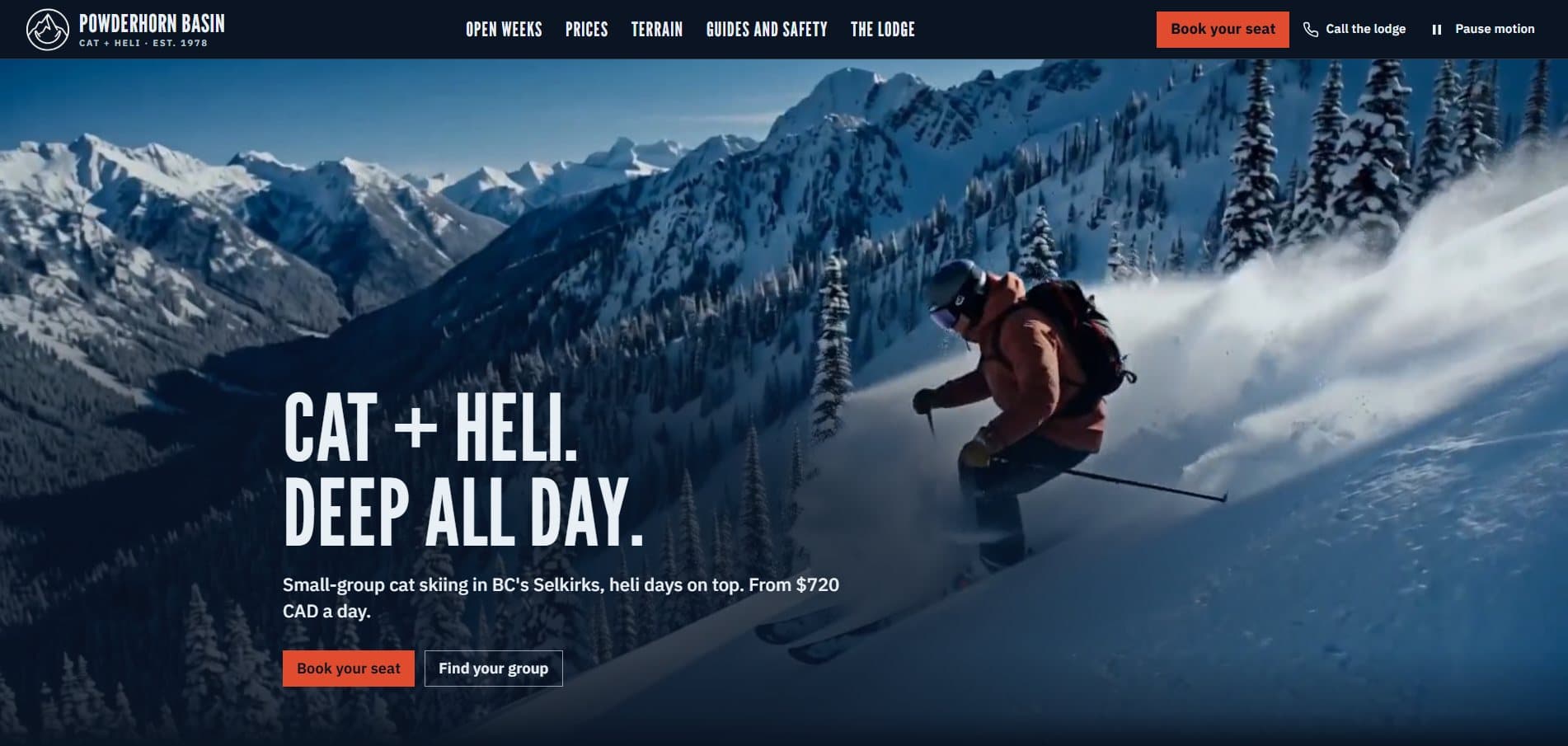
I rebuilt Powderhorn in October 2026 around the guides' 5:45 morning meeting. The homepage opens on a short film of the basin under the line "Cat + heli. Deep all day." Below it, Find your group offers four plain lines. Pick one and a slate board seats you in one of three cats, with your guide, your pace, a sample run list and the weeks that still have room. Scroll on and Your run paints that group's line down the painted tenure map, from the Horn at 2,610 metres to the cat at 1,540. Around it sit an open-weeks board, a bill that builds itself line by line, a storm calculator, a guides and safety page with a study pit you probe by scrolling, ten journal guides and a booking form with five answers.
Highlights
- Find your group: four plain lines, and the slate board seats you in one of three cats
- Your run: your group's line painted down the tenure map as you scroll, from the Horn to the cat
- An honest not-this-winter answer for anyone who cannot link turns in soft snow yet
- An open-weeks board with every week of the winter marked Open, A few seats or Full
- The whole bill: build your week line by line, with every tax in the total and the tip beside it
- A storm calculator: pick what the weather did and see what comes back to you, in dollars
- A study pit on the guides and safety page, probed by scrolling and read in plain words
- A booking form with five answers, everything else optional, and the lodge's number beside it

Pages and surfaces
- Home (Find your group and Your run)
- Open weeks (the board)
- Packages and the whole bill
- Terrain and the painted map
- Guides and safety
- The lodge
- The fleet
- Getting here
- Our story
- FAQ
- Book your seat
- Journal and 10 guides
- Accessibility
- Privacy
- Terms
Real code. Real routes. Production ready.
- One data file feeds every price, run list, open week and storm rule, so the board, the bill and the booking form agree
- The headline's contrast over the hero film was checked on every frame, the lightest included
- Phones get a centred crop of the same film, and a pause button sits on the two pages that move
- Visitors who turn off motion get still frames, and the group finder works as plain buttons
- Fonts preload with matched fallbacks, so prices never render in a stand-in face, and layout shift measured 0 on every route
- Built toward WCAG 2.2 AA, with every route checked for sideways scrolling at phone widths
Stack
How it was built
Powderhorn Basin is a fictional concept, and every page of the site says so. The operation, the town of Muleshoe, the guides, the terrain, the open weeks and the snow figures are invented. The hero film and every photograph are generated, and the booking form sends nothing. For a real operator, the same site runs on your real tenure, your real guides, your real open weeks and your real bookings. Facts read from the live concept on October 5, 2026.
Your guests should know their seat before they book it.
Powderhorn is the proof. The same group finder, open-weeks board and plain bill can be built around your terrain and your guides. Already have a site? Start with the free check-up and I will show you where it loses the first-timer. No website yet? Tell me about your operation and I will show you where to begin.
No website yet? Start your first one here
Built as The Engine, $6,500. Own It Monthly can spread the build over 12 payments, yours outright at the end.
In this industry yourself? Read the adventure operator website design playbook.
More work
03 / 23