


 hello@kootenaymade.ca
 Castlegar, BC. Serving the Kootenays and beyond.
GenerateIdeas
An app idea forge that grades every idea against live market data.
176
Pages in the sitemap
73
Idea category and trade pages
86
Blog guides
5
Stations in the forge
An idea tool that flatters people is worse than none.
A blank prompt box hands the work back.
An idea tool that opens on an empty box asks the user to know what they want. That is the thing they came to find.
And it costs the businessVisitors who make an account and never generate an idea are sign-ups that never become users.
A score that praises everything means nothing.
If every result comes back a winner, the grade stops meaning anything and nobody trusts the next one.
And it costs the businessA score nobody trusts turns every result into a support question about why.
Web and phone drift apart.
When the web app and the phone app keep separate accounts and balances, users lose track of what they paid for.
And it costs the businessTwo balances mean two sets of billing questions, and every mismatch lands in my inbox.
Built as one workbench, worked in order.
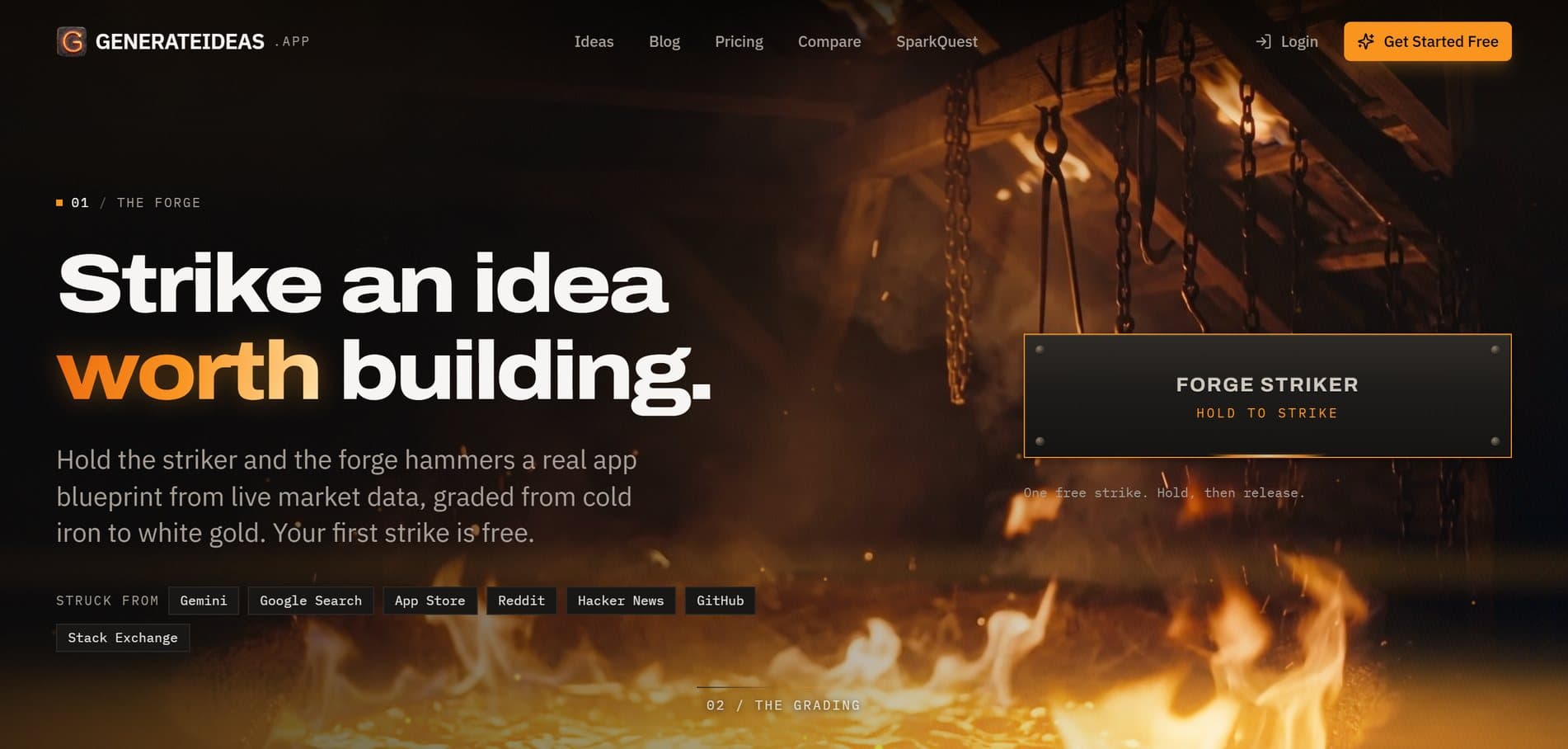
Hold to strike an idea.
The user holds a striker and the forge returns a full blueprint: name, problem, niche, features and a grade.
Grades that run cold.
Every idea is graded from 50 to 99, and a crowded market caps how high a score can climb.
Five stations in order.
Strike, temper, compare, plan and carry. Each station takes the idea further, from the first strike to a build plan and a prompt.
One account on web and phone.
SparkQuest on the iPhone shares the same login, the same spark balance and the same grading scale.
The thinking behind the build
GenerateIdeas is my own web app for people who want to build software and have not picked the idea yet. It is built as a forge. The user holds a striker and gets a full app blueprint drawn from live market data, with a grade that says so when an idea runs cold. From there the idea can be tested, compared and planned. SparkQuest, its iPhone app, runs on the same account.
People come to GenerateIdeas wanting to build something and not knowing what. An idea tool that opens on a blank box asks them for the very thing they came to find. One that praises every idea it returns is worse, because someone may spend months building on a compliment. GenerateIdeas had to give structure on the first screen and grade with a straight face.
The concept is a forge. Steel shows its temperature by colour, so the grades do too: cold iron, tempered blue, oxide purple and white gold, on a 50 to 99 scale. The homepage says that most strikes land cold, and a crowded market caps how hot a score can climb. A high grade means open water, and the forge says so when an idea does not have it.
The signature move is the striker. The user holds a button, the forge hammers, and a full blueprint comes back from a live category: a name, the problem, the niche, the features and a grade. The first strike is free. From there the idea moves through four more stations: temper it against the market, compare it with another, plan the build week by week, and carry it out with a master prompt for AI coding tools.
Search brings people to the door. The site has 63 idea category pages, from AI and fitness apps to browser extensions, and 10 pages of ideas for particular trades such as landlords and personal trainers. Beside them sit 86 blog guides and 3 comparison pages. Each one meets a searcher at the niche they already care about and leads to the forge. A free idea validator and an app cost calculator sit alongside.
SparkQuest is the pocket version, live on the App Store for iPhone, with Android on the way. It shares one account, one spark balance and one grading scale with the web forge, so a user can strike on the phone and plan at the desk under one login. Payments run through Stripe on the web and RevenueCat in the app.
The pattern carries to any business that sells a judgment: a quote, an assessment, a recommendation. Give the visitor something to do before asking for anything, show how the answer was reached, and let the grade stay honest even when it disappoints. A contractor's estimate tool or a clinic's intake check can work the same way.
What a builder knows before they commit a weekend.
A grade they can believe
Scores cap in crowded markets, so a high grade carries weight.
A plan and a prompt to start with
A strong idea turns into a week-by-week build plan and a master prompt for their coding tool.
One account everywhere
The same login and spark balance work on the web and in SparkQuest.
Everything that shipped.
I built the GenerateIdeas web app in React and TypeScript with Vite, with the public pages rendered ahead of time for search. The forge's five stations run as Supabase edge functions, with Google's Gemini model generating the blueprints and payments through Stripe. The public site carries 63 category pages, 10 trade pages, 86 blog guides, a free validator and a cost calculator. I also built SparkQuest, the iPhone app, in Expo and React Native. It shares one account and one spark balance with the web.
Highlights
- A hold-to-strike forge that returns a full app blueprint: name, problem, niche, features and a grade
- Grades from 50 to 99 in the colours of heated steel, capped in crowded markets
- Temper, compare and plan stations that test an idea and turn it into a week-by-week build plan
- A master prompt with every blueprint, written for AI coding tools like Cursor, Claude, Bolt and Replit
- 63 idea category pages and 10 trade pages, each a way in from search
- 86 blog guides, 3 comparison pages, a free idea validator and an app cost calculator
- SparkQuest for iPhone, sharing one login and one spark balance with the web app

Pages and surfaces
- Home (the forge)
- Idea browser
- 63 idea category pages
- 10 ideas-by-trade pages
- Gallery
- Trending
- Problem report
- 86 blog guides
- 3 comparison pages
- Idea validator
- App cost calculator
- SparkQuest
- Privacy, terms and cookie policy
Real code. Real routes. Production ready.
- React, TypeScript and Vite, with every public page rendered ahead of time so search engines read it in full
- Supabase edge functions run each station, with Google's Gemini model behind the blueprints
- Stripe on the web and RevenueCat in SparkQuest, tied to one account and one spark balance
- A sitemap generated on every build, so new category pages and guides reach search without a manual step
- Expo and React Native for SparkQuest, live on the App Store with an Android version on the way
Stack
How it was built
GenerateIdeas and SparkQuest are my own products, and I build and run them. Counts read from the live site on October 5, 2026.
Building a product people come back to?
GenerateIdeas shows how a tool earns trust: something to do on the first screen and an answer that holds up. The same thinking fits a quote tool or a booking app. Start with the free check-up, or if you have no website yet, tell me what you want to build and I will show you where to begin.
No website yet? Start your first one here
This one is owned KMD infrastructure, not a client package. The same craft is for hire: see the services.
More work
18 / 23