


 hello@kootenaymade.ca
 Castlegar, BC. Serving the Kootenays and beyond.
Disclosure
A pre-launch app brand whose website hands visitors a role, a record and something to do while they wait.
118
Pages in the sitemap
59
Official events on the ledger
73
Intel files
3
Field tools in the browser
An app nobody has heard of needs a reason to wait for it.
Before launch there is nothing to download.
Until the app is in the stores, the website is the only part of the product a visitor can touch. A bare coming-soon page gives them nothing to do.
And it costs the businessA visitor who leaves with nothing to do leaves no way to reach them, so launch day starts with a short list.
An unusual idea can read as a joke.
A first-contact training app lives or dies on tone. If the site winks, nobody takes the quiz seriously enough to finish it.
And it costs the businessAn unfinished quiz means the visitor never reaches the card claim, which is where the email is asked for.
The site and the app feel like strangers.
When the website and the app look and sound different, visitors lose the thread between them.
And it costs the businessEvery visitor lost between the site and the store has to be won again from the start.
Built so the site does real work before the app exists.
The quiz draws a card.
Ten scenario questions assign one of four roles and draw an iris print for a card with a page of its own.
A public record, checked.
59 official events and nine case files, each given a verdict against its source.
Field tools that work today.
A sky identifier, a sighting report builder and a Drake equation calculator run in the browser before the app exists.
One file, every page.
The leaked-file design holds from the eye on the home page to the routing slip in the footer.
The thinking behind the build
Disclosure is my own app brand, a field app that trains ordinary people for the first minutes of contact. The app is in development for iOS and Android, so for now the website carries the whole brand. It has to make an odd idea feel serious, give a visitor something to do in the first minute, and hold their place for launch day. In September 2026 I rebuilt it from end to end as a leaked government file.
An app that is not in the stores yet has one public surface, its website. For Disclosure that surface carries a strange premise, civilian training for first contact. It has to hold a visitor long enough to leave an email for launch. A plain waiting-list page would not do it. The site had to feel like part of the product.
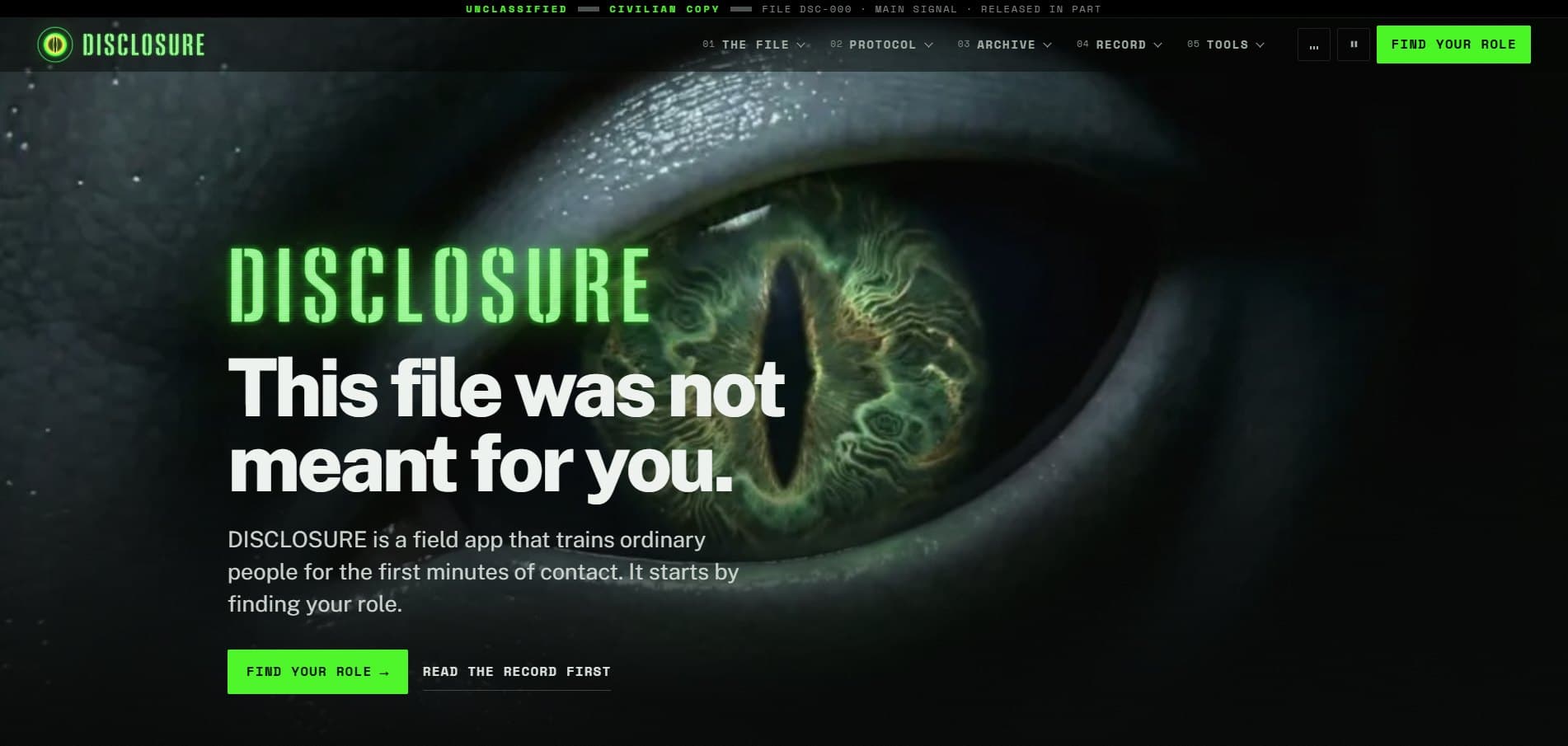
In September 2026 I rebuilt the site as a leaked government file. It opens on an eye that moves as the page scrolls, under the line "This file was not meant for you." Every page after it keeps the fiction: a banner marking at the top, numbered dossier tabs for navigation, section headings that declassify as they arrive, torn-paper exhibits with witness sketches, and a routing slip for a footer. Because the tone never winks, a visitor takes the quiz seriously enough to finish it.
The signature move is the classification. Ten short scenarios, each with four responses, assign one of four roles: Sentinel, Diplomat, Scholar or Survivor. A fifth, First Contact, stays sealed. The answers also draw an iris print that no one else carries, and it lands on a First Contact Card. The card has its own page that shows its iris when the link is shared, and the email that sends it is how a visitor holds a place for launch.
A premise like this invites made-up claims, so the site keeps a public record instead. The Disclosure Ledger lists 59 official events since 1947, from hearings and laws to reports and releases, each checked against its source: 48 verified and 11 partly verified, with five claims that do not hold up set out apart. Nine case files are each labelled explained, disputed or unexplained. The rebuild also removed invented percentages and fake counters from the old site.
Three field tools work today, before the app exists. The sky identifier takes a time, a place and a direction, checks real satellite and planet positions, catches Starlink trains, and hands off to a sighting report builder that routes a report to the right body. A Drake equation calculator rounds them out. The archive holds 73 intel files in six categories and a 106-term glossary, each file opening with a direct answer, which gives the brand depth and gives search engines 118 pages to find.
The app is in development for iOS and Android, and the site says so. It names the five features the app launches with, from the classification to crew drills, and which of them are free. The site itself is built toward WCAG 2.2 AA, with a motion pause on every page, an optional clock on the drill and a published accessibility statement. Every page was checked on screens from 320 to 2,560 pixels wide.
The pattern fits any product that has to earn attention before it can be bought: an app in development, a course before it opens, a venue before opening day. Give the visitor something to do on the first page, make the result theirs to keep, and ask for the email at the moment it is worth something to them.
What a visitor gets before the app is out.
Something to do at once
The quiz starts from the first screen, and it asks for nothing to begin.
A result that is theirs
Each visitor leaves with a role, an iris print and a card page to share.
A straight answer on the app
The site says the app is in development, names its five launch features and says which are free.
Everything that shipped.
I rebuilt getdisclosure.app as 118 fast static pages on Vercel, all on one design system: a classified-file header with numbered dossier tabs, headings that declassify as they arrive, and a routing slip for a footer. It carries the role quiz, a six-scene drill, five role dossiers, an archive of 73 intel files in six categories, nine case files and the Disclosure Ledger of 59 official events since 1947. Three field tools run in the browser: a sky identifier that checks real satellite and planet positions, a sighting report builder and a Drake equation calculator. Sign-ups are stored in Supabase, and every card goes out by email with a page of its own.
Highlights
- A ten-question role quiz that assigns one of four roles and draws an iris print from the answers
- A First Contact Card with its own shareable page, sent by email with the card image
- The Disclosure Ledger: 59 official events since 1947, each checked against its source, with filters and CSV and JSON downloads
- Nine case files, each labelled explained, disputed or unexplained
- A sky identifier that checks real satellite and planet positions for a time, a place and a direction
- An archive of 73 intel files in six categories, each opening with a direct answer
- A six-scene drill on a blackout night, with an optional clock and a pause at any time
- The classified-file design on every page: numbered dossier tabs, declassifying headings and a routing-slip footer

Pages and surfaces
- Home (the leaked file)
- Role quiz and the First Contact Card
- 5 role dossiers
- The briefing
- The ten-second drill
- Intel archive: 6 category hubs and 73 files
- The Disclosure Ledger and the 2026 PURSUE releases
- 9 case files
- 3 field tools: sky identifier, sighting report and Drake equation
- Glossary of 106 terms
- A shareable page for every card issued
- FAQ, about, accessibility, privacy and terms
Real code. Real routes. Production ready.
- Static HTML, CSS and JavaScript on Vercel, with one shared design system across 118 pages
- One iris and card engine runs in the browser and on the server, so the emailed card matches the one on screen
- The sky identifier reads satellite orbits from CelesTrak through a serverless route the CDN caches
- The ledger's filters live in the page address, and its data downloads as CSV or JSON
- Every intel and case file is its own page with breadcrumb structured data, and IndexNow tells Bing when one changes
- Built toward WCAG 2.2 AA, with a site-wide motion pause, forced-colours support and an accessibility statement
Stack
How it was built
Disclosure is my own product, and I build and run it. The app is in development and has not launched, and the site says so on the page. The ledger and case files report the public record with a source for each entry. Counts read from the live site on September 29, 2026.
Launching something new? Give people a reason to wait.
Disclosure shows how a website can do real work before the product exists. The same approach fits an app, a course or a new location. Start with the free check-up, or if you have no website yet, tell me what you are launching and I will show you where to begin.
No website yet? Start your first one here
This one is owned KMD infrastructure, not a client package. The same craft is for hire: see the services.
More work
17 / 23