


 hello@kootenaymade.ca
 Castlegar, BC. Serving the Kootenays and beyond.
Kootenay Made Digital
My own studio site, built to the standard I promise every client.
228
Pages in the sitemap
130
Guides
22
Industry pages
23
Case studies
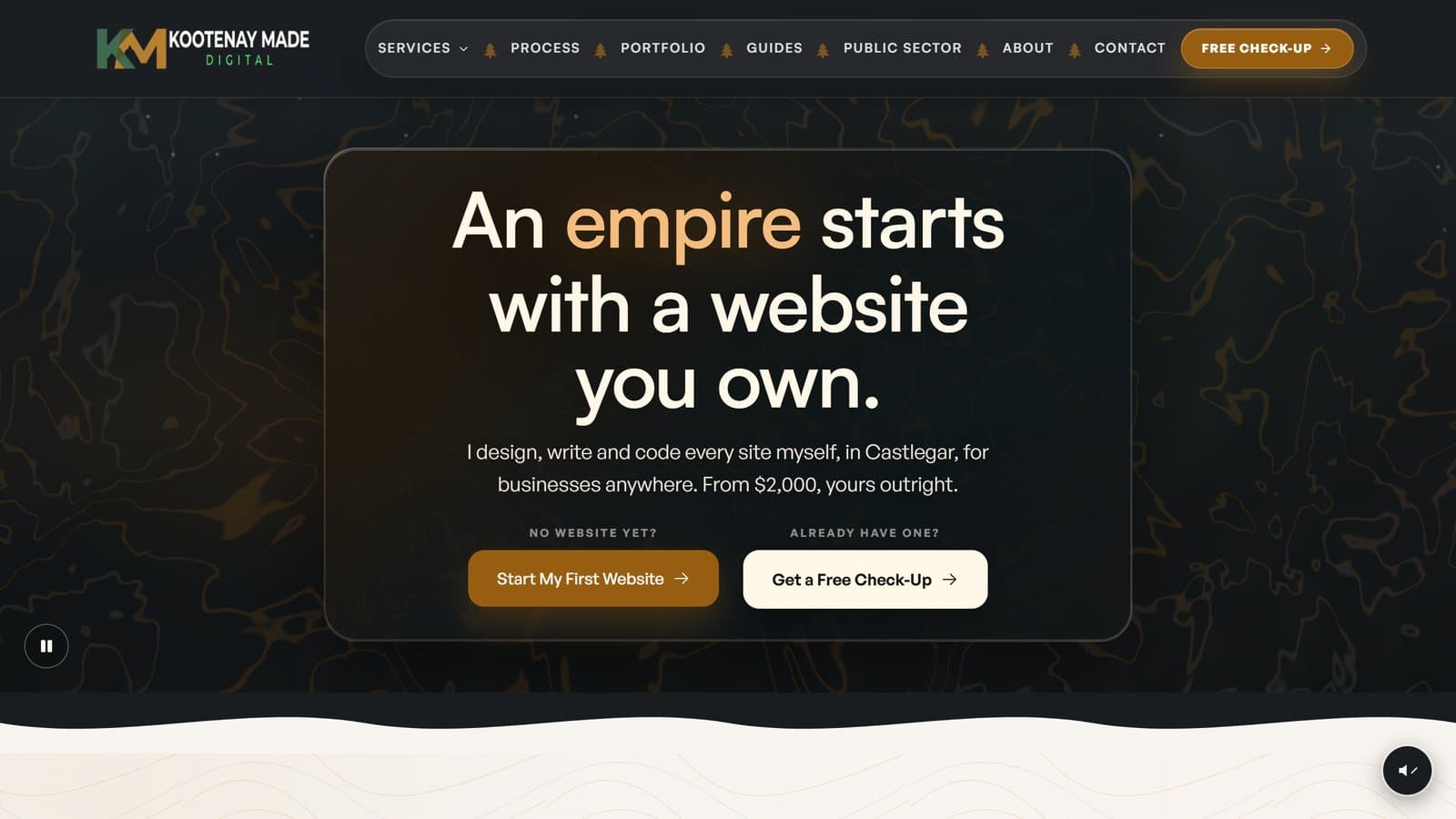
A web designer's own site is the first proof a buyer checks.
My own site is checked first.
Before anyone calls, they look at my site. If it is slow, generic or vague, nothing I say about their site will be believed.
And it costs the businessA weak site means the first call starts with me proving I can build, when it should start with what the business needs.
Prices hidden behind a phone call.
An owner who cannot see what a build costs or includes has to write and ask. That is one more step before they trust anyone.
And it costs the businessEvery enquiry that opens with a price question is a conversation spent on a number the page could have shown.
Some visitors have no website yet.
A site that only offers to fix an existing website gives a first-time owner nowhere to start.
And it costs the businessThose owners leave without saying why, and someone else builds their first website.
Built so a visitor can check the work before they call.
A free check-up on the page.
Paste an address and Lighthouse tests it on a simulated phone while my server reads eight browser protections. The report ranks what to fix.
Two doors on every button.
Every check-up button sits beside a first-website path, so an owner with no site has a place to start.
Prices on the page.
The services page shows full prices, and a check in the build stops the release if a page and the price list disagree.
One map, many views.
A custom WebGL survey map of a valley runs behind the pages, and each major page shows it through its own lens.
The thinking behind the build
Kootenay Made Digital is my web studio in Castlegar, established in 2026, and this is its website. I have built websites since 2022. A buyer checks a studio's own site before anything else. If I say a site should load fast, publish its prices and give a first-time owner somewhere to start, mine has to do all three. So the site carries its proof in a form a visitor can test: a free check-up, 23 case studies and 130 guides.
A web designer's own site gets judged harder than any client's. Owners in a small region compare a handful of names, and the site is usually the first thing they check. It has to say what I build, what it costs, how long it takes and whether I can be trusted, before anyone picks up the phone. It also has to work for two very different visitors: an owner with a tired website, and an owner who has never had one.
The visual idea came from the place. A custom WebGL shader draws a living survey map of a Kootenay valley, with contour lines and beacons. The same map runs across the site, and each major page views it through its own lens. The blog looks up into a starfield, the contact page fires signal flares, and the case studies zoom in on the site plan.
The free check-up lets an owner test my claims on their own site. They paste their address, and Google's Lighthouse loads the site on a simulated phone while my own server reads the eight browser protections it sends. The report gives a grade, names each problem in everyday words with the measurement behind it, and ranks the fixes. It asks for no email. The owner can save a one-page PDF or send the results to me.
Every page leads to the same two doors. An owner who already has a site goes to the check-up. An owner with no site goes to a first-website page. Twenty-two industry pages each speak to one trade, fifteen town pages speak to the towns I work in, and the 130 guides answer the questions owners ask before they hire anyone. The services page lists full prices.
The site checks itself before it ships. Before every build, a script compares the prices on the pages with the published price list and stops the release if they disagree. Plain-text price and service files sit beside the pages, so AI assistants quote the same numbers. The homepage went through my formal jury review in September 2026, a customer read first and a design score second, and its findings are kept as a written ledger. The site is built toward WCAG 2.2 AA.
Everything on this site is on offer for a client build: a design grown from one idea in the business, prices and next steps in plain view, pages written for each audience, and checks that stop a wrong number going live. The Neighbours Lodge, the private hub clients use after launch, runs on the same codebase.
What an owner can check before they get in touch.
The price before the call
Full prices sit on the services page, so an owner knows the range before they write.
A place to start from zero
An owner with no website gets a first-website path beside every check-up button.
Proof they can open
Twenty-one case studies link to live sites, and the check-up runs on their own site in about a minute.
Everything that shipped.
I design, write and code the whole site myself on Next.js 16, React 19 and Tailwind 4, hosted on Vercel. The survey map behind the pages is a custom WebGL shader. The site carries 10 service pages, 22 industry pages, 15 town pages, 6 region pages, 23 case studies and 130 guides. The free check-up runs Google's Lighthouse and my own check of the browser protections a site sends. Kootenay Breaker, a playable arcade game, has its own page. Clients get the Neighbours Lodge, a private hub built on Supabase.
Highlights
- A free check-up that runs Lighthouse and reads eight browser protections, then ranks the fixes in everyday words
- A custom WebGL survey map behind the pages, seen through a different lens on the blog, contact page and case studies
- Two doors beside every check-up button: fix the site you have, or start your first one
- 22 industry pages and 15 town pages, each written for one trade or one town
- 130 guides answering the questions owners ask before they hire a web designer
- Full prices on the services page, checked against one price list before every release
- Kootenay Breaker, a playable arcade game with power-ups named for the region
- Plain-text price and service files for AI assistants, kept in step with the pages

Pages and surfaces
- Home
- Services and prices
- 10 service pages, from websites and Shopify to web apps and The Empire
- 22 industry pages
- 15 town pages, Castlegar to Revelstoke
- 6 region pages, West Kootenay to worldwide
- 3 local service pages: Shopify in Nelson, Kootenay ecommerce and Kootenay branding
- Portfolio and 23 case studies
- 130 guides
- The free check-up
- Own It Monthly
- Process
- Public sector
- The Kootenay business web census
- Kootenay Breaker (the arcade game)
- About and contact
- Trust and security
- AI policy
- Accessibility, privacy and terms
Real code. Real routes. Production ready.
- Next.js 16 and React 19 on Vercel, with the arcade game kept on its own page so no other page loads it
- One WebGL shader draws the survey map, and each page sets its lens instead of loading a new visual
- A build step compares page prices with the published price list and stops the release on any mismatch
- The check-up's header check runs on my own server and refuses private or internal addresses
- Supabase behind the Neighbours Lodge, the private client hub with support tickets, guides and resources
- llms.txt and pricing.md served beside the pages, so AI answers quote the site's own prices
Stack
How it was built
Kootenay Made Digital is my own business, established in 2026, and this is its website. I have built websites since 2022, and I design, write, code and run this one myself. Counts read from the live site on October 5, 2026.
Your site should prove what you say.
Everything on this site is on offer for yours: a design built around one idea from your business, prices in plain view and a clear next step. Start with the free check-up, or if you have no website yet, tell me about your business and I will show you where to begin.
No website yet? Start your first one here
This one is owned KMD infrastructure, not a client package. The same craft is for hire: see the services.
More work
16 / 23