


 hello@kootenaymade.ca
 Castlegar, BC. Serving the Kootenays and beyond.
Smokefall
A restaurant site that knows what time it is and shows tonight's menu first.
26
Pages in the sitemap
6
Light states that follow the clock
25
Dishes and drinks search can read
14
Journal entries for local search
Every restaurant site gets asked the same two questions first.
Are you open right now?
It is the first thing a hungry person checks. The hours often sit on a contact page that says nothing about holidays or closed days.
And it costs the businessSomebody leaves the pass to answer the phone at six, when the room is fullest. Other diners arrive at a locked door and do not come back.
The PDF menu is a closed door.
A PDF cannot show up in search for the dishes inside it. On a phone it turns into a pinch-and-zoom chore.
And it costs the businessA menu that only changes when someone re-exports a file drifts out of date. Servers then spend the shift correcting it at the table.
Template sites make every kitchen look alike.
A room with real atmosphere ends up in the same photo-and-hours layout as every other place in town. The website gives diners no reason to drive for it.
And it costs the businessDiners then choose by distance, and slow nights get filled with specials and discounts.
Built like the day board and lit like the room.
The site knows what time it is.
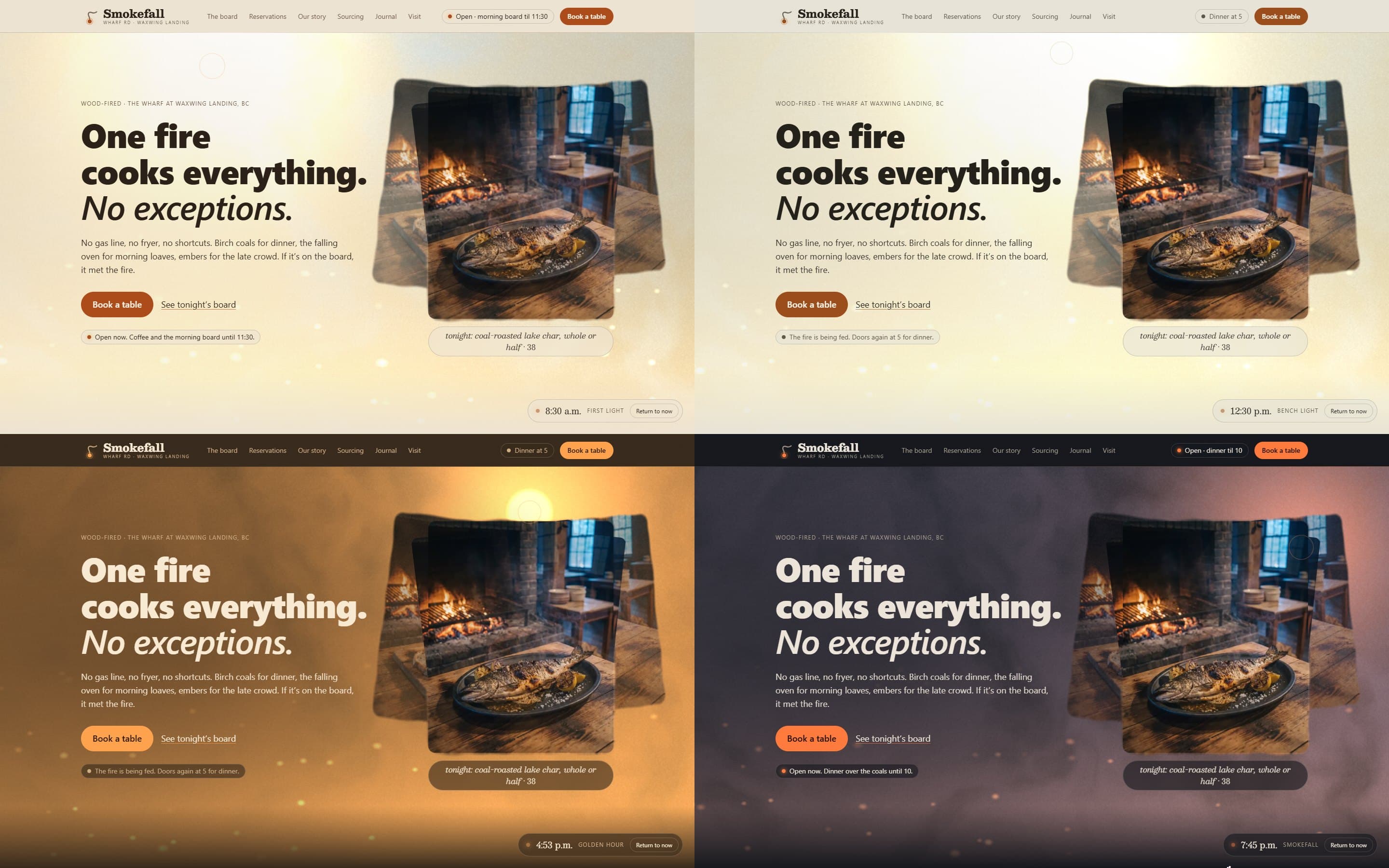
Six light states follow the restaurant's clock, from coffee light at the morning board to embers after ten. The open-now line reads the posted hours and changes its message through the day.
Drag the sun to see the day.
A visitor can grab the sun in the homepage sky and drag it. The whole site re-lights as the day passes, and the open-now line follows.
The menu lives in the page.
The morning, evening and embers boards are real text with menu markup for search. The menu page also has its own print layout.
A clear path to every table.
Reservations, private dining for the whole shed and the walk-up patio each have their own page, with the rules for each stated up front.
The thinking behind the build
Smokefall is a fictional wood-fired restaurant in an old fruit-packing shed on the wharf at Waxwing Landing, an invented BC lake town. One fire cooks everything, from the morning loaves to the late embers menu. A diner opening a restaurant site has two questions. Are they open right now, and what can I eat tonight? The site answers both from the first screen, because it knows what time it is.
A hungry person opening a restaurant site wants two answers. Are they open right now, and what can I eat? Many sites answer with hours on a contact page and a PDF menu from last season. Smokefall was built so the first screen answers both. The page itself shows the time of day, the open-now line reads the posted hours, and tonight's dishes sit right under the headline.
The kitchen runs one fire through the day, so the site does too. Six light states follow the restaurant's clock: first light, bench light, golden hour, smokefall, embers and banked. Arrive at 8:30 in the morning and the page sits in coffee light with the morning board. Arrive at seven at night and it turns to blue dusk and embers with the dinner menu. The open-now line changes its message through the day, right down to the fire resting on Monday and Tuesday.
The homepage makes the system something you can touch. Grab the sun in the sky and drag it, and every surface re-lights as the day passes, open-now line included. Behind it, hearth smoke drawn live in the browser curls toward the cursor and sparks lift off the coals. Three dish photos sit inside that smoke, and a click deals the next plate. The food appears in the firelight, the way a diner would see it at the table.
The menu is real text in the page. Three boards, morning, evening and embers, list 25 dishes and drinks with menu markup, so search engines can read every one. The menu page also has its own print layout. Reservations ask for a name, an email, the party size, the day and the sitting. The patio is walk-up only, the whole shed can be booked for a private night, and each has its own page saying so.
All 26 pages carry their full text in the page itself, with restaurant and menu structured data for search. Fourteen journal entries answer the questions people search before a night out, from patio season to why the kitchen closes on Mondays. Waxwing Landing, the farms and the people are invented, and the reservation form books nothing. For a real kitchen, the same site runs on its real hours, its real board and its real booking system.
What a hungry diner sees in the first few seconds.
Open or closed at a glance
The open-now line reads the posted hours, so a diner knows before they get in the car.
Tonight's dishes up front
The evening board sits right under the headline, in the right light for the hour they arrive.
A menu a phone can read
Every dish is text on the page. Nobody has to pinch and zoom a PDF from the passenger seat.
Everything that shipped.
I built a 26-page restaurant site around a lighting system with six states that follow the restaurant's clock. The homepage carries the draggable sun, live hearth smoke with three dish photos inside it, and tonight's board. Around it sit the full menu as real text, reservations, private dining, the patio, a sourcing page for six farms and the story of the shed. There are also gift cards, a visit page with hours and directions, a designed 404 page and fourteen journal entries.
Highlights
- Six light states that follow the restaurant's clock, from first light in the morning to banked overnight
- An open-now line that reads the posted hours and changes its message through the day
- A draggable sun in the homepage sky that re-lights the whole site as the day passes
- Hearth smoke drawn live in the browser that follows the cursor, with three dish photos inside it
- A full menu of morning, evening and embers boards as real text with menu markup
- Reservation, private dining and walk-up patio pages, each with its own rules stated up front
- A sourcing page for six farms and the story of the 1912 packing shed
- Fourteen journal entries aimed at the searches locals and visitors make about dining out

Pages and surfaces
- Home (the day board)
- The board (full menu)
- Reservations
- Private dining
- The wharf patio
- Sourcing
- The story of the shed
- Gift cards
- Visit (hours and directions)
- Contact
- Journal and 14 entries
- Privacy
- Designed 404 page
Real code. Real routes. Production ready.
- The light states and the open-now line read one clock, so hours change in one place and update everywhere
- Any page can be previewed at another hour by adding the time to its address, which makes the states easy to check
- The menu carries restaurant and menu structured data, so search engines can read every dish
- Every page's full text is in the served HTML, so search engines and slow connections read all of it
- The smoke is a custom WebGL scene written from scratch, with no 3D library to download
- An llms.txt file gives AI assistants the restaurant's details, and the build aims at WCAG 2.2 AA
Stack
How it was built
Smokefall is a fictional concept, and every page of the site says so. Waxwing Landing, Sorrel Lake, the farms, the people and the menu are invented, and the reservation form books nothing. For a real kitchen, the same site runs on your real hours, your real board and your real room. Counts read from the live site on October 5, 2026.
Your dining room has atmosphere. Your website should too.
Smokefall is the proof. The same light states, open-now line and real menu can be built around your kitchen and your hours. Already have a site? The free check-up will show where it sends hungry diners somewhere else. No website yet? Tell me about your restaurant and I will show you where to begin.
No website yet? Start your first one here
Built as The Engine, $6,500. Own It Monthly can spread the build over 12 payments, yours outright at the end.
In this industry yourself? Read the restaurant website design playbook.
More work
06 / 23