City of Castlegar
A civic website concept built around resident service discovery, municipal information architecture, accessibility, and Castlegar’s river-valley identity.
Overview
The Project
The City of Castlegar concept is a full civic information architecture exercise. Municipal websites are often deep, fragmented, and difficult for residents to use under pressure. This build reorganizes city content around what people actually need to do: pay, report, search, apply, learn, contact, attend, and get help.
Pages / Routes
175 sitemap routes across resident services, planning, government, community, news, support, and utility content.
Market
Castlegar, BC
Core Stack
Next.js + React + TypeScript
What We Built
The Build
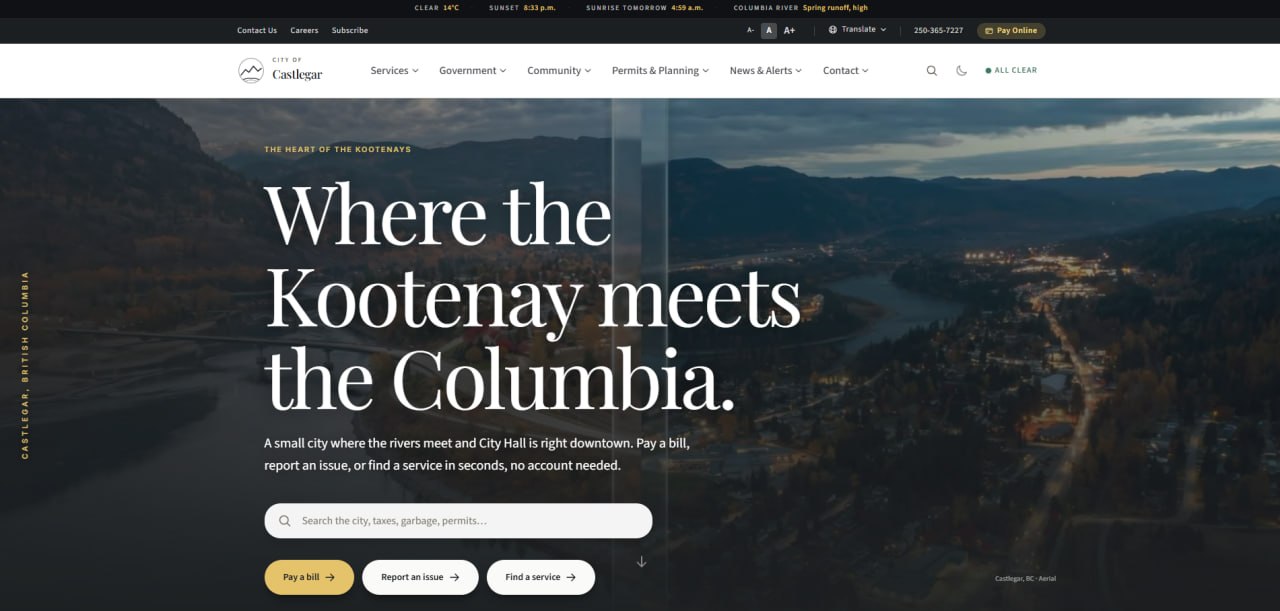
We built a 175-route municipal website concept with major hubs for services, government, community, planning, news, emergency information, payments, requests, support, contact, directories, documents, events, accessibility, and local resources. The interface pairs a polished Castlegar visual identity with practical civic UX: search, quick actions, text-size controls, translation affordances, emergency paths, and resident-first navigation.
Key Highlight
The strongest outcome is service clarity at municipal scale. A resident looking for taxes, utilities, pet licences, building permits, council meetings, mental health resources, emergency preparedness, or staff contacts can move through the site by task instead of decoding city-hall bureaucracy.
Case Study
The thinking behind the build
The design problem was not “make a prettier city homepage.” It was “make a city easier to use.” A municipal site has dozens of audiences: residents, seniors, parents, business owners, newcomers, builders, job seekers, tourists, reporters, and people in urgent situations. The architecture needed to support all of them without collapsing into noise.
The site uses hub-based wayfinding. High-frequency actions live close to the surface, while deeper civic content sits in predictable families: services, government, community, planning, news, and contact. That makes the experience feel calm even though the sitemap is large.
The psychology is trust through competence. Civic websites do not need fake excitement; they need reliability, clarity, and proof that someone thought through the stressful moments. Emergency routes, support resources, directory paths, and service pages all signal that the city is organized around the resident, not the org chart.
Technical Case Study
Scope, stack, and shipped systems
175 sitemap routes across resident services, planning, government, community, news, support, and utility content.
Pages / Surfaces
Technical Highlights
Features