

 hello@kootenaymade.ca
 Castlegar, BC. Serving the Kootenays and beyond.
 14 min read
Key takeaways
- Local SEO is mostly a trust and clarity game, not a keyword game.
- A complete Google Business Profile usually beats a fancy website with a dead profile.
- Reviews, photos, and hours are freshness signals that move calls.
- Clear, specific service pages give Google and customers better signals than one vague page.
- Most Kootenay businesses only need to look sharper than the average competitor to start winning.
- You cannot fix visibility you have not measured. Search yourself first, then repair what you actually saw.
- Build the service page first. A town page earns its place only when it carries proof that town actually produced.

On this page
What is local SEO and how does it work?
Local SEO is the work that helps nearby searchers find your business and trust it enough to act. It combines your Google Business Profile, your website, your reviews, and consistent business information so that when someone searches for what you sell near them, you appear and look like the obvious choice.
Rankings matter, but the call only happens if the profile, the page, the proof, and the contact path all make sense together. You are not gaming an algorithm so much as giving Google and a real person enough clear, current signals to choose you confidently.
Most of it is unglamorous: accurate hours, the right categories, a few good photos, a handful of specific reviews, and pages that actually explain your services. Boring, but it is what moves the phone. It is also what AI assistants read when they answer in place of a results page, and how AI answers differ from the map pack is worth ten minutes once the basics are in.
Local SEO is not keyword sorcery. It is trust, clarity, proof, and an easy next step.
Why does local SEO matter for Kootenay businesses?
In smaller Kootenay markets, customers compare two or three options and decide fast. Locals weigh reputation and convenience, while visitors who do not know you judge entirely by what shows in search: photos, reviews, hours, and whether the business looks alive. A sharper presence wins more of those quick decisions.
The region also has overlapping markets. A single business might serve Castlegar, Trail, Rossland, Nelson, Robson, and the wider West Kootenay, or work out of Cranbrook across the East Kootenay, without needing a thin duplicate page for every place name. Local specificity has to be useful, not decorative. For one town’s version of that, see my page on Nelson web design.
The good news: the bar is often low. Many competitors have a half-asleep profile, no service pages, and stale photos. You usually do not need to become an SEO obsessive. You need clearer signals than the average competitor and an easier next step. The four-town question gets its own section below, because it is where most Kootenay businesses go wrong.
How low the bar sits depends on which town you are in, and that part is countable. On The Kootenay List, compiled September 3, 2026, 511 of Nelson’s 714 businesses have a website, 72 percent. Trail sits at 36 percent, with 178 of its 276 businesses carrying no site at all. A Trail plumber competes against a much thinner field than a Nelson cafe does, and that changes how much work it takes to look like the obvious choice.
How does local ranking actually work?
Google ranks local results on relevance, distance, and prominence. Relevance is how well your profile and pages match the search. Distance is how close you are to the person searching. Prominence is how known and trusted the business is. Website work lifts two of the three, and nothing you write moves the building.
That is why the cheap answer to four towns fails. Four pages carrying the same paragraphs with a different place name looks busy in a proposal and reads like a photocopier joined a marketing cult. The better answer is a service-area story that holds up, built from real service pages, a clean profile, local proof, internal links, accurate structured data, and something you actually measure.
- 01
Distance still has teeth
Google ranks local results on relevance, distance, and prominence. Website work lifts relevance and prominence, and no amount of it moves your shop closer to a searcher in Maps.
- 02
Routes change the job
Castlegar to Trail is a different job than Nelson to Rossland. Highway 3, 3A, 6, and 22, the bridge crossings, winter roads, and appointment windows all shape what a customer needs to know before they call.
- 03
Towns search differently
Trail searches skew practical and service-led. Rossland skews mountain, seasonal, and property-specific. Nelson mixes locals, tourism, heritage buildings, and Kootenay Lake context. Castlegar tends to act as the hub.
- 04
Fake proximity backfires
Virtual offices, phantom town pages, and copied service-area claims create trust problems with Google and with people. Say where you are based, where you travel, and what proof you have in each market.
Ranking across four towns is possible. Pretending distance does not exist is amateur hour. Say where you are based, which towns you realistically serve, and what affects travel or availability, then back all three with proof.
What actually moves calls for a local business?
Four things move the phone: a complete Google Business Profile, specific service pages, recent reviews and fresh photos, and a frictionless next step. When these work together, a searcher can find you, trust you, and contact you in one short sitting. Miss one and intent leaks away.
- 01
Google Business Profile
For most local searches this is the first impression and often the deciding one. Categories, hours, photos, services, and reviews all feed the local pack and Maps results before anyone reaches your site.
- 02
Service pages with intent
Each main service deserves its own page that explains the problem, your offer, proof, the towns you cover, your process, and the next step. One page covering everything gives Google and customers weak signals.
- 03
Reviews and freshness
Recent, specific reviews and current photos tell both people and Google the business is alive and chosen. Stale profiles lose to active competitors even when the work is better.
- 04
A frictionless next step
Visibility only pays off if the searcher can call, book, ask, or visit without friction. Tap-to-call, a short form, and clear hours convert intent into a phone that rings.
Use this quick audit before you buy another mysterious SEO package. If you can answer yes to most of these, your foundation is solid.
- A complete Google Business Profile with the right categories, hours, phone, website link, services, and current photos.
- Clear pages for each main service, not one vague homepage trying to cover everything.
- Recent reviews that name a specific service, town, or outcome, not just generic five-star praise.
- Consistent business information (name, address, phone) across your site, profile, and directories.
- Fresh photos of real work, staff, products, or storefronts so the business looks active right now.
- An easy mobile contact path: tap-to-call, short forms, a visible service area, and booking links.

Google Business Profile vs. website: which matters more?
You need both, and they do different jobs. Your Google Business Profile wins the first glance in Maps and the local pack, where most local searches start. Your website wins the decision, explaining the offer, proving trust, and turning attention into a booking. Treating either as optional leaves calls on the table.
| What is being compared | Google Business Profile | Your website |
|---|---|---|
| Primary job | Get found and glanced at | Explain, prove, and convert |
| Where it shows | Maps and the local pack | Search results and direct visits |
| You control it | Partly, rented ground | Fully, owned ground |
| Best at | Hours, photos, reviews, directions | Services, proof, pricing context, booking |
| Search depth | Limited to profile fields | Pages for every service and town |
| When it wins | The first ten seconds | The decision to call or book |
The takeaway: a strong profile with a weak website gets you glances that go nowhere. A strong website with a dead profile means people never reach the website at all. For the profile side, my Google Business Profile guide for Kootenay businesses covers the cleanup in detail.
What does local SEO look like by business type?
The core pattern is the same for everyone, profile plus pages plus proof plus an easy next step, but the details change by industry. Here is what the highest-impact local signals look like for common Kootenay business types, so you can focus on what your customers actually check.
- Contractors and trades
- Service pages, before and after photos, reviews naming jobs and towns, service-area clarity, emergency-work rules, and tap-to-call front and centre.
- Clinics and wellness
- Services, practitioners, online booking, hours, location, accessibility, payment or insurance notes, trust proof, and a clear intake step.
- Restaurants and cafes
- Menu, hours, photos, patio status, reservations, a fresh Google profile, reviews, parking notes, and phrases both locals and visitors search.
- Retail and local shops
- Products, brands, local-maker proof, gift cards, pickup, hours, events, and concrete reasons to visit instead of ordering online elsewhere.
- Tourism operators
- Season dates, route context, booking and availability, photos, reviews, what to bring, weather or smoke policies, and visitor FAQs.
- Professional services
- Clear services, who you help, your process, credentials, local proof, a consultation path, and content that answers real buyer questions.
Town page or service page: which should you build first?
Build the service page first in almost every case. It explains the offer, the proof, the process, the service area, and the next step, so it answers the searcher directly. A town page earns its place only when it carries local proof that town actually produced. The test is whether the page can stand on its own.
| What is being compared | Town page | Service page |
|---|---|---|
| Primary job | Signal local relevance for one town | Explain the offer, the proof, and the next step |
| When it wins | Only with real local proof | Almost always, as the anchor page |
| Core content | Town projects, photos, reviews, route notes | Who it is for, what is included, process, FAQ, contact |
| Biggest risk | Thin duplicate copy with a swapped name | Too vague to convert a ready buyer |
| Best used as | Deeper proof under a service page | The page that ranks and takes the call |
| Build order | After proof exists for that town | First, before any town page |
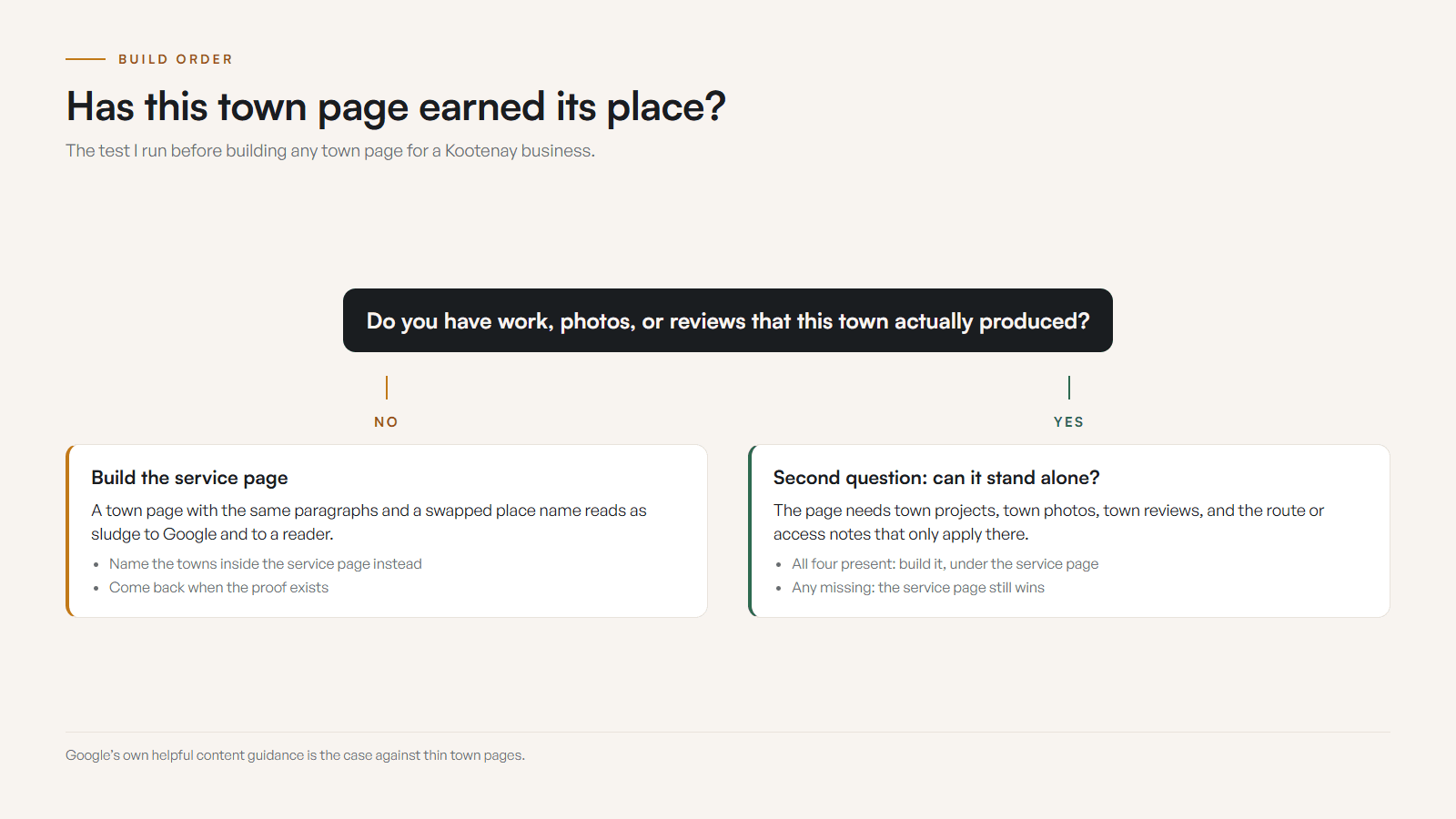
A Castlegar landscaper usually needs a strong landscaping page, a snow removal page, a lawn care page, and a renovation cleanup page long before separate Nelson, Trail, and Rossland pages. If a Rossland page can talk about steep driveways, winter access, Red Mountain seasonal properties, real reviews, and work you actually did up there, it has earned its place. If it cannot, let the service pages do the heavy lifting.
Are you visible in local search right now?
Before you open the profile and start stabbing buttons, find out where you stand. Search your business name, your service plus town, and a couple of the towns you serve, from a private window and then from a phone. Different starting locations produce different local results, so test the way a customer does instead of from your own desk.
- 01Open a private window and search your exact business name. You want one clean profile, correct details, and no duplicate or old address hiding underneath.
- 02Search your core service plus the town, something like "electrician Castlegar" or "cafe Nelson", and note whether you land in the map pack, on the second scroll, or nowhere.
- 03Repeat it on a phone with location turned on. Mobile Maps is where most local searches happen, and results shift with where the person is standing.
- 04Search an old business name or an old address to catch stale listings that quietly split your signal in two.
- 05Write down exactly what appeared for each search. That short list is your diagnosis, and everything after it is repair rather than guesswork.
The repair depends entirely on the symptom. If your exact name does not return a clean profile, that is a health problem. The cause is verification, suspension, duplicates, or an old address, and it gets fixed before anything else. If the name works and the service searches do not, the problem is relevance and proof, which means categories, reviews, photos, and whether the website explains the service in the words people use.
The map pack is the boxed set of three listings with a map above the regular results, and it runs on those same three factors. When a competitor sits above you, open their listing and compare category, review count, photo freshness, and how complete they look. That gap is usually your to-do list rather than a mystery.
How do I improve my local SEO? What to fix first
Fix the leaks in order of impact. Start with your Google Business Profile, then your homepage clarity, then service pages, reviews, photos, and the mobile contact path. Most local SEO problems are not exotic, they are a half-finished profile and a vague homepage that loses people in the first ten seconds.
- 01Update your Google Business Profile: categories, hours, services, phone, website link, and current photos.
- 02Rewrite your homepage first screen so the offer, location, proof, and next step are obvious in ten seconds.
- 03Create or sharpen a page for each main service people actually search for.
- 04Ask three or four recent happy customers for a specific review that names the service or town.
- 05Add fresh photos that prove the business is active now, then make calling or booking painless on mobile.
One common mistake worth naming: spinning up thin pages for every nearby town to chase coverage. Google treats near-duplicate town pages as sludge, and they rarely rank. Build fewer, stronger service-area pages instead. Once the profile and pages are sound, here is which Kootenay business directories are worth listing on. If you want a hand prioritizing, the free check-up flags the highest-impact fixes first.
Is paying for local SEO worth it?
For many Kootenay businesses, the basics are worth doing yourself: profile, pages, reviews, and photos cost time more than money. Paying for help is worth it when you want speed, a proper service-page structure, or a website built to turn visibility into booked work rather than just glances.
Judge it by what it pays back. If a tighter profile and three clear service pages would let you stop losing calls to a worse competitor, the return shows up fast. If your site cannot take a booking or make calling easy, fix that before spending on traffic, because more visitors to a leaky page just means more lost intent.
If you would rather have it done properly, that is what my Engine websites are for: local SEO foundations, clear service pages, and a contact path that converts. The full picture of how I approach this lives on SEO for Castlegar and the Kootenays. Either way, start by knowing where your visibility leaks, then fix the highest-impact gaps first.
Sources and further reading
- Google Business Profile Help
The source of truth for categories, hours, services, photos, and the profile fields that shape local pack and Maps results.
- Google Search Central: SEO Starter Guide
Helpful pages, crawlable links, descriptive titles, and useful content remain the foundation under every local ranking.
- Google Search Central: LocalBusiness structured data
How to give machines your location, hours, phone, and address so they can understand and surface your business.
- Google Search Central: page experience
Mobile display, HTTPS, and avoiding intrusive elements matter because most local searches happen on a phone.
- Google Business Profile: improve your local ranking
Google describes local ranking around relevance, distance, and prominence, and recommends complete, accurate information, hours, photos, and review responses.
- Google Search Central: creating helpful content
Frames useful content around people-first value, first-hand experience, and satisfying the reason someone visited. This is the case against thin town pages.
Frequently asked questions
What matters most for local SEO in the Kootenays?
A complete Google Business Profile, clear service pages, recent and specific reviews, consistent business information, current photos, local proof, and a website that makes calling or booking easy. Those signals carry most local search results here.
How long does local SEO take to work?
Small fixes to your profile and page clarity can show up in a few weeks. Meaningful gains in visibility and call volume usually take a few months of consistent work on reviews, content, photos, and trust signals.
Can I just use my Google Business Profile instead of a website?
No. The profile is powerful but rented ground you do not control. Your website explains the offer, builds trust, supports deeper search, and turns interested people into calls, bookings, and enquiries the profile alone cannot.
Should I make a page for every town I serve?
Only if each page is useful and locally specific. Thin, duplicate town pages hurt more than they help. Strong service-area pages explain local context, proof, services, and a clear next step for that market.
Do reviews really affect local rankings?
Yes. Recent, specific reviews influence both how Google ranks you and how people choose. A steady flow of reviews that name the service, town, or outcome signals an active, trusted business and lifts your local visibility.
Is one page enough for a local business website?
Sometimes, for a simple business with a single offer. If you serve several towns, offer multiple services, or need to prove expertise, one page becomes a bottleneck that limits both search coverage and conversion.
Can I rank in Nelson if my business is based in Castlegar?
Yes, though distance still matters in local results, especially in Maps. A Castlegar business supports Nelson visibility with a complete Google Business Profile, realistic service-area settings, strong service pages, Nelson-specific proof, and honest reviews. You cannot erase the fact that a searcher may be standing closer to someone else.
Should I add schema for local SEO?
Yes, when the facts are accurate. LocalBusiness structured data clarifies name, phone, address if it is public, hours, area served, and location details. Schema supports clarity and it does not rescue a weak page or a faked service area.
Related pages
- Trades and contractor websites
- Auto repair and tire shop websites
- Wellness and clinic websites
- Web design in Castlegar
- Web design in Nelson
Kootenay Made Digital
I build websites, local presence, and calm AI setups for Kootenay small businesses. Plain language, published prices, and clear work that makes you easier to find and easier to choose.